
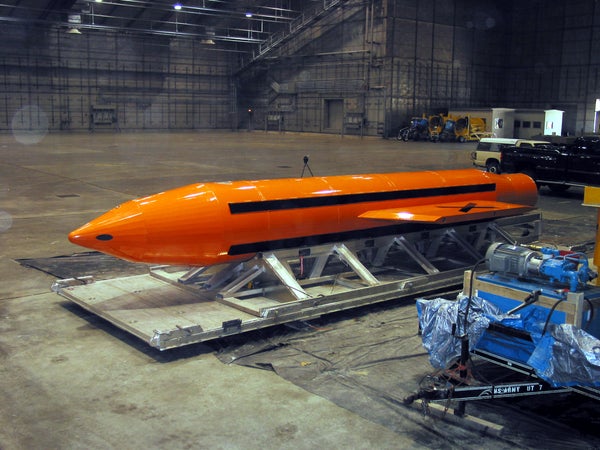
The idea of dropping an air-blast bomb—even if it’s the largest nonnuclear ordnance ever used by the U.S. in combat—to target fighters holed up in tunnels deep underground might at first seem counterintuitive. The GBU-43/B Massive Ordnance Air Blast Bomb, or "Mother of All Bombs" (MOAB), which the Air Force unleashed on ISIS fighters and tunnels Thursday in the Achin District of Afghanistan’s Nangarhar Province, never actually struck the ground. But the massive crunch of air pressure created by the nearly 22,000-pound MOAB would have wiped out anyone in the vicinity, and certainly sent a clear signal that the Trump administration is willing to use unprecedented force.
Unlike a bomb designed to actually penetrate a building or the ground, the MOAB (also called a fuel-air bomb) has a “proximity fuse” on its nose that ignites the warhead when it reaches a certain altitude—which might be anywhere between 50 and 1,000 feet—says Edward Priest, a former Air Force Special Operations combat controller who retired from the military in 2015. “When they blow up, they blast fuel into the air,” Priest explains. “That fuel atomizes. Then there’s a secondary explosion that lights the fuel that’s been atomized.”
An air blast bomb “doesn’t throw out a lot of fragmentation like you’d expect from a normal bomb—it’s all blast overpressure, which can blow down trees and use the trees themselves as the fragmentation,” Priest says. “That type of bomb wouldn’t work well, for example, to destroy tanks, although the overpressure would kill the people in them. You’d overpressure the people hiding in the caves there. You’d never find them—it just blows your lungs out of your mouth. It kind of turns you inside out.”
On supporting science journalism
If you're enjoying this article, consider supporting our award-winning journalism by subscribing. By purchasing a subscription you are helping to ensure the future of impactful stories about the discoveries and ideas shaping our world today.
The use of air-blast bombs in Afghanistan dates back to the beginning of the U.S. military’s arrival following the 9/11 attacks on New York City and Washington, D.C. The Air Force dropped several BLU-82 air-blast bombs—a smaller MOAB predecessor—during the early days of fighting the Taliban and al Qaeda, including the December 2001 Battle of Tora Bora. Use of the BLU-82—aka the "Daisy Cutter"—was phased out in subsequent years. “This is a tough munition to use,” says A. J. Clark, a former military intelligence analyst and president of Thermopylae Sciences + Technology, a provider of geospatial intelligence technology. “It might make sense if there’s a concentration of enemy troops but it’s not something you want to use when you have friendlies or civilians in the vicinity. There’s no way to control it.”
The decision to use the MOAB at this time was probably as much political as it was strategic. “More than anything, anytime you drop one of these you want to make an audacious statement, in this case to reinforce our resolve to fight in Afghanistan,” Priest says, adding they produce a large mushroom cloud that can be seen for miles.
Clark agrees. “These types of bombs were developed as much for their psychological impact as anything else,” he says. The military uses “bunker buster” bombs to penetrate the ground in certain situations, but the caves they were targeting are likely too deep for something like that to have any effect, Clark adds. After reaching an impasse in Afghanistan for the past five years, he thinks the Nangarhar bombing says “we’re taking things to a new level in Afghanistan.”