
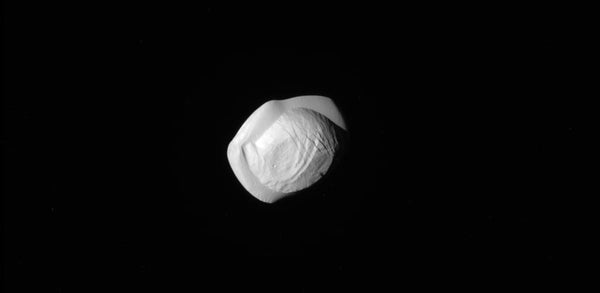
The odd shapes of Saturn’s inner moons, which resemble objects ranging from ravioli to potatoes, may be due to mergers of tiny moonlets, a new study finds.
The new finding may help to explain how moons in general may form, researchers said in a new paper describing the work.
The Cassini spacecraft, which studied the ringed planet up close for 13 years, revealed that unlike Earth’s spherical moon, the small moons closest to Saturn had strange, irregular shapes. These odd forms range from Pan’s and Atlas’ ravioli-like shape to Prometheus’ resemblance to a combination of Moby Dick, a potato and H. R. Giger’s Alien skull. [Cassini Spacecraft Photographs Saturn’s Strangest Moons]
On supporting science journalism
If you're enjoying this article, consider supporting our award-winning journalism by subscribing. By purchasing a subscription you are helping to ensure the future of impactful stories about the discoveries and ideas shaping our world today.
Previous research had suggested ways in which each of these bizarre moons might have formed. However, until now, researchers did not have an explanation that encompassed the whole range of these unusual shapes, study lead author Adrien Leleu, a dynamicist at the University of Bern in Switzerland, told Space.com.Leleu’s team ran computer simulations to see how the shapes of Saturn’s inner moons might have evolved over time. The powerful effects of Saturn’s gravitational pull were a key influence on these simulations.
Saturn’s mass is 95 times Earth’s mass, and Saturn’s inner moons orbit the giant planet at a distance of less than half that between Earth and its moon. As such, Saturn’s inner moons experience huge tidal forces that can pull them apart, the researchers said. The planet’s powerful gravitational pull made it unlikely that Saturn’s inner moons formed by gradual accretion of material around a core, "which is the go-to scenario for the formation of celestial bodies," Leleu told Space.com.
Instead, the researchers found that Saturn’s inner moons likely formed through a series of collisions between tiny moonlets, known as the pyramidal regime formation scenario. “If that is the case and these bodies formed that way, it has important implications for formations of moons in general, because [previous research has shown] that the pyramidal scenario could be at the origin of most of the moons in the solar system,” Leleu said.
The computer simulations revealed that near-head-on collisions led to ravioli-like flattened objects with equatorial ridges, similar to the shapes of Pan and Atlas. Mergers involving slightly more oblique impact angles resulted in elongated shapes resembling Prometheus.
Study co-author Martin Jutzi, also of the University of Bern, had previously found that collisions between comets could lead to bodies with the flattened shapes and equatorial ridges seen on Pan and Atlas.
“For bodies such as comets or asteroids, the impact configuration that would form these equatorial ridges have a very low probability of happening,” Leleu said. “But the small moons of Saturn are in a very specific environment—they are very close to Saturn and its rings, and on almost perfectly circular orbits, and almost all in the same plane.”
The computer simulations also revealed the special environment in which Saturn’s inner moons exist that makes near-head-on collisions frequent. “We found that 20 to 50 percent of the small moons should display either an equatorial ridge or an elongated shape, while the rest should have more random potato-like shapes,” Leleu said. “And this is the case. Considering the six inner moons Pan, Atlas, Prometheus, Pandora, Janus and Epimetheus, the first three display these features, while the others—Pandora, Janus and Epimetheus—have random shapes.”
Leleu, Jutzi and their colleague Martin Rubin, also of the University of Bern, detailed their findings online May 21 in the journal Nature Astronomy.
Copyright 2018 SPACE.com, a Purch company. All rights reserved. This material may not be published, broadcast, rewritten or redistributed.