
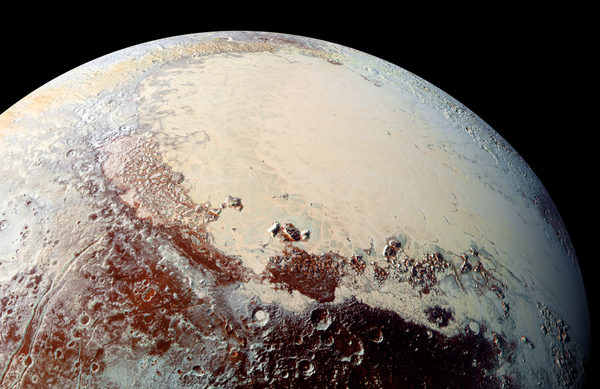
Buried oceans like the one thought to slosh beneath the icy surface of the dwarf planet Pluto may be incredibly common across the cosmos.
A gassy insulating layer probably keeps Pluto’s liquid-water ocean from freezing solid, a new study reports. And something similar could be happening under the surfaces of frigid worlds in other solar systems as well, study team members said.
“This could mean there are more oceans in the universe than previously thought, making the existence of extraterrestrial life more plausible,” lead author Shunichi Kamata, of Hokkaido University in Japan, said in a statement.
On supporting science journalism
If you're enjoying this article, consider supporting our award-winning journalism by subscribing. By purchasing a subscription you are helping to ensure the future of impactful stories about the discoveries and ideas shaping our world today.
Pluto’s “Heart” Hints at Buried Ocean
The case for a subsurface ocean on Pluto is bolstered by the location of Sputnik Planitia, a 600-mile-wide (1,000 kilometers) plain of nitrogen ice that forms the left lobe of the dwarf planet’s famous “heart.”
Observations by NASA’s New Horizons probe showed that Sputnik Planitia is aligned with Pluto’s tidal axis—the line along which the gravitational pull from the dwarf planet’s biggest moon, Charon, is most powerful. Scientists think that Pluto rolled into this orientation because of extra mass concentrated at and near the surface in the Sputnik Planitia region.
That extra mass likely comes from the nitrogen ice that’s built up on the plain, as well as water from the buried ocean, which was freed to rise from deep underground after the comet impact that formed Sputnik Planitia shattered the crust in that locale, previous research suggests.
But how could a buried ocean stay unfrozen on Pluto over the 4.6-billion-year history of the solar system? After all, the dwarf planet doesn’t circle a gas giant, so its innards aren’t roiled and heated by tidal forces nearly as dramatically as are the insides of Jupiter’s moon Europa and the Saturn satellite Enceladus, both of which also harbor subsurface oceans.
The new study offers a possible explanation. Kamata and his colleagues hypothesized that an insulating layer of “gas hydrates”—ice-like solids composed of gases trapped within “cages” of molecular water—beneath Pluto’s ice shell might be responsible, then performed computer simulations to test the idea.
In simulations run without the gas hydrates, Pluto’s ocean froze solid hundreds of millions of years ago. But with the insulating layer, the ocean persists to this day, the researchers found. The gas hydrates also act as an insulator in the other direction, helping to keep Pluto’s surface cold enough to support observed variations in ice-shell thickness, the researchers said.
It’s unclear what the gas inside the water cages might be (if such a layer does indeed exist). But the study team thinks methane is a good candidate, partly because Pluto’s wispy atmosphere is notably lacking the stuff.
The new study was published online today (May 20) in the journal Nature Geoscience.
Copyright 2019 Space.com, a Future company. All rights reserved. This material may not be published, broadcast, rewritten or redistributed.