
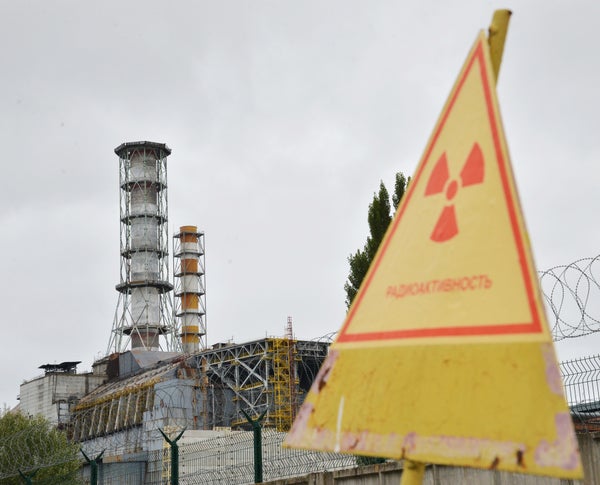
On Aug. 26, the Dragon space capsule dropped into the Pacific Ocean somewhere off the coast of Baja California, Mexico. Onboard were payloads containing fungi that had now grown in two of the most extreme conditions known to man: outer space and the Chernobyl Atomic Energy Station.
These fungi are radiation resistant. Thirty years ago, they survived when a routine test led to an explosion that blasted radioactive material throughout northern Ukraine. By sending these fungi to the International Space Station, Kasthuri Venkateswaran, a research scientist at NASA’s Jet Propulsion Lab, and Clay Wang, a professor at the USC School of Pharmacy, have tried to push them to adapt again.
The day the capsule landed, Venkateswaran and Wang made thehour-long drive to Long Beach, Calif., to pick up the samples, loading the cylindrical tubes of fungi into coolers. Back in the lab, Venkateswaran and Wang have spent the past month studying how the trip changed the fungi. Their goal is to use these impressively resilient organisms to point the way to drugs that could impart similar resilience to humans, such as those getting cancer treatment. But to repurpose a different space metaphor, it’s one small step.
On supporting science journalism
If you're enjoying this article, consider supporting our award-winning journalism by subscribing. By purchasing a subscription you are helping to ensure the future of impactful stories about the discoveries and ideas shaping our world today.
Kasthuri Venkateswaran at the Jet Propulsion Laboratory in Pasadena, Calif.
Since the late 1990s, the fungi have been in the care of Tamas Torok. His lab at Lawrence Berkeley National Laboratory in California holds the more than 2,000 fungal organisms found at Chernobyl and the surrounding areas. The fungi, kept at minus-80 degrees Celsius, are frozen in time to preserve their genetic makeup.
Microbiologist Nelli Zhdanova and her colleagues at the Institute of Microbiology and Virology in Kiev originally collected the samples with robots in the decades after the explosion. They found that microbial life was unexpectedly thriving at the site of the world’s worst nuclear accident.
Her team discovered that not only could these fungi live inside the 30 kilometer exclusion zones, but that some of the strains growing closest to the radiation could perform an astonishing feat. “Once the fungus discovered the radiation source, they grew directionally toward it,” Torok said. “This was a brand new experience, nobody had ever seen it before.”
Further examination showed that the fungi had a higher expression of melanin (the same pigment that colors our hair and skin) which could absorb radiation. The fungi closest to the reactor were dark black from melanin, but the farther away they got, the lower the levels became.
A more recent study at Albert Einstein College of Medicine took that finding one step further. The Chernobyl fungi, scientists discovered, were actually helped by the radiation, transforming something normally lethal—gamma rays—into an energy source.
Chernobyl fungi sent to ISS are grown in petri dishes in the lab at NASA’s Jet Propulsion Laboratory.
That caught the eye of Venkateswaran, whose job at NASA is, in part, to prevent microbial hitchhikers from getting to space. In that capacity, he’s interested in microbes that can tolerate high radiation because they present a risk of living through spaceflight to contaminate other planets or asteroids. Venkateswaran also knew that when a microbe went to space, its gene expression could be dramatically affected.
In his lab at USC, Wang studies how natural products might lead to pharmaceuticals. In April, the two teamed up to send four strains of the fungus Aspergillus nidulansto ISS to answer a basic question: would fungi produce something new? Wang declined to share specifics before the results are published, but said that they saw definite changes in the molecules the fungus produced.
“That’s when we thought, why don’t we send this radiation-resistant fungi to [the] space station and see how it grows?” Venkateswaran said.
Venkateswaran is the space biology expert and Wang’s role is to help isolate, classify, and purify whatever they may discover. If the two of them could determine what new compounds the fungi were making in response to the increased radiation, those could theoretically be converted into drugs.
Such a drug could be used as a kind of “sun block” for radiation in people, Venkateswaran imagines — for instance cancer patients being treated with radiation therapy, workers at nuclear plants like Chernobyl, or NASA astronauts on long duration flights.
Some such radioprotective drugs exist presently, but the American Cancer Society calls them an active area of research.
Fungi have a track record of producing helpful drugs. They produce “secondary metabolites”—things not necessary for a fungus’s basic functioning, but made when survival necessitates it—that can be turned into medication. We already take advantage of several of these metabolites. Penicillin, the first antibiotic, is produced by a fungus to ward off bacteria. Lovastatin, the active ingredient in many cholesterol medications, and cyclosporine, an immunosuppressant used during organ transplants, are both compounds made by fungi.
Wang says that there could be an untold number of useful metabolites hidden, unexpressed, in a fungus’s genome. Up to 400 or 500 genes can be silent in a fungus, but finding a new metabolite requires a stressful environment. An environment, perhaps, like microgravity.
Cladosporium sphaerospermum is one of eight fungi the researchers are now genetically sequencing.
Eight species of the Chernobyl fungus were launched into space on July 18. They were sent in low-temperature containment so that the spores couldn’t grow until they were safely in microgravity. Then, the astronauts on ISS brought the fungi to room temperature to grow for seven- and 14-day periods, before returning them to a freezer.
Now, the fungi are housed in Venkateswaran’s lab in Pasadena. For the past month, Venkateswaran and Wang have been culturing and doing a variety of genomic sequencing on the fungi to see how their gene expression may have changed during their trip in space. They say they have already seen differences inmetabolite production, though they expect their analysis to stretch on for at least the rest of the year.
Though it’s an exciting and dramatic way to hunt for new drug compounds, space orbit probably won’t become a common path to drug discovery, Venkateswaran said. Commercial access to ISS is increasing, but there are only six scientists onboard and their time and space are limited.
And with fungi’s 10,000 genes, and no understanding of exactly what turns them on and off in space, it can be tough to predict the outcomes—meaning it’s not simple to know which species to send up in the first place, or what molecule to look for when they come back.
If Wang and Venkateswaran do find molecules of interest in these fungi, it will be awhile before it could be turned into medicine. Their next steps would be to purify a sample and test it in animals, after which a metabolite often has to be chemically tweaked for toxicity.
“I think the best way to think about this project is: we’re looking at leads,” Wang said. “Can we find, using the ISS as a platform, leads that make compounds that are interesting and new and have some biologic effect?”
For now, the answers are still up in the air.
Republished with permission from STAT. This article originally appeared on October 11, 2016