
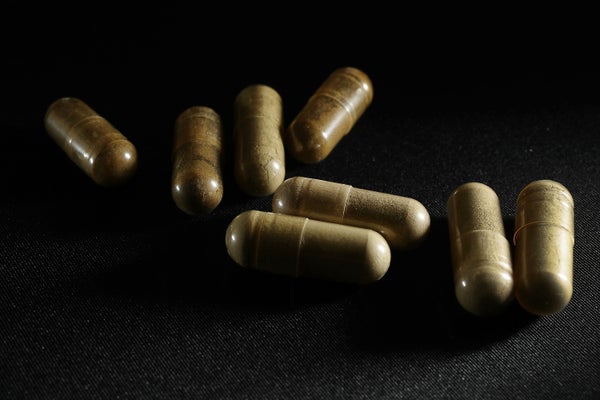
Researchers and users of kratom or Mitragyna speciosa were stunned by the Drug Enforcement Administration’s abrupt withdrawal last week of its stated plan to place the Southeast Asian plant under an emergency ban in the United States. One reason for the famously tough federal agency’s unusual move was “a large volume of phone calls from the American public” as well as messages from the scientific community and letters from members of Congress, says DEA spokesperson Russ Baer.
The withdrawal of an emergency substance restriction is something the DEA “has never been done before. It’s an unprecedented action,” Baer says. “[While] the DEA still believes kratom is a dangerous, harmful substance,” he says the agency wants to send the message that it is listening to citizens: “We don’t want the public to believe we are simply a group of government bureaucrats who don’t care about their safety and health.”
The DEA’s about-face comes about a month and a half after it first announced its intent to put kratom in its most restrictive drug category, Schedule I, which is reserved for substances deemed to have no currently accepted medical use and a high risk of abuse. It also includes heroin and LSD. While the ban loomed, kratom users and advocates drummed up phone calls, letters and demonstrations in protest. But most did not expect this to actually work. “I envisioned them withdrawing the intent to schedule,” says Susan Ash, founder of an advocacy group called the American Kratom Association. “I knew it was a pretty ridiculous wish of mine.” On Wednesday morning she got a call with the news. “I was in shock,” Ash says. “I’ll probably still be in shock tomorrow. Words cannot describe my relief right now.”
On supporting science journalism
If you're enjoying this article, consider supporting our award-winning journalism by subscribing. By purchasing a subscription you are helping to ensure the future of impactful stories about the discoveries and ideas shaping our world today.
The kratom tree’s raw leaves or tea brewed from them have traditionally been used in Thailand, Malaysia and other parts of Southeast Asia as a mild stimulant and analgesic, and some modern users claim it has helped ease them out of opioid dependence without traumatic withdrawal symptoms. Others say they use it as what they believe to be a safer way to manage chronic pain. Thailand outlawed kratom in 1943, partly because of reports that it was dangerous and addictive. In the United States kratom is available online and is sometimes sold in stores and bars.
Scientists studying the plant say they were pleasantly surprised by the DEA’s decision. Susruta Majumdar, a medicinal chemist at the Memorial Sloan Kettering Cancer Center in New York City, says he had been cramming in experiments to get fresh data on kratom’s safety profile before the ban kicked in. “I was hurrying up and I was really scared that this ban was going to happen,” he says. “Oh, I’m relieved! It shows the DEA is listening to the public, which is a good thing. We’re very happy.”
Had the ban gone into effect, which could have happened any time after September 30, scientists say Schedule I restrictions would have heavily encumbered research efforts. “It’s exciting from one standpoint that we might be able to keep doing the work we’re doing,” says Chris McCurdy, a pharmacologist and kratom researcher at the University of Mississippi.
McCurdy, Majumdar and others believe kratom’s active ingredients, mitragynine and 7-hydroxymitragyine—or chemical analogs of these molecules—might hold a key to developing powerful next-generation drugs that can treat pain but not cause some of the devastating side effects of conventional painkillers including morphine, oxycodone or other opioids. Majumdar is one of the scientists trying to develop such alternatives.
But kratom advocates and researchers are being cautious about how much they celebrate. The DEA could still put the substance on an emergency schedule later. Or the agency could permanently schedule the plant, a process that can take a couple of years. “That’s the place where you get nervous still,” McCurdy says. Ash says she is “extremely happy, but cautiously optimistic.” But she also notes that kratom is still illegal under local laws in six states: Tennessee, Vermont, Wisconsin, Indiana, Arkansas and Alabama.
For its next step, the DEA is opening a six-week period for the public to comment on concerns, research and science related to kratom. After that the agency will look to the Food and Drug Administration to complete an evaluation of kratom’s medical and scientific potential. “The final question for us is if the FDA determines kratom to be a medicine or not,” Baer says.
That could take years. In the meantime, Ash and other advocates say they will continue lobbying to keep kratom available, and scientists are protecting their work by applying for research licenses from the DEA. “We cannot afford to stop, because [kratom] has real promise. I’m applying for a Schedule I license just in case,” Majumdar says.