
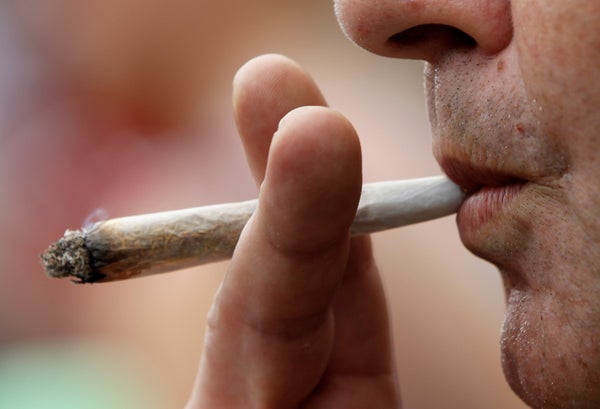
Even as voters ushered in a Republican-led Congress and a Donald Trump presidency they created a new era for marijuana use in the U.S. California, Massachusetts and Nevada all voted to green-light recreational cannabis use in their jurisdictions, meaning a welter of Americans—more than 20 percent of the country’s adult population—can legally blaze up. With the addition of California, the map of legal recreational marijuana use will now include the entire Pacific coast.
Americans also weighed in on other controversial health issues, with votes on assisted suicide in Colorado and on ways to handle escalating drug prices in California. But up-or-down votes on medical or recreational marijuana use were widespread, cropping up across nine states.
Four of those states—Arkansas, Florida, Montana and North Dakota—were voting on either allowing or expanding cannabis use for medical purposes. The other five—Arizona, California, Maine, Massachusetts and Nevada—were voting on whether or not to allow adults aged 21 and older to consume weed recreationally. California’s “yes” vote, after several failed attempts in recent years, could blow up the current marijuana market. The passage of Proposition 64, legalizing recreational cannabis use in the most populous state, may lead to a tripling of the legal industry’s size and eventually help grow it to $50 billion nationwide, according to analysis from the research group Cowen and Company.
On supporting science journalism
If you're enjoying this article, consider supporting our award-winning journalism by subscribing. By purchasing a subscription you are helping to ensure the future of impactful stories about the discoveries and ideas shaping our world today.
Until now four states and the District of Colombia had approved adult recreational marijuana use, giving 5.6 percent of the U.S. adult population legal access to cannabis without a doctor’s orders, says Karmen Hanson, a marijuana policy analyst at the National Conference of State Legislatures. A much larger swath of the country—25 states, D.C., Guam and Puerto Rico—had already allowed medical use. (Donald Trump has also said that he supports medical access.)
Despite the flurry of state-level action, cannabis use remains illegal at the federal level. In August the Drug Enforcement Administration announced its plans to keep the plant in the same legal category as heroin and LSD. This legal conundrum has proved increasingly awkward for marijuana businesses trying to conduct banking, and for researchers who run up against federal restrictions. As more states legalize weed for recreational or medical use, “the more pressure it will put on the administration no matter who wins the election,” Stanton Glantz, director of the Center for Tobacco Control Research and Education, said in an interview before the election results were in. He says marijuana should be legalized for recreational use but warns that states have not yet built in inadequate safeguards to protect public health. “Marijuana needs to be treated like tobacco, with strong graphic warning labels and restrictions on marketing and taxes,” he says. “The ideal situation would be that marijuana is legal so no one is being thrown in jail, but no one would want it—which is what we are striving for with tobacco.”
As legalization and marijuana-related economic activity have gained momentum, however, research about marijuana’s potential therapeutic benefits or dangers has been quickly outpaced. Formal cannabis studies often remain difficult to conduct because of the drug’s illegal status, says Donald Abrams, a member of a National Academy of Sciences committee that is currently reviewing the available science on marijuana’s health effects—and one of the few researchers to conduct human trials with it. Marijuana’s federal Schedule I designation under the Controlled Substances Act keeps it illegal for any purpose. Scientists can only work with cannabis from a government-approved provider—not the products that are commercially available to most users—Abrams says. Against the backdrop of growing marijuana use, however, the federal government recently said it would ease certain research restrictions.
Beyond marijuana, voters in two states grappled with hot-button health issues including a law that would have capped prescription drug prices for certain buyers (California), and another that would have permitted physician-assisted suicide (Colorado). The Colorado effort managed to secure a majority of voters but California’s proposal to rein in prescription drug prices within its borders appeared unlikely to pass by early Wednesday morning.
Colorado’s action will make it the fifth state—after California, Oregon, Vermont and Washington—to put a physician-assisted suicide law on the books. These laws generally allow a person with a terminal illness to receive a prescription for life-ending drugs from a clinician. (In a sixth state, Montana, assisted suicide is technically illegal but a court ruling protects physicians who aid dying patients from prosecution.)
Some of these issues may garner attention at the White House and in the new Republican-led Senate and House, juggled alongside other divisive topics including the future of the Affordable Care Act, the opioid crisis and how to handle safety net programs including Medicare and Medicaid. The new president-elect has previously said, however, that marijuana legalization should be left up to the states.
Here are the election ballot results, below:
Medical marijuana (allowing or expanding use)
Arkansas—Pass
Florida—Pass
Montana—Pass
North Dakota—Pass
Recreational marijuana (adults aged 21 and older)
Arizona—Fail
California—Pass
Maine—Undecided but trending toward passage with 89% of precincts reporting
Massachusetts—Pass
Nevada—Pass
Drug price cap (prohibits state agencies from paying more for a prescription drug than the U.S. Department of Veterans Affairs would pay)
California—Undecided but trending toward fail with 93% of precincts reporting
Physician-assisted suicide (allows any adult in the state with a terminal illness and only six months to live to receive a prescription for life-ending drugs)
Colorado—Pass