
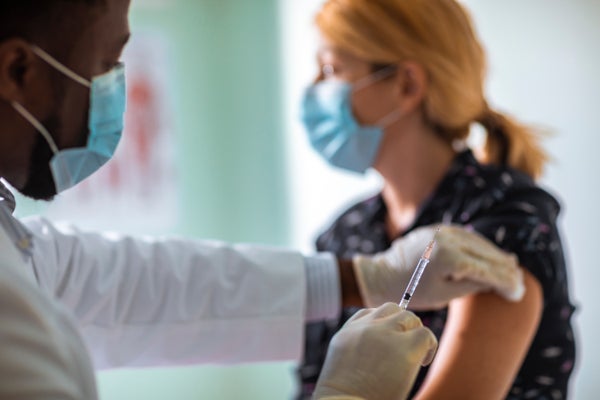
On Monday, the U.S. Centers for Disease Control and Prevention issued new guidelines on how fully vaccinated people can gather with others. The recommendations state that those who have completed a vaccine series or have gotten a single-shot vaccine more than two weeks prior can visit with one another indoors without masks or six-foot social distancing. And the CDC says that such individuals can similarly visit unvaccinated people from a single household if everyone in that household is at low risk of developing a severe case of COVID-19. Fully vaccinated people are no longer required to quarantine or get tested if they are exposed to someone with COVID but do not develop symptoms (at least for the first three months post–full vaccination). But fully vaccinated people who live in non-health-care settings such as prisons or group homes should still quarantine after exposure, according to the CDC’s recommendations.
Scientific American discussed the new guidelines with Nahid Bhadelia, an infectious disease physician and medical director of Boston Medical Center’s special pathogens unit.
[An edited transcript of the interview follows.]
On supporting science journalism
If you're enjoying this article, consider supporting our award-winning journalism by subscribing. By purchasing a subscription you are helping to ensure the future of impactful stories about the discoveries and ideas shaping our world today.
Are the new CDC guidelines firmly grounded in science?
Yes. Public health guidelines have to combine both what the science says for safety, as well as what is best for the maximum number of people. I think these guidelines do a nice job of balancing data around decreased transmission of coronavirus from people who are vaccinated and the continued risk of community transmission because so many people are not vaccinated. We have vaccine trials that showed people who were vaccinated tended to have few breakthrough infections. [Editor’s Note: Breakthrough infections occur when a person develops an illness despite being vaccinated.] Then there are data that show countries that have greater numbers of vaccinated people have a decrease in transmission. We haven’t yet figured out what the minimum amount of virus is that an infected person can have and still be able to transmit it to other people. But there are some data that show people who are vaccinated, if they do get infected, have less virus in their airways. Based on those things, I think the CDC guidance is based in science and also strikes a pragmatic balance.
How does being vaccinated reduce the risk of transmitting the virus if you do become infected?
The biggest part of what vaccines do is prepare the immune system to respond to an infection. It’s like a boot camp for your immune system. The next time you encounter the virus, your immune system is able to quickly fight it, so the virus can’t replicate as much in your body. The reduced transmission comes from the fact that less virus has been able to replicate in your body because your immune system is able to block that.
Do the guidelines go far enough, or are they overly strict?
In the current setting, because so few of us are vaccinated, I think the cautious approach is the right one. The guidelines draw a distinction between what vaccinated people can do with one another and what they can do with unvaccinated, low-risk people and limit that to gatherings within households. There are still vulnerable populations in society, so we need to protect them and people who are on the front lines and doing service work. And that’s why that distinction and a cautious approach are good right now.
What would warrant a broader relaxation of COVID restrictions?
We would need to see a disconnect between cases and hospitalizations and deaths. What we’ve seen throughout this pandemic so far is: first, there’s an increase in cases and then a secondary wave of hospitalizations and then a tertiary wave of deaths right behind that. But now that we have people getting vaccinated, while I wouldn’t be surprised if cases go up because of the new variants, hopefully we can keep hospitalizations and deaths low. We can’t let our guard down just as we’re at the finish line—like we’re seeing in Texas or in Idaho, where people were burning masks. Now is the most dangerous time to do that. I would hope masking continues for a bit longer.
Why is this kind of messaging from the CDC important?
I think it’s scary for people who have lost loved ones, and because we’ve had so many deaths, to just say, “All right, we’re going to open up.” That’s why the gradual approach is a good one. It’s an incremental adjustment to normalcy. The worry I have is that if you take the science, which shows very clearly that there’s a reduction in viral transmission for people who are vaccinated, and then you don’t act, I think you lose credibility with the public. People can be inspired to get vaccinated by showing them there’s a light at the end of the tunnel. And guidelines that allow vaccinated people an incremental return to normalcy help that.
What unknowns still exist about the novel coronavirus?
One thing is the variants aspect. One of the things the B.1.1.7 variant [first identified in the U.K.] does—and, thankfully, vaccine efficacy is not affected by it—is increase the amount of virus in your airway. If you get a variant that not only affects vaccine efficacy but also viral load [the amount of virus in a person’s blood], then the question is whether that will that affect vaccinated people’s ability to transmit the virus to other people. But that’s why we need to get everybody vaccinated as soon as possible—because once you’ve done that, the chances of new variants evolving is much less.
Read more about the coronavirus outbreak from Scientific American here. And read coverage from our international network of magazines here.