

The following essay is reprinted with permission from The Conversation, an online publication covering the latest research.
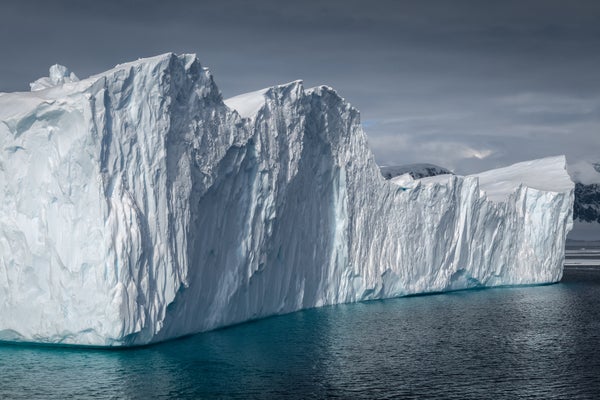
East Antarctica’s Conger ice shelf—a floating platform the size of Rome—broke off the continent on March 15, 2022. Since the beginning of satellite observations in the 1970s, the tip of the shelf had been disintegrating into icebergs in a series of what glaciologists call calving events.
On supporting science journalism
If you're enjoying this article, consider supporting our award-winning journalism by subscribing. By purchasing a subscription you are helping to ensure the future of impactful stories about the discoveries and ideas shaping our world today.
Conger was already reduced to a 50km-long and 20km-wide strip attached to Antarctica’s vast continental ice sheet at one end and the ice-covered Bowman Island at the other. Two calving events on March 5 and 7 reduced it further, detaching it from Bowman and precipitating its final collapse a week later.
The world’s largest ice shelves fringe Antarctica, extending its ice sheet into the frigid Southern Ocean. Smaller ice shelves are found where continental ice meets the sea in Greenland, northern Canada and the Russian Arctic. By restraining how much the grounded ice flows upstream, they can control the loss of ice from the interior of the sheet into the ocean. When an ice shelf like Conger is lost, the grounded ice once kept behind the shelf may start to flow faster as the restraining force of the ice shelf is lost, resulting in more ice tumbling into the ocean.
What caused the collapse?
Ice shelves are sometimes referred to as the “safety band” of Antarctica because they buttress the upstream flow of ice from the bordering ice sheet. Little of the Antarctic ice sheet melts at its surface, where snow piles up. Instead, most of the continent loses ice through calving and melting along the underside of the floating ice shelves.
The breaking and detachment of parts of ice shelves is a natural process: ice shelves generally go through cycles of slow growth punctuated by isolated calving events. But in recent decades, scientists have seen several large ice shelves undergoing total disintegration.

A Sentinel-1A image of the iceberg C-38 taken on March 17, 2022. The iceberg calved from the Conger Ice Shelf in East Antarctica. Credit: U.S. National Ice Center
Along the Antarctic Peninsula, the whip-like land mass which extends from the West Antarctic mainland, these include Prince Gustav ice shelf (from 1989 to 1995), Larsen A ice shelf (1995), Larsen B (2002), and Wilkins ice shelf (2008 to 2009). In East Antarctica, where Conger once was, Cook ice Shelf was partially lost in the 1970s. Taken together, this series of collapses suggests that some underlying environmental conditions, such as ocean and atmosphere temperatures, are changing.
It is too soon to say what triggered the collapse of the Conger ice shelf, but it appears unlikely to have been caused by melting at the surface—there are no indications of any ponds atop the ice shelf. The most recent sequence of events also preceded the record high air temperatures recorded in Antarctica on March 18.
What the future holds
As glaciologists, we see the impact of global warming on Antarctica in increasing ice loss with time. And what happens in Antarctica does not stay in Antarctica.
The consequences of the Conger ice shelf collapse are unlikely to be of global significance as the catchment area feeding ice into the former shelf is small. And due to its shape, the Conger ice shelf was most likely not a significant buttress to the flow of ice upstream.
But global warming is making events like this more likely. And as more and more ice shelves around Antarctica collapse, ice loss will increase, and with it global sea levels. There is enough ice in the West Antarctic ice sheet to raise sea levels by several meters, and if East Antarctica starts losing significant amounts of ice, the impact on sea levels could be measured in tens of meters.
Not everything that happens in nature is due to global warming alone. Antarctica loses mass through the discharge of icebergs and waxing and waning ice shelves as part of a natural cycle. But what we are seeing now, with the collapse of the Conger ice shelf and others, is the continuation of a worrying trend whereby Antarctic ice shelves undergo area-wide collapse one after another.
This article was originally published on The Conversation. Read the original article.