
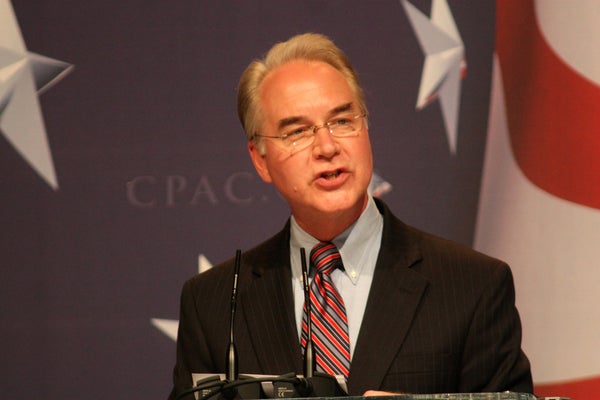
Tom Price, the Georgia congressman tapped by President-elect Donald Trump to be the next secretary of the Department of Health and Human Services, is set to become the most powerful person in health policy.
Price has made his name in Washington for his strong opposition to the Affordable Care Act—and implementing whatever congressional Republicans pass to repeal and replace the law would be a big part of his job.
But his work will touch many other parts of health care and medical science. HHS helps shape how doctors care for their patients, how prescription drugs are approved, and what medical research the federal governments funds.
On supporting science journalism
If you're enjoying this article, consider supporting our award-winning journalism by subscribing. By purchasing a subscription you are helping to ensure the future of impactful stories about the discoveries and ideas shaping our world today.
Here’s what we know about how Price, a former orthopedic surgeon, feels about those other issues.
Tort reform
Price’s pet project since he was first elected to public office 20 years ago has been reforming state and federal laws to limit doctors’ vulnerability to lawsuits from former patients who allege malpractice.
In the Georgia Senate, he advocated for a $250,000 limit on the damages that juries could award to aggrieved patients, a position opposed even by some other Republicans. Price said that “there is too much money on the table” in medical malpractice litigation, which drives up the costs of malpractice insurance premiums and, by extension, health care.
Price’s Obamacare replacement bill would create state administrative tribunals to hear cases of alleged malpractice, in lieu of jury trials.
‘Patients first’
A recurring theme in Price’s musings on health care is putting patients back in charge. In Price’s view, even popular federal health care programs like Medicare have been detrimental to medicine because they limit choices for doctors and patients, through restrictive reimbursement rates and federal rules on what treatments and procedures are covered by the program. He has said since the election that the new GOP-controlled government should overhaul Medicare, presumably in support of House Speaker Paul Ryan’s proposal to push the program toward a voucher system.
Price’s own solution to these problems include price transparency and health savings accounts. Some economists argue that HSAs would give consumers more “skin in the game” by making them more directly responsible for paying for their health care, which would drive down costs.
His Obamacare replacement plan would also allow states to create an official database disclosing quality ratings for physicians, hospitals, and other health care providers as well as the prices they charge.
Limits on medical research
When STAT asked Price about Vice President Joe Biden’s cancer moonshot this year, he said of course he supported medical research—but he wasn’t willing to give the government a blank check.
“We’re all in favor of increasing funding for cancer research,” he said. “The problem that the administration has is that they always want to add funding on, they never want to decrease funding somewhere else. That’s what needs to happen.”
Price has also been outspoken against research using embryonic stem cells. When the Obama administration lifted restrictions on stem cell research imposed by President George W. Bush, the scientific community showed overwhelming support.
But Price warned that changes would “force taxpayers to subsidize research that will destroy human embryos.”
Strongly anti-abortion
Price has a 0 percent rating from Planned Parenthood and a 100 percent rating from National Right to Life—that probably tells you everything you need to know. He has supported defining personhood as beginning from the moment of conception and therefore providing constitutional protections to unborn persons. He has opposed federal funding for abortions and Planned Parenthood at every turn.
In the Georgia Senate, Price also voted for a bill that would require women to wait 24 hours before getting an abortion and that doctors advise them on the physical and emotional risks of abortion.
No Medicare negotiations for drugs
Trump flirted during the campaign with support for Medicare directly negotiating the prices it pays for prescription drugs. It fit with his deal-making image, it’s popular with the public—but it was an unusual stance for a Republican.
If he’s serious about pursuing it, the president-elect won’t find a supporter in his new HHS secretary.
When congressional Democrats were pushing to make that change in 2007, Price called it “a solution in search of a problem.”
Republished with permission from STAT. This article originally appeared on November 29, 2016.