
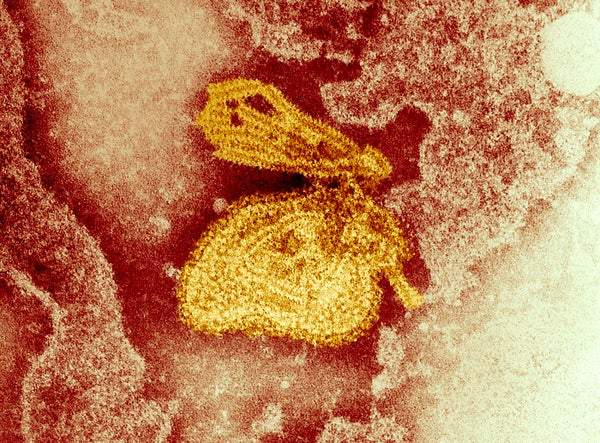
You could be forgiven if you thought mumps was no longer a problem in the U.S. That’s because for the past few decades, thanks to widespread use of a vaccine against this contagious virus, it wasn’t.
Yet in the past several years increasing numbers of college students and others have started getting mumps again—and 2016 marks the biggest spike in a decade. Seven states (Arkansas, Iowa, Indiana, Illinois, Massachusetts, New York and Oklahoma) have each reported more than 100 cases this year. As of December 3 there have been more than 4,000 cases across 46 states and the District of Columbia, with about half occurring in Arkansas in a variety of schools, workplaces and colleges. By comparison, in 2010 there were 2,612 cases reported to the U.S. Centers for Disease Control and Prevention, and in 2012 there were 229.
Oddly enough most mumps patients said they had received their two recommended doses of the combined measles-mumps-rubella (MMR) vaccine, according to the CDC. In Arkansas, the state with the largest outbreak, around 70 percent of the mumps patients self-reported that they were fully vaccinated against mumps, according to the CDC.
On supporting science journalism
If you're enjoying this article, consider supporting our award-winning journalism by subscribing. By purchasing a subscription you are helping to ensure the future of impactful stories about the discoveries and ideas shaping our world today.
So what’s behind the comeback? One factor may be that the vaccine’s effectiveness appears to wane over 10 or 15 years, says William Schaffner, an infectious diseases specialist at Vanderbilt University Medical Center. Exactly why this year has been such a large problem, however, climbing to more than 4,000 cases, remains a mystery. “That has all of us puzzled,” Schaffner says. Vaccination coverage rates in the worst-affected states of Arkansas, Illinois and Iowa is generally high. All have two-dose coverage rates around 90 percent or better, according to the CDC.
Janell Routh, a medical officer in the CDC’s Division of Viral Diseases, says this year’s sudden increase may simply be cyclical. “We know generally that mumps cases wax and wane over years. This year in particular we know the spike was driven by three large outbreaks,” she says.
Scientists agree that mumps outbreaks often occur in crowded environments where people may come in contact with one another’s saliva or mucus—via things like sharing food or drinks, or kissing. “The virus is always out there,” says Paul Offit, a pediatrics professor at The Children’s Hospital of Philadelphia. “The most likely reason for these outbreaks is that vaccine immunity is fading,” he says. Routh says the agency still does not have strong enough evidence to answer that type of question. “We don’t know the level of antibody required to stop a case of mumps in a person, so that question of knowing if the vaccine works less well over time is something we’re still working to investigate,” she says.
Other theories to explain the spike do not check out either, according to the CDC. It does not appear that the virus has mutated in a way that would make vaccines less effective against it, Routh says, noting the main genotype of the virus in the U.S. has remained the same over the past decade. There is also no evidence the virus is being imported by unwitting travelers or students, Routh adds. “We know the mumps vaccine is only 88 percent effective after two doses, so that means a certain portion of vaccinated people are still vulnerable,” she says, which underscores the possibility the cases could be home-grown. Also, the fact that about 30 percent of mumps cases are asymptomatic makes it difficult to trace outbreaks to one particular person, she says.
This winter the CDC’s Advisory Committee on Immunization Practices will consider whether or not to recommend a third dose of the vaccine, Routh says. Her agency’s guidelines already include administering a third dose of the vaccine during an outbreak. So far the effectiveness of this has not been established, but the CDC says it is working with college campuses that have had outbreaks in the past to assess the effectiveness of their emergency third-dose campaigns. For now, Schaffner says, parents should check with their pediatricians to make sure their children are up to date on immunizations—and if they are unsure, they should get their child a third MMR vaccination.
