
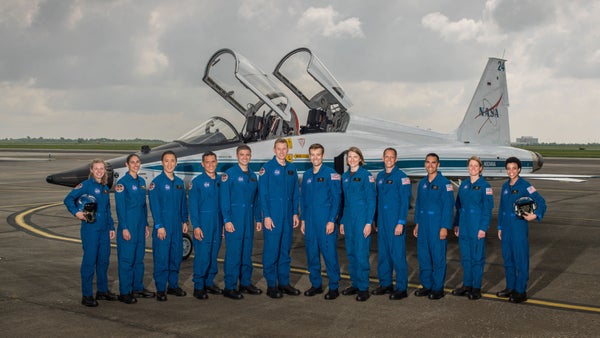
NASA has welcomed a dozen more people into its astronaut family, but the new additions aren't ready to go to space just yet.
Yesterday (June 7), the agency unveiled its 2017 astronaut class — seven men and five women chosen from a record-breaking initial pool of 18,353 applicants. (The previous high was 8,000 applicants, back in 1978, NASA officials said.)
The 12 new astronaut candidates (or "ascans," in NASA parlance) won't become full-fledged astronauts until they complete two years of training. This work, which begins in August, will be varied and rigorous. [What It's Like to Become an Astronaut: 10 Surprising Facts]
On supporting science journalism
If you're enjoying this article, consider supporting our award-winning journalism by subscribing. By purchasing a subscription you are helping to ensure the future of impactful stories about the discoveries and ideas shaping our world today.
For example, the newcomers will learn all about the International Space Station (ISS) and its many systems. They'll practice taking spacewalks in a giant swimming pool at NASA's Johnson Space Center (JSC) in Houston, and they'll simulate berthing visiting vessels with the orbiting lab's giant robotic arm.
NASA's primary partner on the $100 billion ISS is Russia's federal space agency, so the candidates will also learn Russian. And they'll be taught to fly supersonic T-38 jets, to help prepare them for the rigors of spaceflight, NASA officials said.
When all of this training is done, the newly minted space fliers will get in line for a trip to the final frontier. (There are currently 44 active, or flight-eligible, members of NASA's astronaut corps.) While they wait their turn, the 2017 class will be assigned "technical duties" at JSC's Astronaut Office.
"Technical duties can range from supporting current missions in roles such as CAPCOM in Mission Control, to advising on the development of future spacecraft," NASA officials wrote in an FAQ about the new astronaut class. (CAPCOM is short for Capsule Communicator; it refers to an individual at Mission Control who communicates directly with crewmembers in space.)
When the wait is over, the 2017 class could be assigned to missions aboard any of four different spacecraft, NASA officials added: the ISS, Boeing's CST-100 Starliner capsule, SpaceX's Dragon capsule or NASA's Orion vehicle.
Starliner and Dragon are being developed to ferry American astronauts to and from the ISS, under multibillion-dollar NASA contracts. Both Boeing and SpaceX aim to begin crewed test flights sometime next year. When the private capsules are fully up and running, they will end NASA's dependence on Russian Soyuz spacecraft to provide this taxi service. [Photos: The Best Astronaut Selfies in Space]
NASA is developing Orion, along with a huge rocket called the Space Launch System (SLS), to help get astronauts to Mars and other deep-space destinations. Orion has been to space once, on an uncrewed test flight to Earth orbit in December 2014 that launched atop a United Launch Alliance Delta IV Heavy rocket.
SLS and Orion are scheduled to launch together for the first time in 2019 on a flight called Exploration Mission 1 (EM-1), which will send an uncrewed Orion on a three-week journey around the moon. The duo's first crewed flight will come a minimum of 33 months after EM-1, NASA officials have said.
One of the 12 new candidates "could be the one that takes that next iconic giant leap and says the words similar to what Neil Armstrong said when he stepped on the moon, and brings the entire NASA family, and this entire world, with them," acting NASA chief Robert Lightfoot said during a press conference yesterday. "That's what the future is for these folks, and it's very, very exciting when we think about it."
EDITOR'S RECOMMENDATIONS
Copyright 2017 SPACE.com, a Purch company. All rights reserved. This material may not be published, broadcast, rewritten or redistributed.