
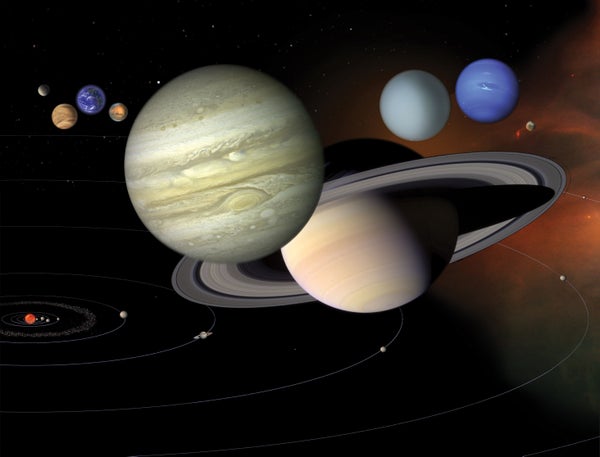
Even at a glance, the planets in our solar system are wildly diverse. Huge and small, airless and densely packed with atmosphere, they have a wide range of characteristics distinguishing them. But if I was backed into a corner, which one would I choose as the oddest of them all?
Easy: Venus is the weirdest planet in the solar system.
There’s a reason we call it Earth’s evil twin. For reasons that are still unclear, long ago it suffered a massive runaway greenhouse effect, filling its atmosphere with heat-trapping carbon dioxide. The result is a planet with 90 times the surface pressure of Earth’s, a temperature above 460 degrees Celsius (860 degrees Fahrenheit) and clouds made of sulfuric acid.
On supporting science journalism
If you're enjoying this article, consider supporting our award-winning journalism by subscribing. By purchasing a subscription you are helping to ensure the future of impactful stories about the discoveries and ideas shaping our world today.
Yet in its troposphere at an altitude of about 50 to 60 kilometers, Venus’s pressure and temperature are similar to those of Earth at sea level. The acid clouds and poisonous air would still be a problem, but in theory, it’s possible that humans could someday live in floating habitats high in the Cytherean skies—strange indeed.
Jupiter is the weirdest planet in the solar system. With a width of 11 Earths wide and a mass that is more than 300 times that of our planet, it’s a gas giant—a colossal bag of hydrogen and helium that turns into a bizarre liquid mix lower in its atmosphere and eventually becomes metallic even deeper down. As far as we can tell, Jupiter has a core of metal and rock, but it’s fuzzy and mushy—not at all like the obvious delineated layers we enjoy on our home world. And it has a powerful magnetic field that billows in the solar wind to stretch outward for hundreds of millions of kilometers, making this the largest continuous structure in the solar system after the sun’s heliosphere. If our eyes could see it, Jupiter’s magnetosphere would appear bigger than the full moon in the sky!
Mercury is the weirdest planet in our solar system. Scorched by the sun, it’s locked in a gravitational tug-of-war with our star that, over time, has forced the planet to spin three times for every two times it orbits the sun. Coupled with its elliptical orbit, this has strange effects; there are spots on the surface where, in the morning, you could watch the sun rise for a time, then set and then rise again, all near the same spot in the sky. And despite Mercury’s intense irradiation, there are deep, cold craters near its poles that never see sunlight and harbor water ice. It’s a planet of paradoxes.
Neptune is the weirdest planet in the solar system. The most distant major planet from the sun and the last stop before interstellar space, Neptune is only dimly illuminated by our star, receiving just 0.1 percent as much light as Earth does. It was discovered not by direct observation but with gravitational effect on Uranus, although it was spotted, unrecognized at the time, by Galileo centuries earlier. Its internal heat powers our solar system’s fastest winds, measured at an incredible 2,200 kilometers per hour—faster than the speed of sound. Don’t ever try to fly a kite at Neptune. It’ll tear your arms off.
Mars is the weirdest planet in the solar system. A tenth the mass of Earth, it nonetheless has the solar system’s tallest mountain and grandest canyon. It’s covered in fine-grained dust composed of various kinds of iron oxide: rust. The atmosphere is lousy with the stuff, tinting the air a butterscotch color—except near the sun in the sky, where light scattering creates a blue aura that is best visible at sunset. This makes it the opposite of Earth, with its blue skies and red sunsets.
Uranus is the weirdest planet in the solar system. Eons ago, some catastrophic event knocked the huge ice giant on its side, and it now orbits the sun with an axial tilt of 98 degrees. This gives it extreme seasons, each lasting 21 Earth years. At its north pole, for example, it takes about four decades after sunrise for our star to set again. And for years, at the height of summer, the sun is nearly directly overhead. On top of this, Uranus’s magnetic field axis is offset from the center of the planet by about 8,000 km. This may have the same cause as the world’s tilt; perhaps it was hit by another massive planet not long after it formed, knocking Uranus catawampus. On top of all that, it may also rain diamonds there.
Saturn is the weirdest planet in the solar system. It’s actually lower in density than water; the oldest joke in astronomy is that if you threw Saturn in a bathtub, it would float, but it would leave a ring. Its gorgeous ring system is the most spectacular thing in our planetary neighborhood, yet if you gathered up all the ice ring particles, they would only make a small moon less than 400 km wide—one more satellite to add to Saturn’s horde of known moons, some 285 in all. And as impressive as its rings may be, the planet also boasts an immense hexagonal vortex almost 30,000 km across at its north pole—so huge Earth could comfortably pass through one of its sides. This is actually a natural atmospheric feature that still looks very much like an alien portal into another place in time and space.
Unsurprisingly, I could go on and on about how strange any given planet in the solar system is—not to mention the smaller objects such as Pluto, as well as the moons, asteroids, comets, Kuiper Belt and Oort Cloud objects—but this is our own prejudice coloring our view.
When it comes right down to it, Earth is the weirdest planet in the solar system—by far. For one thing, it has plate tectonics—the sliding and buckling of great slabs of rock that constantly reshapes its surface—a feature that isn’t found anywhere else around the sun. Earth also has an unusually large moon relative to its size, a ratio far larger than that of any other moon around a major planet.
Even stranger, Earth’s distance from the sun, coupled with its inherent atmospheric greenhouse effect, gives our planet a surface temperature where water can coexist in three phases: solid, liquid and gas. This situation is unique among the sun’s planets and is critical for Earth’s exceptional status; water is an excellent medium for life to arise and evolve. It can dissolve and mix important prebiotic minerals, and its water cycle—in which water evaporates over the oceans, rains out in a different location and then washes back to the sea—transports these materials to places where they can concentrate and churn up complexity.
Over time—billions of years—these simpler materials have bumped and ground and fallen apart and reformed, taking advantage of the chemistry around them and energy from the sun to become the astonishing and dazzling variety of biology we see all around us.
You want weird? Of all the hundreds of worlds in our solar system, only one is known to have life, and you live on it.
Weirdness is relative, though. We are still probing these other places, looking and sniffing around to search for life, extant or otherwise. We may yet find it, several times over. And if we do, Earth may wind up being not so weird after all.