New Issue: Orbital Catastrophe Ahead? Read Now

When It Comes to Evolution, Microbes Have to Pick and Choose

Bacteria face trade-offs when optimizing traits involved in antibiotic resistance

Join Our Community of Science Lovers!

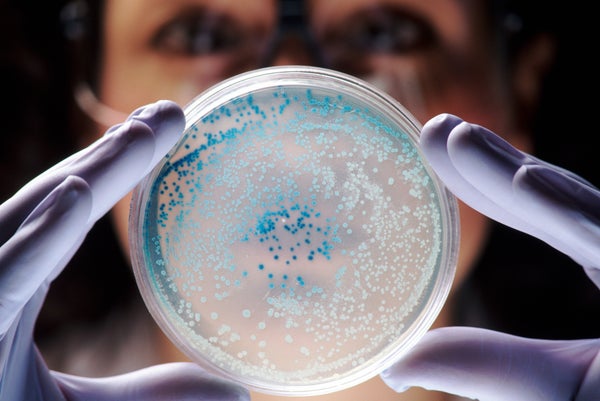
To survive hostile environments, an organism often has to acquire new traits. But the rules of evolution appear to restrict how many such characteristics it can optimize at once. In a new study, researchers say they found that some bacteria make a genetic trade-off: the microbes involved were able to develop only one of two new traits and selected the one that best helped them thrive in a given setting.

The results could provide a model for studying how infectious microbes become resistant to antibiotics. “We want to understand the rules, if there are rules, for how organisms adapt,” says senior study author Seppe Kuehn, a biological physicist at the University of Illinois at Urbana-Champaign. “If we can, maybe there's a chance to make great breakthroughs in terms of treatment.”

David Fraebel, a graduate student in Kuehn's laboratory, grew Escherichia coli in either a nutrient-rich or nutrient-poor growth medium and measured how quickly the microbes spread. A mathematical model predicted that the fastest-spreading microbes would be those that combined two traits: swimming speed and growth rate. But instead the microbes chose just one trait: in the nutrient-rich environment, those that migrated farthest had opted for speedy swimming. In contrast, in the nutrient-poor medium, the fastest reproducers won out.


On supporting science journalism

If you're enjoying this article, consider supporting our award-winning journalism by subscribing. By purchasing a subscription you are helping to ensure the future of impactful stories about the discoveries and ideas shaping our world today.


By comparing the DNA sequences of the more evolved microbes with those of their ancestors, Fraebel found that the fastest movers had acquired one mutation, whereas the quickest reproducers had acquired a different one. None of the surviving organisms had both.

The finding, reported in eLife, suggests the fittest bacteria selected one “evolutionary path or the other,” Kuehn says. Such compromises may be one of the many genetic tools organisms use to survive when confronting a challenge in their environment.

Journalist Michael Waldholz led a team of reporters who were awarded a Pulitzer Prize in 1997 for their coverage of AIDS. He lives in New York State’s Hudson Valley.

More by Michael Waldholz
Scientific American Magazine Vol 317 Issue 4This article was published with the title “Genetic Compromises” in Scientific American Magazine Vol. 317 No. 4 (), p. 21
doi:10.1038/scientificamerican1017-21

Subscribe to Support Independent Journalism

Great science journalism requires human expertise, time, effort and creativity. And it costs money. That’s why I and the journalists here at Scientific American hope you’ll join our community.

When you subscribe, you are supporting staff and freelance journalists who are passionate about telling science stories that are true, important and compelling. Our editors and reporters are often experts in their fields, which means they understand the nuances of big discoveries and can untangle the breakthroughs from the hype. With a subscription, you are also supporting rigorous fact-checking to ensure the words we publish are precise and accurate. And you’re supporting original illustrations, graphics and photos that bring you closer to an advanced laboratory, an ice sheet in Antarctica or a space mission in orbit. You’re helping us craft other types of high-quality journalism as well: Our newsletters are carefully written, edited and curated by staffers you have or will come to know and love. Our Science Quickly podcast is based on original reporting, collaboration with editors and scientists and exacting production.

Subscriptions keep this engine running so we can continue to deliver thoughtful, rigorous and independent science journalism to you. In an era of viral misinformation, this work is crucial. If you value what we do, I hope you’ll consider joining us as a subscriber

Thank you,

Jeanna Bryner, Editor in Chief, Scientific American

Subscribe