
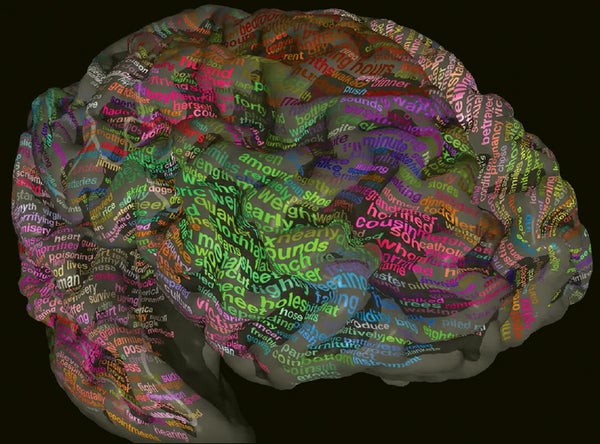
Listening to speech is so easy for most of us that it is difficult to grasp the neural complexity involved. Previous studies have revealed several brain regions, collectively called the semantic system, that process meaning. Yet such studies have typically focused on specific distinctions, such as abstract versus concrete words, or found discrete areas responsive to groups of related words, such as tools or food. Now a team of neuroscientists in Jack Gallant's laboratory at the University of California, Berkeley, led by Alexander Huth, has generated a comprehensive “atlas” of where different meanings are represented in the human brain.
The researchers played two hours of stories from the Moth Radio Hour, a public broadcast show, to seven participants while recording their brain activity in a functional MRI scanner. They then analyzed the activity in the roughly 50,000 voxels (three-dimensional pixels) that make up the entire brain, creating detailed maps of where different meanings are represented in each individual. This approach contrasts with standard studies, where activity is averaged across many participants to look at similarities across a group while ignoring variations among individuals.
The maps cover much of the cortex, the outermost brain regions controlling higher cognitive functions, extending beyond areas traditionally thought of as language centers. Every meaning appears in multiple locations, and every location contains a cluster of related meanings. Some areas selectively respond to words related to people, for instance, whereas others respond to places or numbers. “This is way more information, and probably way more generalizable to natural narrative comprehension, than any previous study,” Gallant says.
On supporting science journalism
If you're enjoying this article, consider supporting our award-winning journalism by subscribing. By purchasing a subscription you are helping to ensure the future of impactful stories about the discoveries and ideas shaping our world today.
The maps were remarkably similar from one participant to the next, though not identical. The researchers developed a statistical tool that enabled them to produce a general semantic “atlas,” by finding functional areas common to all participants. This technique, improved and extended to other cognitive functions, could ultimately be useful for mapping brain function so as to minimize the impact of surgery or other invasive treatments.