
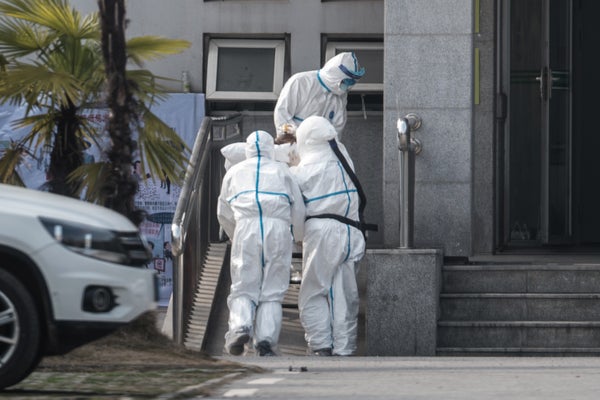
The World Health Organization announced Monday that it would convene an expert panel to determine whether a fast-developing outbreak caused by a new virus in China should be declared a global health emergency.
The news came as China reported confirmed cases in Beijing and in Guangdong province, 14 cases in health care workers—a first—and a confirmed incident involving human-to-human spread of the new virus, known provisionally as 2019-nCoV. It is a coronavirus, from the same family as the viruses that caused the 2003 SARS outbreak, which sickened more than 8,000 people globally, killing nearly 800.
It also comes as China prepares to celebrate the Lunar New Year, when people throughout the country travel to be with family. Experts fear this event could spread the virus widely.
On supporting science journalism
If you're enjoying this article, consider supporting our award-winning journalism by subscribing. By purchasing a subscription you are helping to ensure the future of impactful stories about the discoveries and ideas shaping our world today.
To date, China has confirmed more than 200 infections with the new virus; four people have died and at least eight others remain in critical condition.
“That’s really a concern,” Ralph Baric, a coronavirus expert at the University of North Carolina, said of the case count, which jumped by roughly 150 cases over the weekend. “That pretty much means that human-to-human transmission is occurring, and it may not be as difficult as had been suggested.”
The WHO has said for some time that human transmission couldn’t be ruled out, though Chinese authorities have been slower to acknowledge the possibility. But that changed Monday, because of cases diagnosed in Guangdong province.
The bulk of the cases so far are in Wuhan, a central Chinese city of 11 million people. But on Monday authorities confirmed five cases in Beijing and 13 in Guangdong.
Most of the Guangdong cases had recently visited Wuhan. But two—family members of a case—had not, showing that the virus can transmit from person-to-person in some circumstances. How readily it does that remains an unanswered question at this point.
Cases have also been exported to three Asian countries. Thailand has reported two cases in tourists from China, and South Korea has confirmed one in a Chinese tourist as well. Japan reported a case in a Japanese traveler who had been to Wuhan, where the outbreak is believed to have started.
Chinese President Xi Jingping spoke publicly of the outbreak for the first time Monday, urging the government to do everything possible to control spread of the virus.
“The recent outbreak of novel coronavirus pneumonia in Wuhan and other places must be taken seriously,” Xi said on the state broadcaster CCTV. “Party committees, governments and relevant departments at all levels should put people’s lives and health first.”
China alerted the WHO of an outbreak of unusual pneumonia cases on Dec. 31. The next day authorities in Wuhan closed a seafood market that many of the initial cases had either worked at or shopped at. In addition to fish, the market sold game. Though the animal source of the virus has not yet been identified, the leader of an expert committee working on the outbreak has said some type of game is the likely source.
Bats are believed to be the source of most coronaviruses, but other animals sometimes play a role when new coronaviruses start infected people. The SARS virus was transmitted by palm civets and other small mammals sold as delicacies in some parts of China. MERS—Middle Eastern Respiratory Syndrome—jumps from camels to people.
The WHO has established a so-called emergency committee to advise Director-General Tedros Adhanom Ghebreyesus on how to deal with the outbreak. The committee will be asked to decide whether it constitutes a public health emergency of international concern, or a PHEIC.
Declaring a PHEIC gives the WHO director-general powers to issue recommendations to other countries, such as urging them not to close borders or restrict trade with a country in the throes of an outbreak. Such measures are viewed as both unlikely to stop disease spread and very likely to discourage countries from being forthright about outbreaks.
However, recommendations from the WHO are only that—the global health agency does not have the authority to require countries to follow its directives. During the West African Ebola outbreak of 2014-2016, for instance, most airlines stopped flights to the affected countries and many countries, including the United States, stopped issuing visas to nationals from Guinea, Sierra Leone and Liberia, the main countries affected.
There are currently two PHEICs that are ongoing—the long-running Ebola outbreak in the Democratic Republic of the Congo and the continued transmission of polio, long targeted for eradication.
Republished with permission from STAT. This article originally appeared on January 20 2020