
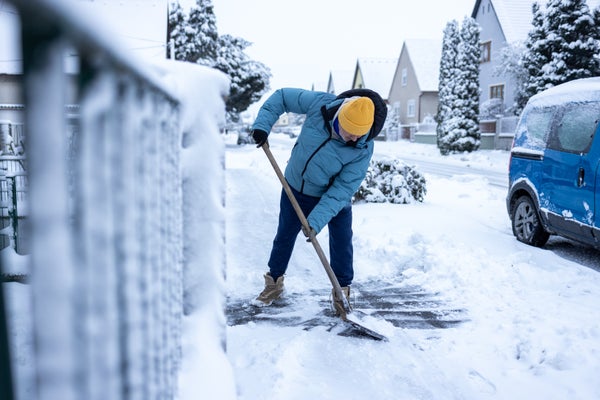
A blizzard is a real test of the social contract. Nature dumps 12 to 18 inches of inconvenience uniformly across an entire community and leaves it up to you and your neighbors to sort out the mess. Who clears the streets or the sidewalk? What about the “sneckdowns”?! Every storm leaves behind a labyrinth of communal responsibility for us to resolve and not always without conflict.
It’s still largely an open mystery why and how social creatures like ourselves choose to cooperate. Game theorists, computer scientists, anthropologists and behavioral economists have all come at the problem from different angles. There’s even a scientific version of the blizzard conundrum called the “snowdrift problem.”
It’s a variation of the prisoner’s dilemma, where two accomplices in a robbery are separated and asked to snitch on each other. Each has to decide whether to betray their partner in order to go free or to stay silent in hopes that both may get off. (If both snitch, both go to jail.) The snowdrift problem asks a related question: Who should shovel in a selfish world?
On supporting science journalism
If you're enjoying this article, consider supporting our award-winning journalism by subscribing. By purchasing a subscription you are helping to ensure the future of impactful stories about the discoveries and ideas shaping our world today.
Imagine you wake up, mid-snowstorm, and must get to work. You manage to exhume your car and make it halfway until a massive snowdrift blocks the road. There’s another car coming from the other direction that is stuck as well, and you both have a shovel.
Both drivers must choose whether or not to cooperate. The game assigns points to each of the four possible outcomes. You win the most points if you can convince the other person to do all of the work. The payout is moderate if both agree to shovel—everyone gets to their job with minimal delay. And even if your opponent opts to stay warm in the car, you’re better off shoveling. It’s not fair, but at least you’ll (eventually) get where you’re going.
Game theorists usually break up the decision into several rounds, as if the two drivers renegotiate after every few minutes of shoveling. Compared with the ostensible consequences of the prisoner’s dilemma, getting fleeced in the snowdrift problem’s scenario isn’t quite as disastrous. (Any amount of tardiness at work beats years in prison.) But in both games, theorists argue, it’s generally better to cheat your opponent if you can. This result raises a question: Why do humans cooperate as much as we do?
Studies show the blizzard version of the game leads to more cooperation than the prisoner’s dilemma does. And many sociologists think the former is a better proxy for real-world cooperative challenges, where betrayal often hurts oneself as well as others.
The snowdrift problem and variants of it are still active areas of study. Recently scientists used graph theory to evaluate a new strategy, which they call “poor-defect-rich-cooperation.” It roughly translates to the following advice: check whether your neighbors are cooperating; if their driveways look clear, then you should decide to pitch in as well.
Scientists turn to these very simplistic models because cooperation is a true wonder of the natural world. Natural selection seems to prescribe selfishness in most situations, and yet, all over the animal kingdom, we see the fruits of collaboration. Games like the snowdrift problem are a way to explore this puzzle using simple math, with the aim of figuring out how a bunch of selfish individuals add up to a coherent society.
Now stop procrastinating and go shovel that walkway.