
By Aaron Ross
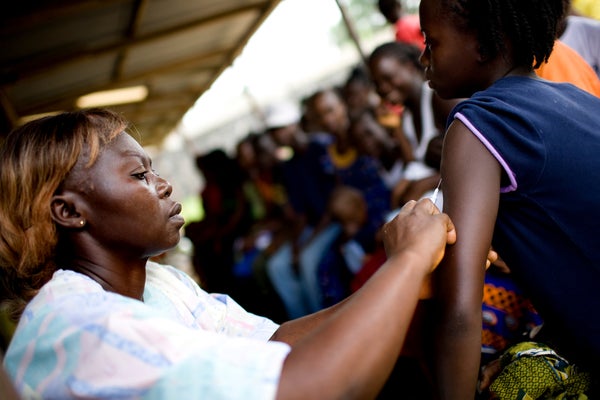
The World Health Organization (WHO) said on Thursday that it will launch emergency yellow fever vaccination campaigns along the border between Angola and Democratic Republic of Congo and in the Congolese capital Kinshasa next month.
The worst yellow fever outbreak in decades has killed about 345 people in Angola, while Congo declared an epidemic in Kinshasa and two other provinces on Monday after reporting 67 confirmed cases and more than 1,000 other suspected cases.
On supporting science journalism
If you're enjoying this article, consider supporting our award-winning journalism by subscribing. By purchasing a subscription you are helping to ensure the future of impactful stories about the discoveries and ideas shaping our world today.
In a statement, WHO said that the campaign would target areas within 75-100 km (45-60 miles) of the border where there are high levels of movement and trade in order to create an "immune buffer" and prevent the disease spreading further.
WHO said that the campaign would begin in July. There is currently almost no vaccine left in Congo and a new stock of more than 1 million doses may take weeks to arrive.
The global stockpile of yellow fever vaccine has already been depleted twice this year to immunize people in Angola, Uganda and Congo. It stands at 6 million doses, but experts warn this may not be enough if there are simultaneous outbreaks in a number of highly-populated areas.
The mosquito-borne hemorrhagic virus is a major concern in Kinshasa, a city of about 12 million people with poor health services, a humid climate beloved of the insects and much stagnant water where they can breed, owing to pour drainage.
The government and international health organizations vaccinated more than 2 million people, about half of them in Kinshasa, between May 26 and June 4.
But there is no more vaccine left, aside from a few doses left in reserve in Kongo Central and some being administered by a government agency at Kinshasa's central hospital, airport and river crossing with neighboring Congo Republic.
To cope with the shortage, WHO has recommended using a fifth of the standard dose of yellow fever vaccine, which would not give lifelong protection to those who receive it but might at least contain the outbreak.
However, a WHO spokeswoman said such a move would not be appropriate for the current emergency plan on the border.
"Due to the logistical challenges involved in rural areas, dose fractioning would not be proposed in this area. WHO would recommend using full doses," Sarah Cumberland said.
She added that the recommendation was being considered only for Kinshasa, "as a way to extend a limited stock of vaccine to cover the entire city".