
In response to President Donald Trump’s tariffs on China, which currently stand at 145 percent, the country has played its trump card: rare earth metals. Along with other minerals that are critical to defense and industry, China has effectively halted exports of seven of these vital metals, as well as products, such as magnets, that incorporate them. China produces 90 percent of the world’s rare earths, as well as 90 percent of the powerful magnets made with these metals—which drive the motors of wind turbines, jet engines and electric vehicles. The suspension is likely to severely disrupt U.S. industry.
What makes rare earths so special?
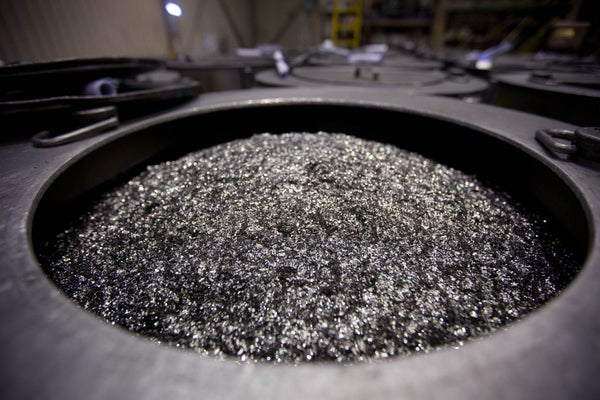
Rare earths are silvery-gray metals. There are 17 of them, ranging from lanthanum (atomic number 57) to lutetium (atomic number 71), and most of them are in their own row in the periodic table because of their unusual atomic structure. Their arrangement of electrons can give them remarkable properties such as luminescence—used for the screens of smartphones—and magnetism. They are often added to other metals in small amounts to enhance their performance; magnets with rare earths can be 15 times as powerful as those without them. China has effectively blocked exports of the following rare earths: samarium, gadolinium, terbium, dysprosium, scandium, yttrium and lutetium.
On supporting science journalism
If you're enjoying this article, consider supporting our award-winning journalism by subscribing. By purchasing a subscription you are helping to ensure the future of impactful stories about the discoveries and ideas shaping our world today.
Why are they rare?
“The rare earths aren’t actually all that rare,” says geologist Simon Jowitt of the University of Nevada, Reno. “What is rare are rare earth deposits you can actually extract the rare earths from.” Although rare earths occur in trace amounts in most rocks, there are only a few places on Earth where their concentration is high enough for their extraction to be economically viable. China has clay deposits with relatively high concentrations of heavy rare earths. The U.S. has an active mine at Mountain Pass, Calif., that mostly produces lighter rare earths. But all the ore extracted there—45,000 metric tons in 2024—is sent to China for processing. That’s because refining the rare earths—in particular, separating them from one another—requires a lot of energy, as well as environmentally damaging chemicals such as hydrochloric acid. Besides, low Chinese prices had made processing in the U.S. economically unviable.
What can the U.S. do now?
In the short run, the U.S. can ease its trade war with China. In the long run, it can develop other sources of rare earths, either among its allies abroad or within its borders. “There’s a significant amount of potential mines in the U.S., in Texas and Nebraska, but there’s no point having a mine unless you’ve got the entire supply chain,” Jowitt says. Mining and processing need to be developed hand in hand.
Another possible source of rare earths is recycling. The hard drives of older computers, the batteries of mobile phones, all contain rare earths. But in these sources, all of these metals are mixed in with other materials, which makes them hard to recycle, Jowitt explains. Researchers are working on the problem and have come up with imaginative solutions such as using chemicals produced by bacteria to separate the desired metals. A company based in Texas is already making magnets from recycled hard drives. Rare earths lie in every home—a veritable gold mine. Finding ways to use them would benefit not only consumers and industry but also our planet.