
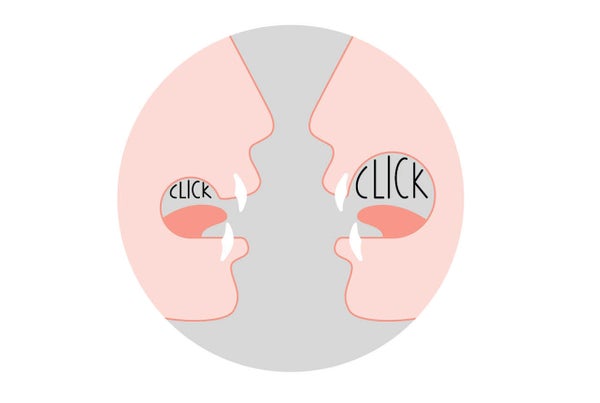
Click sounds, such as those found in some languages in Africa, make perfectly good consonants. So why do they appear so rarely in most human speech? One culprit may be anatomy.
Previous studies have suggested that in some speakers of click languages, the alveolar ridge—the rounded bump between the upper teeth and the roof of the mouth—is small or even absent. In recent research, Scott Moisik of Nanyang Technological University in Singapore and Dan Dediu of the Max Planck Institute for Psycholinguistics in Nijmegen, the Netherlands, built biomechanical models that simulated clicks in vocal tracts with alveolar ridges of varying sizes. Their results, published in January in the Journal of Language Evolution, showed a clear disadvantage for tracts with large ridges. These allowed less air to be trapped in the mouth and required more muscular force to produce a click.
The authors interpret this finding as support for an anatomical bias against clicks. They believe the bias is probably weak at the individual level; people with large alveolar ridges can still learn click languages. Nevertheless, their models suggest that such individuals may find it difficult to learn click consonants or that their pronunciations may be different.* Amplified over generations, this bias might explain why such consonants are so rarely found in languages worldwide.
On supporting science journalism
If you're enjoying this article, consider supporting our award-winning journalism by subscribing. By purchasing a subscription you are helping to ensure the future of impactful stories about the discoveries and ideas shaping our world today.
These results are not the first to challenge the traditional premise among linguists that language evolution is largely immune to external factors. Several other researchers have recently argued that geographical context, environmental conditions and genetics could all play a role. But Moisik and Dediu's work goes a step further by singling out one feature of human anatomy and quantifying its contribution to a particular type of speech sound.
Susanne Fuchs, senior researcher at the Leibniz Center of General Linguistics in Berlin, who was not involved in the work, says the study's conclusions are valid. But she cautions that they may present a chicken-and-egg problem: “The palate shape of an individual matures from early childhood to puberty and ... may be affected by frequent productions of clicks,” Fuchs says. “Therefore, over the course of history, it may well be possible that vocal tract properties and click productions developed in parallel.”
*Editor's Note (11/17/17): This sentence from the print article was edited after it was posted online to correct an error in the original.