
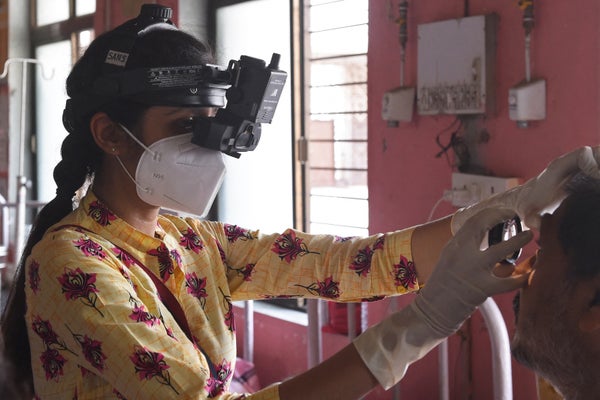
The hospital of the Mahatma Gandhi Institute of Medical Sciences, a medical school in the town of Sevagram in the Indian state of Maharashtra, has been taking in patients afflicted with COVID since May 2020. But in the middle of last month, something changed. Patients arrived with problems the physicians there had not yet seen in the pandemic: people were not only breathless and feverish yet had pain and pressure behind their cheekbones and around their eyes.
Their cases were some of the earliest indications of a wave of illness that is now swamping India, an epidemic within the pandemic: infections with a rare group of fungi called mucormycetes. The infection they cause, mucormycosis—“black fungus,” colloquially—can infest the sinuses and bones of the face and invade the brain or cause patients to lose an eye. When it goes untreated—and treatment is prolonged and difficult—mucormycosis can kill up to half of those who contract it.
There have been almost 12,000 cases of the infection in India in recent months, with most of them occurring in the western states of Maharashtra and Gujarat. “There was no fungus in the first wave” of COVID, says S. P. Kalantri, a professor of medicine at the Mahatma Gandhi Institute of Medical Sciences and medical superintendent of its hospital. “The black fungus has painted the country red in the second wave.”
On supporting science journalism
If you're enjoying this article, consider supporting our award-winning journalism by subscribing. By purchasing a subscription you are helping to ensure the future of impactful stories about the discoveries and ideas shaping our world today.
The epidemic of mucormycosis is yet another of the unpleasant surprises produced by the COVID pandemic—following MIS-C, a severe inflammatory syndrome that seems to mostly affect children, and “long COVID,” a complex of symptoms that continue to afflict patients months after initial infection. Mucormycosis is one of an array of ferocious fungal diseases that have attacked COVID patients, including a lethal yeast called Candida auris and a spate of infections with Aspergillus fungi that have earned the acronym CAPA (for COVID-associated pulmonary aspergillosis).
These fungal infections arise after a COVID diagnosis, which seems to be a clue. A standard component of treatment for severe cases of COVID is high doses of corticosteroids, anti-inflammatory drugs that damp down the immune system’s overreaction to infection. Steroids save lives, but they simultaneously make a patient more vulnerable to attack by whatever bacteria or fungi are already in their body or hanging around their environment.
“Fungal spores are everywhere, but we are pretty efficient at clearing them from our lungs,” says Arturo Casadevall, a physician and molecular microbiologist at the Johns Hopkins Bloomberg School of Public Health. “But COVID damages the lung. So then you have a double whammy: reduced capacity to naturally clear the spores and reduced immune response as a result of steroids.”
That collision of factors is complicated by something else. Years before COVID appeared, researchers in Australia and Europe, as well as India, all reported that mucormycosis seemed particularly ferocious in patients with uncontrolled diabetes. That is setting Indian COVID patients up for disaster. “Even in rural areas, every eighth adult aged 30 and beyond is diabetic,” Kalantri says. “Most have suboptimal control of sugar. When these patients test COVID-positive, they often are prescribed high-dose steroids, often in the first week. Irrational and unscientific treatment of COVID is extremely common.”
Fungal infections after COVID have been so widely reported from multiple countries that physicians are starting to develop treatment algorithms to blunt their attack. “People that present with COVID and a new diabetes diagnosis or severe diabetes—that is an extreme risk,” says Kieren Marr, a physician at the Johns Hopkins University School of Medicine and medical director of its transplant and oncology infectious diseases program, who recently published research on Aspergillus fungus infections in COVID patients. “In our center, we would say that all of the risk factors would justify potentially giving an antifungal drug preventatively.”
Identifying a case of mucormycosis early can be challenging. Unlike some other fungal infections, there are no blood-based tests that can detect it. Diagnosis requires doing a biopsy, examining the sample and sometimes following up with a CT scan—all of which imply the availability of specialty personnel to perform those tasks and advanced equipment to support them. In the under-resourced parts of India’s vast health care system, those cannot be guaranteed.
Even antifungal drugs are in short supply in India, according to news reports, and they may be unaffordable for most. There are relatively few categories of antifungals, and while some of them have been available for decades, newer versions that are less toxic to patients are expensive and scarce. For the preferred drug, “one-day therapy costs 30,000 rupees (about $410), a catastrophic health expenditure for 99 percent of Indians,” Kalantri says. “The therapy often lasts for weeks and requires an intravenous infusion, admission to the hospital and close monitoring of the kidney function.”
It is not possible, at this point, to predict an end to the shadow epidemic of black fungus, though greater awareness of patients’ vulnerability may allow physicians in India to recognize cases earlier. For now, it remains one more way in which the pandemic caught the world by surprise and one more illustration of how its worst effects have fallen hardest on countries that can afford them least.