
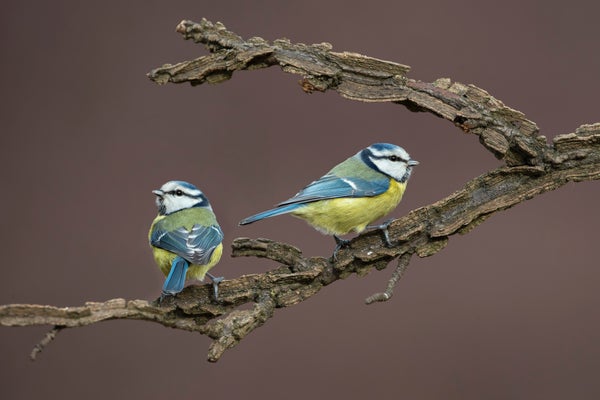
Humans are not the only animals that endure divorce; some birds go through it as well. A recent study reveals why members of one such species, the Eurasian blue tit, sometimes break their bond.
When ornithologists refer to “divorce,” they mean that both members of a breeding pair survive to the following breeding season but end up pairing with new partners rather than reuniting. Great blue herons divorce after every breeding season, and emperor penguins split up around 85 percent of the time. In contrast, just 9 percent of mallard duck pairs call it quits, and albatrosses almost never break up. Many researchers have focused on understanding how these separations affect reproductive success, but until now few have focused on the process itself.
Behavioral ecologist Carol Gilsenan of the Max Planck Institute for Ornithology in Germany and her colleagues monitored hundreds of Eurasian blue tits for eight years, using artificial nest boxes in a protected forest in southern Germany. In their findings, published in Animal Behaviour, 64 percent of breeding pairs split up during the study—even though faithful pairs produced more eggs and reared more fledglings. If both members of a pair returned to their previous territory around the same time, they were more likely to reunite; if they were on different schedules, they were more likely to separate.
On supporting science journalism
If you're enjoying this article, consider supporting our award-winning journalism by subscribing. By purchasing a subscription you are helping to ensure the future of impactful stories about the discoveries and ideas shaping our world today.
“If you turn up early, you can't afford to wait around,” Gilsenan says. “It could be that your former mate is injured or even dead. If you wait, you may forgo a breeding opportunity, so you need to pair up.” Adult mortality in blue tits is extremely high—around 50 percent—so the bird that returns first is more likely to breed again by finding a new partner rather than risk being left out entirely. The birds seem to be simply playing the odds.
The researchers also discovered that if pairs maintained contact outside the breeding season, they were more likely to have synchronized schedules and therefore to remain faithful to each other.
Josh A. Firth, a zoologist at the University of Oxford, who was not involved with the study, says this analysis apparently rules out a number of other possible causes of avian divorce, including low reproductive success rates, infidelity, and genetic or behavioral compatibility. “In wild animal populations,” he says, “divorce can be driven by consequential effects—almost accidentally.”