
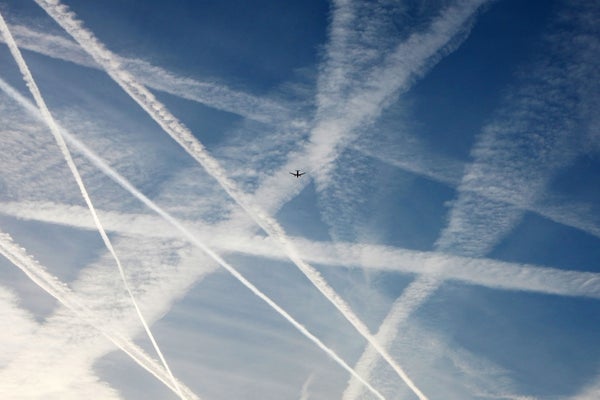
Jets leave white trails, or contrails, in their wakes for the same reason you can sometimes see your breath. The hot, humid exhaust from jet engines mixes with the atmosphere, which at high altitude is of much lower vapor pressure and temperature than the exhaust gas. The water vapor contained in the jet exhaust condenses and may freeze, and this mixing process forms a cloud very similar to the one your hot breath makes on a cold day.
Jet engine exhaust contains carbon dioxide, oxides of sulfur and nitrogen, unburned fuel, soot and metal particles, as well as water vapor. The soot provides condensation sites for the water vapor. Any particles present in the air provide additional sites.
Depending on a plane's altitude, and the temperature and humidity of the atmosphere, contrails may vary in their thickness, extent and duration. The nature and persistence of jet contrails can be used to predict the weather. A thin, short-lived contrail indicates low-humidity air at high altitude, a sign of fair weather, whereas a thick, long-lasting contrail reflects humid air at high altitudes and can be an early indicator of a storm.
On supporting science journalism
If you're enjoying this article, consider supporting our award-winning journalism by subscribing. By purchasing a subscription you are helping to ensure the future of impactful stories about the discoveries and ideas shaping our world today.
The mixing gases contained in the contrail rotate with respect to the ambient air. These regions of rotating flow are called vortices. (Any sharp surface, such as the tip of a wing, can cause vortical flow in its wake if it is sufficiently large or the flow is sufficiently fast.) On occasion, these trailing vortices may interact with one another.
In one well-known example of this fact, the Crow Instability causes the vortices to develop symmetric sinusoidal oscillations and eventually to merge and form vortex rings behind the jet. This instability can be triggered by turbulence in the surrounding air or by local variation in air temperature or density, which may itself be the result of the stratification of the atmosphere. When the contrails are visible and strong, it is possible to see the white streaks become wavy and then leave rings floating high in the sky, like smoke rings from a giant cigar.
Recent research has suggested that the ice clouds contained in contrails cause greenhouse effects and contribute to global warming as part of the insulating blanket of moisture and gases in the atmosphere. Researchers in this area seized on the opportunity presented on September 11 and 12 over the U.S. The complete cessation of commercial air traffic offered a control sky without contrails for use in quantifying the environmental effects of contrails.