
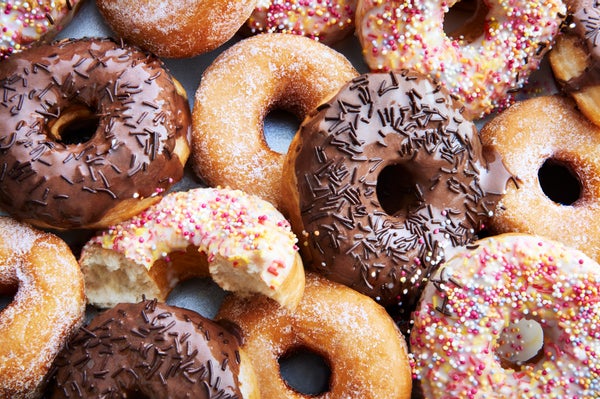

Cookies, cakes, brownies, muffins, ice cream, gelato, pudding. You name it, I love it. And based on how many daily tempting encounters I have with sweets, I know I’m not the only one. But if our bodies actually suffer from eating too much sugar, then why do we crave it? And why don’t we have such strong cravings for food like, say, broccoli, which is a great source of vitamin C, vitamin K, iron, and potassium, all things our body actually needs? If it's so bad for us, then why does sugar taste so good?
It turns out, scientists have been asking this question for decades. There are hundreds of peer-reviewed journal articles trying to answer that very question. Let’s take a look at what they’ve come up with.
On supporting science journalism
If you're enjoying this article, consider supporting our award-winning journalism by subscribing. By purchasing a subscription you are helping to ensure the future of impactful stories about the discoveries and ideas shaping our world today.
Kids love sugar
Although some of us outgrow our love of sugar—perhaps as our desire for it becomes outweighed by our desire to avoid the post-sugar haze or crash—you would be hard-pressed to find a child who doesn’t have a sweet tooth. But let's stop a moment before we blame their parents for letting them indulge. Studies have shown that the love children have for sugar may be innate. In other words, kids may have a built-in love of all things sweet.
The preference for sweet foods is found to be already evident in newborns, who prefer sweeter formulas. It also seems to be shared by children globally across cultures and climates. There's further evidence that kids’ taste buds are more sensitive to bitter-tasting foods, further pushing them to reach for the sweets.
One study showed that adults tend to max out their sugar preference at about the level of sugar in a can of soda, but older children still liked drinks that were twice as sweet. The scientists couldn’t find a limit to the concentration of sugar younger children preferred. It turns out that the kids still liked the sugary drink even past the point where there was too much sugar to be dissolved in water anymore.
Our bodies need sugar
Sugar gets a bad rap, but it isn’t all bad. Sugar provides our bodies with calories, which we can then convert into energy. Children, in particular, need this energy to fuel their rapid growth. Sugar also helps us store fat, which can be drawn on later should we need it.
Our body knows to crave the things it needs as a way of signaling our brain to start eating what we’re missing. As a vegetarian, I know that when I start thinking about stealing the peanut butter sandwich that's been floating around in my kid's backpack, it’s probably not because the sandwich is so delicious. It's more likely that I haven’t gotten enough protein for the day.
In the times of pre-human primates and early humans, those who ate the most calories had a better shot at survival and thus at passing on their genes. Fruit, the most common natural source of sugar, could provide more energy than other sources of food, like vegetables, but was relatively scarce. So some scientists suggest that those early humans that ate the most fruit lived longer and had more babies. Those future generations may have then evolved to crave that sugary fruit as an important part of their survival.
Now, of course, sugar is no longer scarce and we consume it in much larger quantities than the occasional rare fruit. So, in the evolutionary game of survival of the fittest, the fittest isn’t necessarily the one with the most sweets anymore. We also extract sugar from fruit and then concentrate it into things like juices and candies. This makes it easier to consume larger quantities of sugar than our body needs. It also means our sugar doesn’t always come with a dose of fiber, as it would if you were simply eating fruit, and the energy we get from these processed sugars may not last us as long.
»Continue reading “Why Does Sugar Taste So Good?” on QuickAndDirtyTips.com