Why Don't Deer Crash into One Another When Startled?

The ruminants seem to head due north or south when fleeing, a new study shows

FABRIZIO MOGLIA Getty Images

Join Our Community of Science Lovers!

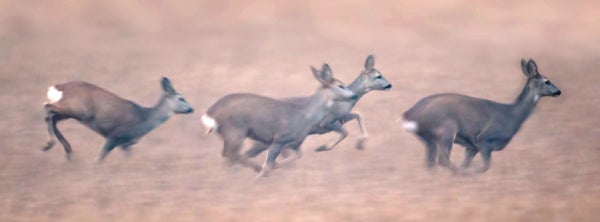
When something frightens grazing deer, they all suddenly bound away together in an apparently organized fashion. How does a stressed-out, possibly panicked group of animals manage to coordinate such a getaway without crashing into one another?

In an effort to find out, biologist Hynek Burda of the Czech University of Life Sciences Prague and his team turned to roe deer, European ungulates that often graze in open fields. As a favorite of hunters, the deer associate humans with danger and run away when approached. During the spring and summer of 2014 the researchers deliberately startled 188 groups of grazing deer in three different Czech hunting grounds.

It is reasonable to assume that the deer would run directly away from an approaching threat or toward the nearest cover. Instead the researchers discovered that the animals preferred heading toward magnetic north or south.


On supporting science journalism

If you're enjoying this article, consider supporting our award-winning journalism by subscribing. By purchasing a subscription you are helping to ensure the future of impactful stories about the discoveries and ideas shaping our world today.


To Burda, this observation suggests that roe deer might be able to detect the earth's magnetic field, as if they have an innate compass. “Magnetoreception is apparently a less exotic sense than usually assumed,” he says. It may allow individuals in the herd to escape without colliding (because they head in the same direction), as well as to rapidly reassemble as a group once the threat has passed. The findings were published in August in Behavioral Ecology and Sociobiology.

Matthew Kauffman, a zoologist at the University of Wyoming who was not involved in the study, says the results are intriguing because researchers seldom consider geomagnetism as a strategy to avoid predators. But he adds that more evidence is needed to confirm the explanation and that Burda and his group should repeat the experiment in different places during different seasons. “Lots of things in the natural environment could correlate with the cardinal directions,” Kauffman says.

Jason G. Goldman is a science journalist based in Los Angeles. He has written about animal behavior, wildlife biology, conservation, and ecology for Scientific American, Los Angeles magazine, the Washington Post, the Guardian, the BBC, Conservation magazine, and elsewhere. He contributes to Scientific American's "60-Second Science" podcast, and is co-editor of Science Blogging: The Essential Guide (Yale University Press). He enjoys sharing his wildlife knowledge on television and on the radio, and often speaks to the public about wildlife and science communication.

More by Jason G. Goldman
Scientific American Magazine Vol 315 Issue 4This article was published with the title “Taking Direction from a Deer” in Scientific American Magazine Vol. 315 No. 4 (), p. 23
doi:10.1038/scientificamerican1016-23

It’s Time to Stand Up for Science

If you enjoyed this article, I’d like to ask for your support. Scientific American has served as an advocate for science and industry for 180 years, and right now may be the most critical moment in that two-century history.

I’ve been a Scientific American subscriber since I was 12 years old, and it helped shape the way I look at the world. SciAm always educates and delights me, and inspires a sense of awe for our vast, beautiful universe. I hope it does that for you, too.

If you subscribe to Scientific American, you help ensure that our coverage is centered on meaningful research and discovery; that we have the resources to report on the decisions that threaten labs across the U.S.; and that we support both budding and working scientists at a time when the value of science itself too often goes unrecognized.

In return, you get essential news, captivating podcasts, brilliant infographics, can't-miss newsletters, must-watch videos, challenging games, and the science world's best writing and reporting. You can even gift someone a subscription.

There has never been a more important time for us to stand up and show why science matters. I hope you’ll support us in that mission.

Thank you,

David M. Ewalt, Editor in Chief, Scientific American

Subscribe