

As the youngest child, I’ve always known my place in the familial order. There’s less pressure but also lower expectations. It means having more lenient and older parents but also, at times, feeling overlooked. And now I feel a bit vindicated.
Scientists have long been fascinated by how birth order can affect every aspect of who we are, from personality to sexual orientation. Now researchers have comprehensively looked at how birth order affects the likelihood of various health conditions.
In a wide-ranging preprint study that looked for 569 conditions across more than 10 million individuals and more than five million families, researchers found that firstborns were more likely to be diagnosed with neurodevelopmental conditions such as autism and attention deficit hyperactivity disorder (ADHD), as well as allergies. Additionally, firstborns were more likely to have childhood psychoses and acne. Those born second, on the other hand, were more likely to be diagnosed with substance use disorders, shingles and gastrointestinal disorders.
On supporting science journalism
If you're enjoying this article, consider supporting our award-winning journalism by subscribing. By purchasing a subscription you are helping to ensure the future of impactful stories about the discoveries and ideas shaping our world today.
The findings have not yet been peer-reviewed but have been submitted to Nature Health.
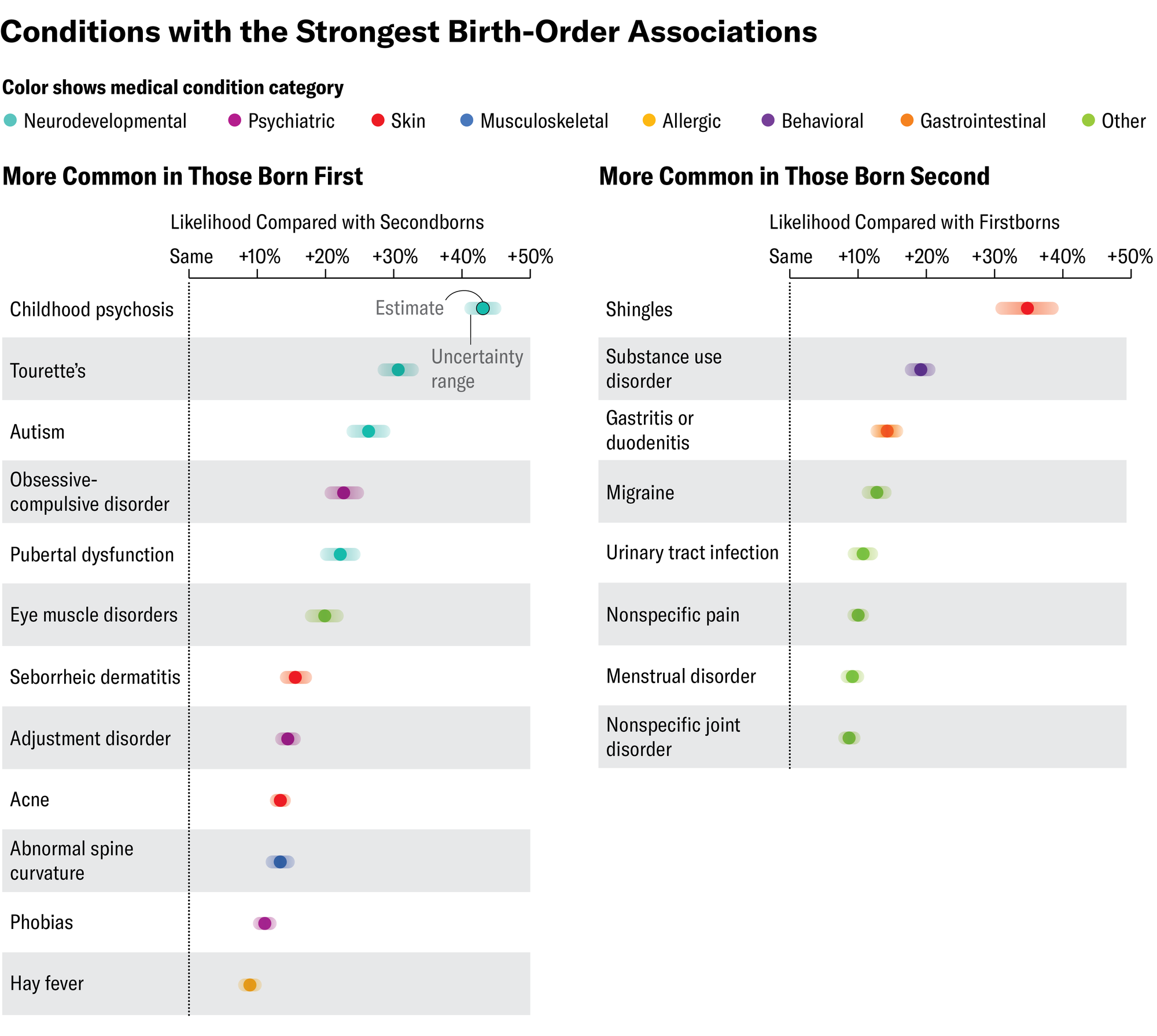
The age gap between siblings also appears to matter. “It seems that smaller age differences [between siblings] are protective against quite a few diseases,” at least relative to larger age gaps, says study co-author Andrey Rzhetsky, a professor of medicine and genetics at the University of Chicago.
Sibling age gaps of less than four years were associated with a lower rate of allergies and asthma—likely because kids who are closer in age interact more often, sharing germs that improve their microbiome. The so-called hygiene hypothesis suggests that lower exposure to allergens in early life makes it more likely that children will develop allergies and asthma—and according to Rzhetsky, this phenomenon is the reason why firstborns and only children are more likely to have these conditions. Firstborns’ immune system may not be exposed to germs from other children in the house as much as that of their younger siblings, especially if the oldest children don’t go to daycare, so they are more likely to overreact to allergens.
The study’s strength is in its large sample size and design, which compared siblings both with their own family members and with siblings within other families to control for socioeconomic status and genetics, says Rodica Damian, an associate professor of social psychology at the University of Houston, who was not involved in the study. “I’m confident that the results that [the researchers] see are probably there, but it’s important to note that they didn’t measure actual disease occurrence,” Damian adds.
Another limitation was that, rather than reviewing the prevalence of health conditions, the researchers looked at administrative insurance claims data, which may reflect that parents are more likely to seek a diagnosis for conditions such as autism, ADHD and allergies for their firstborn than they are for their subsequent child. “You can’t get a diagnosis if you don’t seek it,” Damian notes. And with children born second, parents might be less inclined to visit their doctor for subtle symptoms.
Additionally, the way a person interacts with the health care system might have nothing to do with their likelihood of developing a condition. The study didn’t include uninsured families or those on Medicaid, which means it skewed wealthier and healthier because poorer families may not have access to high quality health care, says Julia M. Rohrer, who studies birth order at Leipzig University in Germany and was not involved in the study.
Nevertheless, Rohrer says, the rigor of the data analysis is apparent. For example, the researchers looked at how “reproductive stoppage”—when parents stop having children after their first child has a severe challenge—affected the data. After excluding those who didn’t have a second child from the group, the increase in autism diagnoses was still present. (Autistic people have a wide range of presentations and support needs.) “The researchers were methodologically thorough. They’re not just trying to tell a nice story but to really get at the right answer,” Rohrer adds.
With regard to second children and the increased incidence of substance use disorders, Damian takes issue with the idea that this association is linked to increased risk-taking behavior in those born second, as the study authors hypothesize. Previous research has shown no link between birth order and risk-taking behavior. Rather, it’s more likely the result of younger siblings being exposed to alcohol and drug use earlier on by their older siblings, she adds.
The variations between siblings identified in the study are small, but at the population level, they can have an effect. “It could be that all of these small effects of birth order come together to make a difference,” Rohrer says.