
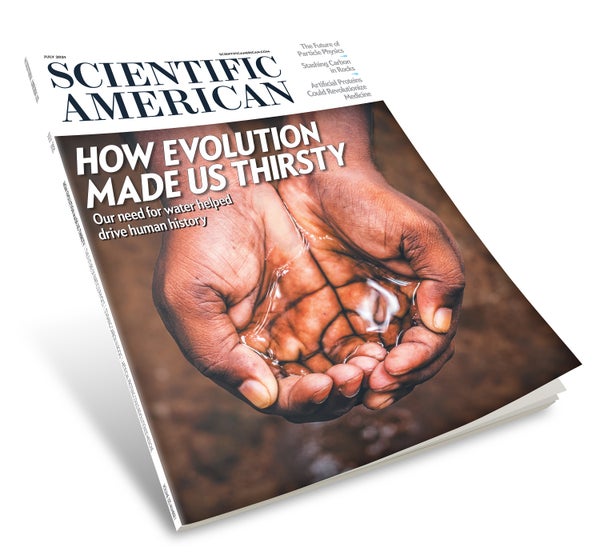
I apologize in advance, but our cover story on human water needs might make you thirsty. I’ve been thinking of it every time I take a drink! We humans are weird animals in a lot of ways, but one of the weirdest is that we’re really bad, physiologically, at staying hydrated. In fact, we are more dependent on water than most other mammals. As biologist Asher Y. Rosinger explains, some of our most distinctive technologies, from clay pots to aqueducts to desalination plants, were developed to let us survive and thrive when and where water is scarce.
One of the great joys of studying, reading about or writing about science is that there’s always something new and mind-bending to learn. The abbreviation “TIL” for “today I learned” is a way to celebrate and share that joy. People use it a lot on social media to introduce some bit of knowledge that delighted them, even if it’s been known for a while and other people might judge them for having learned it just today. It’s such a nice sign of humility and enthusiasm, the opposite of “duh, everybody knows that.” The fact that humans are so thirsty is just one of the things I learned while reviewing this month’s issue.
TIL: The most common state of matter in our universe is plasma. This ionized gas is the fourth state of matter, one we encounter in our daily lives a lot less than solids, liquids or more familiar gases. But plasma is the main ingredient in stars and is most of what exists outside our planet, as well as in some new types of particle accelerators. Electrical engineering professor Chandrashekhar Joshi is developing these tools with the aim of revealing new fundamental physics.
On supporting science journalism
If you're enjoying this article, consider supporting our award-winning journalism by subscribing. By purchasing a subscription you are helping to ensure the future of impactful stories about the discoveries and ideas shaping our world today.
Rock from Earth’s mantle pokes up through the crust in only a few places, including Canada, California, Japan, New Zealand and Oman. A mantle rock called peridotite reacts with water and air once it’s exposed, sucking out carbon dioxide and petrifying it—a lot of it—in newly created minerals. Some geologists estimate that Oman’s rocks could make a big dent in greenhouse gases if this natural process is accelerated, as journalist Douglas Fox reports. Controlling the climate crisis will require many different solutions, and this one is on the verge of scaling up.
Some of the techniques to reverse or prevent soil erosion are also climate solutions, as biologist and science policy expert Jo Handelsman describes. She shares a quick, smart, achievable list of farming, fertilizing and grazing practices that would benefit food producers as well as the planet. Would you pay extra for food that’s labeled for improving carbon storage in the soil? I gladly pay a small premium for coffee grown in bird-friendly conditions, so I’m sure I’d look for that label.
The science of manipulating and even fashioning new proteins is blazing right now, sped up (as much research has been) by the COVID pandemic. In a thrilling story starting here, writer Rowan Jacobsen shows us the race to create better vaccines that could stimulate the immune system more efficiently than the current versions and even prepare our bodies to resist new coronavirus variants. In the photographs for this story, the confident, determined scientists behind this research seem to be saying, “We’ve got this.”
Our final story started with the images. Photographer Grant Delin was amazed by the efficiency and emotion of the vaccine clinic where he got his own COVID vaccine. He teamed up with writer and Scientific American contributing editor Robin Lloyd to capture the drama of people experiencing the most important (and speediest) biomedical achievement of our lifetimes.