
Well, it’s confession time: I’ve been lying to you.
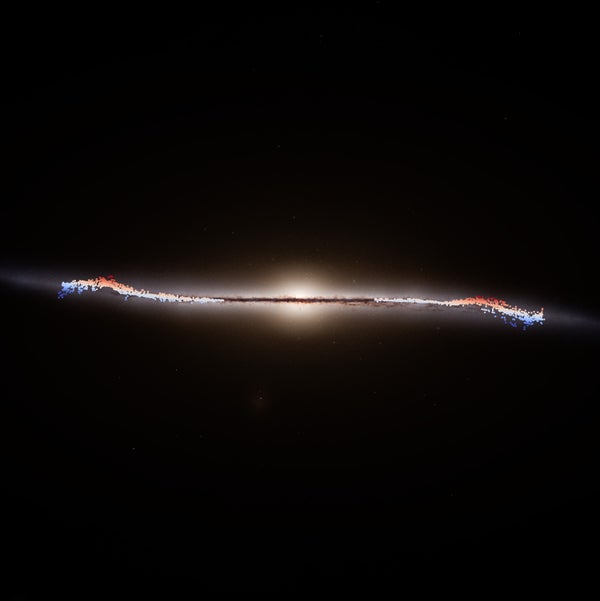
I’ve said on many occasions in this column that our Milky Way galaxy has a flat disk. But it’s not really flat—not according to any reasonable definition of the term, at least.
Now, in my defense, I wasn’t exactly prevaricating; I was simplifying. That’s a perfectly acceptable and even advantageous thing to do in science. When you’re trying to understand or explain some complex thing, it helps to make it as simple as possible so that the math and physics are easier to crack. It’s like assuming, at first, that Earth is a perfect sphere or that the sun contains all the mass in the solar system. Once you work out the basic equations that describe your simplified model, you can gradually add complexity back in—but in a way that makes the problem tractable.
On supporting science journalism
If you're enjoying this article, consider supporting our award-winning journalism by subscribing. By purchasing a subscription you are helping to ensure the future of impactful stories about the discoveries and ideas shaping our world today.
To be fair, when you look at the glow of the Milky Way from a dark site, it does look flat—flat-ish. And lots of similar galaxies and their disks also appear flat.
But many of them, maybe even most of them, aren’t. They’re wiggly and wavy and bendy. Our galaxy is part of this warped group.
First, a quick overview: The Milky Way is classified as a disk galaxy, with a broad, circular collection of stars, gas and dust about 120,000 light-years across. It’s a few thousand light-years thick, so “flat” is at least a decent adjective to use for it. In its center is a bulge of stars, and the entire thing is surrounded by a vast halo of stars and dark matter about a million light-years wide.
That last bit is important. Hang on a minute, and I’ll explain why.
We’ve known for some time that out toward its edges, the disk of the Milky Way is warped—flared up on one side and down on the other rather like the brim of a fedora. Research published in the journal Science in 2019, however, refined this idea considerably. The team of astronomers behind that paper used data from Gaia, a now retired European Space Agency mission that mapped the positions, motions and distances of more than a billion stars. They specifically looked at Gaia’s observations of some 2,400 Cepheid variables—special kinds of stars that pulsate, changing in brightness. The time it takes for a Cepheid’s brightness to change is related to its luminosity, the amount of energy it gives off. By comparing a Cepheid’s intrinsic luminosity with how bright the star appears in our sky, we can calculate its distance.
By mapping so many Cepheids in the galactic plane, the scientists were able to trace the overall shape of the Milky Way’s disk, and they found that the warping really stands out. Our galaxy looks a bit like a vinyl LP that’s been out in the sun too long (kids, ask your grandparents).
What causes such warping? It’s possible for a collision with a smaller galaxy to gravitationally affect the stars in a disk, similar to the way a rock tossed into a pond creates spreading ripples. But astronomers who presented their research in Nature Astronomy in 2023 had a very different idea for what’s been tugging on our galaxy’s brim: dark matter.
As I mentioned earlier, the galaxy is embedded in a halo of stars and dark matter. About a year before publishing their paper, some of the members of this team, along with other astronomers, found that the stellar halo was not spherical, as previously assumed, but instead was elongated and squished a little like a slightly flattened American football. It was also tilted with respect to the plane of the galaxy.
They posited that the more diffuse and nigh-invisible dark matter halo might have the same shape as the stellar halo. By modeling the effects that the much more massive dark matter halo would have if it were structured and oriented in a similar way, they found that this formation naturally created a gravitational field that tugged on the disk, which would explain not just the shape and size of the warp but also its orientation in the disk. Although this isn’t necessarily case closed, they do make a pretty solid argument.
But that’s not the only way our galaxy’s disk is off-kilter. New research shows it’s also corrugated.
Last year another group of scientists used Gaia data to look at 17,000 young stars—which tend to form right in the middle of the galaxy’s disk—and 3,400 Cepheid variables in a region of the Milky Way tens of thousands of light-years across. They found that in the main disk and well into the warped outer parts, there is an up-and-down wave that strongly resembles the corrugation pattern in thick cardboard.
It’s similar to the “wave” fans do at sports games, where they stand up and sit back down in a swell that moves around the stadium. In the Milky Way’s case, the stars in the galaxy move up and down relative to the plane of the disk. Because so many of the stars the researchers measured are young, the scientists think the gas in the galaxy—which forms stars—moves up and down as well. So whatever this pattern is, it’s intrinsic to the structure of the disk.
The cause of this wave isn’t known, but the most likely culprit is, this time, a collision with a smaller galaxy. One potential, even probable, guilty party is the Sagittarius Dwarf Spheroidal galaxy, a small object with a tiny fraction of the Milky Way’s mass. It orbits our galaxy in a nearly vertical loop, diving through the disk as it goes. In 2018 astronomers published a paper in Nature reporting that they had found—again, using Gaia data—wavelike motions in six million stars within approximately 10,000 light-years of the sun, similar to the waves found in the outer disk. They suggest that the Sagittarius galaxy might have created these structures the last time it passed through the disk, several hundred million years ago.
The sun also displays this motion; careful measurements show it has a vertical velocity as it orbits the galactic center. Our solar system bobs up and down with it. Every so often it moves through the disk, but after it reaches some distance from it, the gravity of the disk pulls it back, and the cycle starts again. This element of our star’s motion may be a part of that greater wave.
So, as you can see, I wasn’t really lying before about our flat disk. I was simply eliding over details that aren’t necessary in a discussion of the overall structure of the galaxy. Yet it’s certainly worth looking at these extra effects—they tell us about the history of our Milky Way and can even reveal how the sun plays its part as well.