
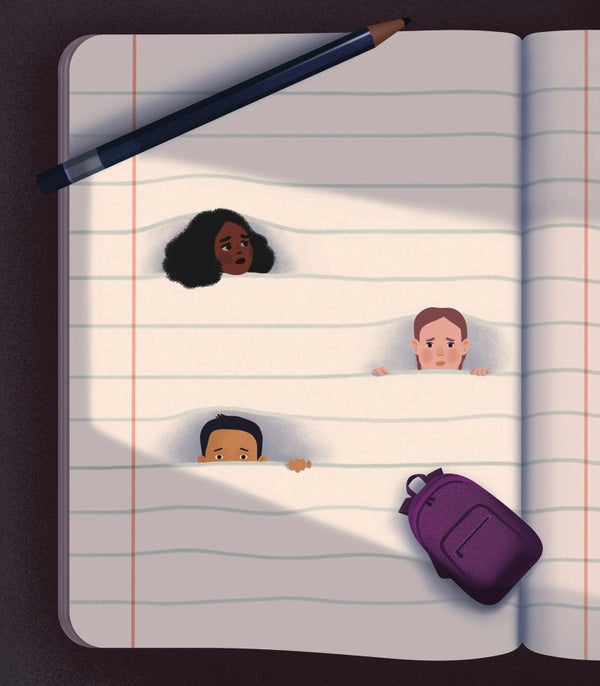
Adults are often embarrassed about asking for aid. It's an act that can make people feel vulnerable. The moment you ask for directions, after all, you reveal that you are lost. Seeking assistance can feel like you are broadcasting your incompetence.
New research suggests young children don't seek help in school, even when they need it, for the same reason. Until relatively recently, psychologists assumed that children did not start to care about their reputation and peers' perceptions until around age nine. But a wave of findings in the past few years has pushed back against that assumption. This research has revealed that youngsters as young as age five care deeply about the way others think about them. In fact, kids sometimes go so far as to cheat at simple games to look smart.
Our research suggests that as early as age seven, children begin to connect asking for help with looking incompetent in front of others. At some point, every child struggles in the classroom. But if they are afraid to ask for help because their classmates are watching, learning will suffer.
On supporting science journalism
If you're enjoying this article, consider supporting our award-winning journalism by subscribing. By purchasing a subscription you are helping to ensure the future of impactful stories about the discoveries and ideas shaping our world today.
To learn more about how children think about reputation, we applied a classic technique from developmental psychology. Kids' reasoning about the world around them can be quite sophisticated, but they can't always explain what's going on in their mind. So we crafted simple stories and then asked children questions about these scenarios to allow kids to showcase their thinking.
Across several studies, we asked 576 children, ages four to nine, to predict the behavior of two kids in a story. One of the characters genuinely wanted to be smart, and the other merely wanted to seem smart to others. In one study, we told children that both kids did poorly on a test. We then asked which of these characters would be more likely to raise their hand in front of their class to ask the teacher for help.
The four-year-olds were equally likely to choose either of the two kids as the one who would seek help. But by age seven or eight, children thought that the kid who wanted to seem smart would be less likely to ask for assistance. And children's expectations were truly “reputational” in nature—they were specifically thinking about how the characters would act in front of peers. When assistance could be sought privately (on a computer rather than in person), children thought both characters were equally likely to ask for it.
We also asked kids about other scenarios. We found that they recognize several more behaviors that might make a child appear less smart in front of fellow kids, such as admitting to failure or modestly downplaying successes. Children are therefore acutely aware of several ways in which a person's actions might make them appear less astute in the eyes of others.
When children themselves are the ones struggling, it seems quite possible they, too, might avoid seeking out help when others are present, given our findings. Their reluctance could seriously impede academic progress. To improve in any domain, one must work hard, take on challenging tasks (even if those tasks might lead to struggle or failure), and ask questions. These efforts can be difficult when someone is concerned with their appearance to others. Research suggests that we may underestimate just how uncomfortable others feel when they ask for assistance.
Such reputational barriers likely require reputation-based solutions. First, adults should lower the social stakes of seeking help. For instance, teachers could give children more opportunities to seek assistance privately by making themselves available to students for one-on-one conversations while classmates tackle group work. Teachers should couple this effort with steps that help students perceive asking questions in front of others as normal, positive behavior. For example, instructors could create activities in which each student becomes an “expert” on a different topic, and then children must ask one another for help to master all of the material.
Seeking help could even be framed as socially desirable. Parents could point out how a child's question kicked off a valuable conversation in which the entire family got to talk and learn together. Adults could praise kids for seeking assistance. These responses send a strong signal that other people value a willingness to ask for aid and that seeking help is part of a path to success.”