
“If you had to choose a moment in time to be born, any time in human history, and you didn't know ahead of time what nationality you were or what gender or what your economic status might be,” what time would you choose? Paleolithic? Neolithic? Ancient Greece or Rome? Medieval times? Elizabethan England? Colonial America? The 1950s? “You'd choose today,” answered the man who posed this question in an April 2016 speech, President Barack Obama. “We are fortunate to be living in the most peaceful, most prosperous, most progressive era in human history,” he opined, adding that “it's been decades since the last war between major powers. More people live in democracies. We're wealthier and healthier and better educated, with a global economy that has lifted up more than a billion people from extreme poverty.”
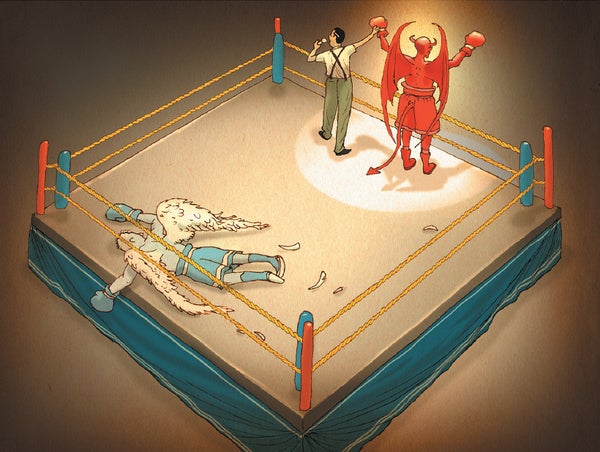
If these facts are true—and they are (see, for example, economist Max Roser's ourworldindata.org and the data at humanprogress.org aggregated from the World Bank, the United Nations, the Organization for Economic Co-operation and Development, and Eurostat)—then why the doom and gloom heaped on us by politicians and pundits on both sides of the political aisle? First, news media outlets are far more likely to report bad news than good, simply because that is what they have been tasked to do. Another day in Turkey without a coup goes unreported, but just try and take over a country without the world's media covering it. Second, as psychologist Roy F. Baumeister explained it in the title of a now classic 2001 paper he co-authored in the journal Review of General Psychology, “Bad Is Stronger Than Good.” Reviewing a wide range of evidence across many domains of life, the authors found that “bad emotions, bad parents, and bad feedback have more impact than good ones, and bad information is processed more thoroughly than good. Bad impressions and bad stereotypes are quicker to form and more resistant to disconfirmation than good ones.” Why?
One answer, I suggest, is in the psychology of loss aversion, in which, on average, losses hurt twice as much as gains feel good. To get someone to take a gamble, the potential payoff must be about twice the potential loss. Why? Because of the endowment effect, which is the tendency to value what we own more than what we do not own. In one experiment, for example, economist Richard Thaler gave subjects a coffee mug valued at $6 and asked them what they would sell it for. The median price was $5.25. Another group of subjects were asked how much they would pay for the same mug. The median price was less than $2.75. Loss aversion and the endowment effect are reinforced by the status quo bias, or the tendency to opt for whatever it is we are accustomed to. For example, we tend to prefer existing personal, social, economic and political arrangements over proposed alternatives.
On supporting science journalism
If you're enjoying this article, consider supporting our award-winning journalism by subscribing. By purchasing a subscription you are helping to ensure the future of impactful stories about the discoveries and ideas shaping our world today.
Why is our psychology wired this way? Evolution. According to Harvard University psychologist Steven Pinker in a 2015 article in Cato's Letter on “The Psychology of Pessimism,” in our evolutionary past there was an asymmetry of payoffs in which the fitness cost of overreacting to a threat was less than the fitness cost of underreacting. The world was more dangerous in our evolutionary past, so it paid to be risk-averse and highly sensitive to threats, and if things were good, then the status quo was worth maintaining.
All of which helps to explain much political pessimism, such as what we are bombarded with every election. In his book Moral, Believing Animals (Oxford University Press, 2003), sociologist Christian Smith reviews the many narratives politicians and pundits construct to reinforce the moral foundations that most concern each side. It boils down to a simple template of “once upon a time things were bad, and now they're good thanks to our party” or “once upon a time things were good, but now they're bad thanks to the other party.” Sound familiar? In 2008 Obama campaigned on “change we need” after eight years of a Republican presidency. In 2016 Donald Trump campaigned on making America “great again” after eight years of a Democratic presidency.
As John Stuart Mill observed in 1859: “A party of order or stability, and a party of progress or reform, are both necessary elements of a healthy state of political life.”