
On supporting science journalism
If you're enjoying this article, consider supporting our award-winning journalism by subscribing. By purchasing a subscription you are helping to ensure the future of impactful stories about the discoveries and ideas shaping our world today.
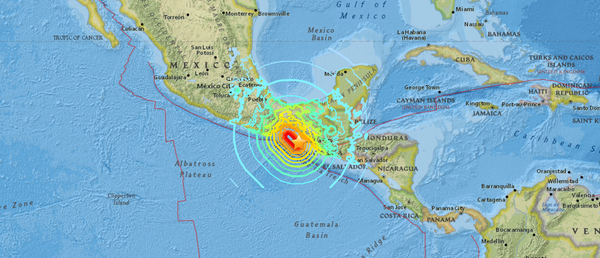
Late Thursday night the biggest earthquake to hit Mexico in 100 years shook the country—and a large part of the globe. The magnitude 8.1 temblor was centered just off the southern end of Mexico’s Pacific coast. It was stronger than the 1985 quake that killed thousands of people in Mexico City. Last night’s quake took 32 lives, according to news reports, and the toll may rise.
The quake happened about 54 miles offshore of the southern state of Chiapas, just to the east of an undersea geologic feature called the Middle America Trench. Here, several parts of the planet’s crust are colliding. This quake, however, probably occurred within one of those crust slabs, not at their junction, according to the U.S. Geological Survey’s Earthquake Hazards Program. The slab fractured about 43 miles below the surface, which is deeper than the trench zone.
The shaking could be detected by seismic instruments across North America and in Asia. It was profound in Mexico City, more than 450 miles away, where warning sirens split the night, buildings shivered, and streetlights and stone monuments swayed back and forth. The noticeable motion in the city is because the earthquake waves were amplified by the loose ground beneath the metropolis, noted Jascha Polet, a seismologist at California Polytechnic State University in Pomona, in a Twitter post. The city is built on sediments from an ancient lake bed.