
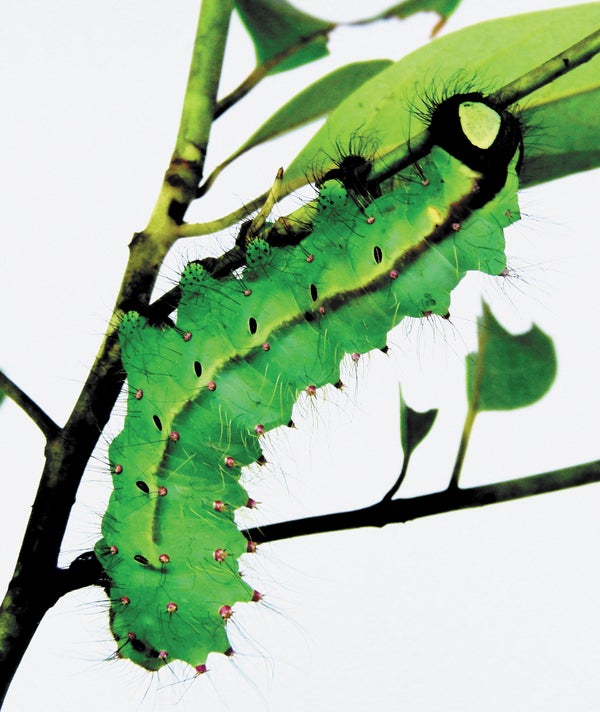
Many research groups are testing “ink” made from silk proteins to print human tissues, implants and perhaps even organs. The process is a less costly alternative to conventional 3-D printing with collagen, a key protein in the body's natural scaffolding. Researchers in Assam, a state in India, are investigating using local silkworm species for the task—they recently submitted a patent for bioinks using a combination of proteins extracted from local species Antheraea assamensis and Samia ricini, as well as the commonly used Bombyx mori. The scientists have woven them into synthetic structures ranging from blood vessels to liver lobes; in a paper published in September in ACS Applied Materials & Interfaces, they described mimicking the cartilage of an entire ear.
Silk is a natural polymer, a substance with long, repeating molecular chains. It is mechanically strong and completely biodegradable, well suited for applications in tissue engineering. To use it, researchers draw liquid silk from the silkworm's glands or dissolve silk fibers in solvents. They carefully mix the gelatinous liquid with a patient's stem cells, then build structures layer by layer with a 3-D printer. After implantation, the cells grow and replace the silken scaffold, which eventually degenerates into amino acids.
Extracting and purifying collagen from animal remains, a common medical source, is complex and expensive. “Compared with collagen, silks have an immense advantage in terms of supply and processing. Local sourcing is also a clear plus in their use in India,” says David Kaplan, who heads the department of biomedical engineering at Tufts University and is not involved in the new research. Silk from domesticated silkworms has been used widely in bioprinting, but Biman B. Mandal's laboratory at the Indian Institute of Technology Guwahati in Assam is among the first to incorporate wild silks.
On supporting science journalism
If you're enjoying this article, consider supporting our award-winning journalism by subscribing. By purchasing a subscription you are helping to ensure the future of impactful stories about the discoveries and ideas shaping our world today.
These silks are ideal candidates for bioinks because they can be combined to build strong and resilient scaffolds, says Mandal, the lab's principal investigator. “This is important, for example, when making bone tissue,” he adds.
Researchers commonly use chemicals to cross-link silk polymer chains, which helps to maintain a 3-D structure, but Mandal's group found a blend of silks and gelatin that works without many of those chemicals. Also, the wild silk has spots that cells naturally attach to, he says: “For other silks, they have to be decorated with chemicals that promote adherence. This can be complicated, expensive and potentially toxic.” Kaplan agrees, adding that these binding spots allow cells to adhere rapidly to the silk matrix.
Mandal and his collaborators have already created prototype structures, including bone and soft tissues such as those of the heart and liver. Reconstructing a human knee meniscus and the complex tissue at the ends of a bone will be next.