
Key concepts
Physics
Wind power
Aerodynamics
Introduction
Have you ever seen a wind turbine? Wind turbines are large towers with blades on top that are spun by the wind. They are one source of clean, renewable energy. They use the movement from the wind-spun blades to generate electricity. But in order for the turbines to work best, environmental engineers have to figure out where to put wind turbines so that they get the best exposure to steady, consistent winds. In this project you will play the role of an environmental engineer and figure out whether it is a good idea to put wind turbines near tall buildings.
Background
Have you ever watched water flow through a stream or river? If there are no obstructions in the way, the water probably flows in a smooth, straight line. This is called laminar flow. If there is something in the water, such as a rock or a branch, however, this causes the water to swirl and tumble as it flows by. This is called turbulent flow. The individual "swirls" are called vortices (the plural of vortex).
On supporting science journalism
If you're enjoying this article, consider supporting our award-winning journalism by subscribing. By purchasing a subscription you are helping to ensure the future of impactful stories about the discoveries and ideas shaping our world today.
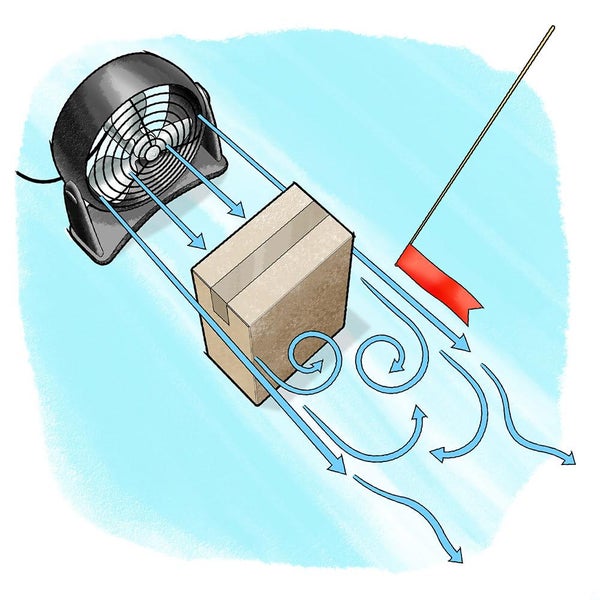
The same thing happens in air when wind blows around a tall structure, such as a building or a tree. This is an important factor to consider when placing wind turbines, because they will generate the most power from steady winds that blow in the same direction. Inconsistent, turbulent flow can decrease power output or even damage the turbines. In this project you will use cardboard boxes to represent "buildings" and see how they affect the flow of "wind" blowing from a fan.
Of course, turbulent flow in air is much harder for us to see than a turbulent stream! Sometimes scientists do controlled experiments using colored smoke to observe airflow. In this project you will use a streamer tied to the end of a stick to visualize the airflow.
Materials
Fan
Stick or rod, a few feet long
Streamer, a few inches long
Cardboard box (The size of the box depends on the size of your fan—the larger the fan, the larger the box. If the box is empty, you might need to put something inside it to weigh it down.)
Preparation
Set up the cardboard box a few feet from the fan, with the fan pointed at the box.
Tie the streamer to the end of the stick.
Procedure
Turn the fan on.
Standing to the side so your body does not interfere with the airflow, use the stick to hold the streamer "upwind" of the box (on the side of the box facing the fan). Which direction does the streamer blow? Is its motion consistent? Do you think this shows turbulent or laminar flow?
Now move the streamer to the "downwind" side of the box (on the side of the box facing away from the fan) but hold it fairly close to the box. What happens to the streamer now? Is the flow in this area turbulent or laminar?
Gradually move the streamer farther and farther away from the box on the downwind side. What happens as you move the streamer farther away from the box? What does that suggest about the airflow?
What conclusions can you draw about the airflow near tall structures? How would this affect the placement of wind turbines?
Extra: See how your results change if you change the speed of the fan.
Extra: Try the same activity with different size boxes. How do the results change?
Extra: Try the activity with different or irregularly shaped objects, such as furniture or houseplants. How do the results change?
Extra: Take your stick and streamer outside on a windy day. Determine which way the wind is blowing and find large objects such as buildings or trees to test the airflow. What happens if you hold the streamer near the corner of a building or behind a tree?
[break]
Observations and results
When you held the streamer "upwind" of the box, you should have seen it blow consistently in one direction, away from the fan. This is because the flow upwind of the structure is laminar (or straight). When you held the streamer just "downwind" of the box, however, it might have fluttered around in all directions or even blown backward. This is because the structure interrupts the smooth flow and causes turbulence. As you gradually moved the streamer away on the downwind side, its motion should have again become consistent, blowing away from the fan. This is because the flow gradually "recovers" and becomes laminar again after the turbulence is introduced.
This is important when placing wind turbines because they should not be too close to large buildings on the "downwind" side. The buildings will create turbulent flow, which will decrease the performance of the wind turbines.
More to explore
Wild Winds: Detecting Turbulence around Structures, from Science Buddies
Whitewater Rafting by Rasheed, Kohner, Scotty and JB, from PBS Kids
Wind Turbines, from Explain That Stuff
Science Activities for All Ages!, from Science Buddies
This activity brought to you in partnership with Science Buddies

