
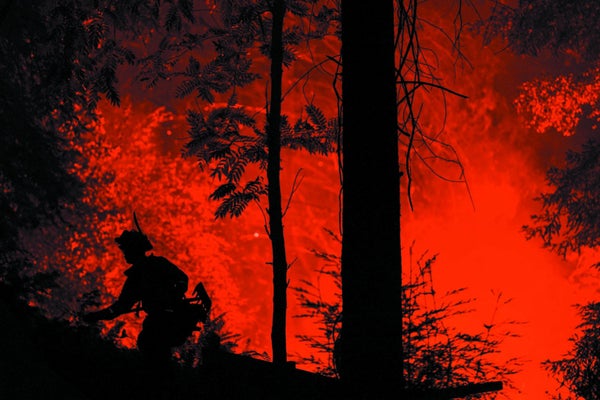
California's August Complex Fire tore through more than 1,600 square miles of forest last summer, igniting nearly every tree in its path. It was the largest wildfire in the state's recorded history, breaking the record previously set in 2018—which had broken the one set the year before. In the fire's aftermath, land managers confronting the effects of steadily larger and hotter infernos burning enormous swaths of forest must determine where to most efficiently plant new trees.
A predictive mapping model recently described in Ecological Applications could inform these decisions, saving time and expense. Called the Postfire Spatial Conifer Restoration Planning Tool, it incorporates data on where conifers are least likely to regenerate naturally and suggests where planting would pack the biggest punch. The tool can “target where seedlings are needed most, where the forest isn't going to come back on its own, where we need to intervene if we want to maintain forests,” says lead author Joseph Stewart, an ecologist at the University of California, Davis.
To develop the model, Stewart and his colleagues catalogued data collected from more than 1,200 study plots in 19 areas that burned between 2004 and 2012. They combined these data with information on precipitation, topography, climate, forest composition and burn severity. They also included how many seeds sample conifer trees produced in 216 locations over 18 years, assessing whether the trees release different numbers of seeds after a fire.
On supporting science journalism
If you're enjoying this article, consider supporting our award-winning journalism by subscribing. By purchasing a subscription you are helping to ensure the future of impactful stories about the discoveries and ideas shaping our world today.
Land managers can plug details from a specific area into the model; they would find, for example, that in low- to moderate-elevation forests that happen to experience drought after a fire, conifers are much less likely to regenerate naturally.
The tool's potential benefits are significant, says Kimberley Davis, a conservation scientist at the University of Montana, who was not involved in the study. Land managers face ever larger burn areas, some with limited natural forest regeneration. “Helping managers to quickly understand where natural regeneration is likely or not will inform the prioritization of limited resources for reforestation efforts,” she says.
Those managers will still have to make hard decisions, such as which species to plant in areas that may experience warmer and drier conditions resulting from climate change, but the model provides some research-based guidance to help the forests recover. And managers of areas affected by the August Complex Fire have time to develop their plans: seedlings they ordered at the time will arrive in 2022.