
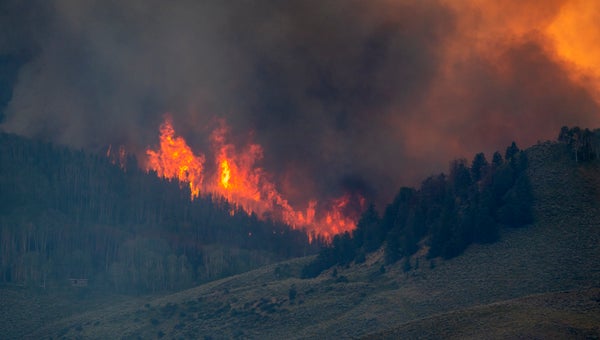
Wildfire “red flag” warnings are in effect for a huge swath of the central U.S., covering an area stretching all the way from northern and western Texas to the Canadian borders of North Dakota and Minnesota. Altogether, areas of Texas, New Mexico, Colorado, Kansas, North and South Dakota, Minnesota, Nebraska and Oklahoma have red flag warnings in place.
These warnings are issued by the National Weather Service when there are ripe conditions for increased risk of wildfires—such conditions include low humidity, strong winds and low moisture on the ground. Regional NWS offices create their own criteria, but typically forecasters look for relative humidity levels of lower than 15 to 25 percent, which means the air is holding on to less water vapor than usual. In addition, winds of at least 15 to 25 miles per hour, measured 20 feet above the ground, can also contribute to the rapid spread of fires. The third condition for the warning is met if there are low levels of moisture in small vegetation, such as grass, leaves and mulch.
Todd Hamilton, a National Weather Service meteorologist in North Dakota, says that the state saw unseasonably warm and dry weather in its western regions on Tuesday and that that has now shifted to the east. In North Dakota, having red flag warnings in effect in late April and early May is not abnormal, he says.
On supporting science journalism
If you're enjoying this article, consider supporting our award-winning journalism by subscribing. By purchasing a subscription you are helping to ensure the future of impactful stories about the discoveries and ideas shaping our world today.
“We expect those type of changes this time of year in North Dakota, so nothing out of the ordinary,” he explains. “With our temperatures warming this spring, we’re slower to green up than areas to our south, so this is our time of year where we can get red flag warnings.”
Still, the threat of wildfires across the U.S. is increasing, driven by climate change. According to NASA, warmer nighttime temperatures have contributed to more frequent, more intense fires because blazes have been able to spread more quickly after the sun has set than they were in the past. One 2025 study, published in Nature Communications, found that the chances of particularly extreme fires has increased by up to 152 percent since 1900. And a 2024 paper found that extreme wildfires are roughly twice as common as they were 20 years ago.
People living in areas with red flag warnings are asked to take extra precautions to avoid accidentally igniting a fire. These include not throwing cigarettes or matches out of moving vehicles and covering burn barrels with weighted metal covers. Any outdoor fires should be extinguished properly, such as by using plenty of water and stirring until everything is cold to the touch. No fires should be left unattended.
The warnings come as wildfires are already burning in the U.S. Southeast. Georgia governor Brian Kemp declared a state of emergency in 91 counties inside the state on Wednesday; he said the number of fires this year has already surpassed Georgia’s five-year average. According to the state’s forestry commission, the blazes have already engulfed more than 35,000 acres of land. Dozens of wildfires are also burning in northern and central Florida, from Tampa up to Pensacola in the state’s northwest and Jacksonville in its northeast.
Drought is making matters worse: data collected by the U.S. Drought Monitor indicates that many of the affected areas are undergoing extreme or exceptional drought conditions.