
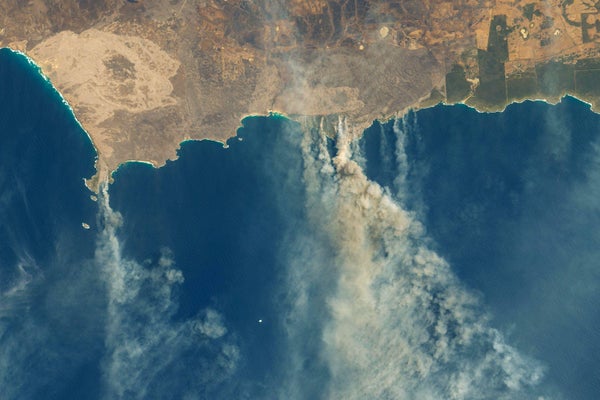
Record-breaking wildfires in Australia at the start of the year caused an extraordinary weather phenomenon. They spawned a spree of towering fire-induced thunderclouds, which catapulted smoke 20 miles into the atmosphere.
Almost 12 months later, some of that smoke is still drifting around the planet.
These “pyrocumulonimbus” events, or “pyroCbs,” are impressive but not uncommon. They form when the heat from a wildfire strengthens currents of rising air in the atmosphere, generating large storm clouds and sending smoke spiraling skyward.
On supporting science journalism
If you're enjoying this article, consider supporting our award-winning journalism by subscribing. By purchasing a subscription you are helping to ensure the future of impactful stories about the discoveries and ideas shaping our world today.
But the “Australian New Year’s event,” as scientists have dubbed it, is easily the largest on record. Recent research suggests it launched a half-million metric tons of aerosol particles into the stratosphere.
That’s on the order of a moderate volcanic eruption, one recent study suggests—enough to potentially have a small effect on the sun’s radiation. It’s about three times more than the previous record-breaker, a massive pyrocumulonimbus event that occurred during western Canada’s wildfire season in 2017.
“It exceeded this previously unprecedented event at almost every level,” said David Peterson, a meteorologist with the U.S. Naval Research Laboratory, at a news conference on pyroCb research, hosted Friday at the annual fall meeting of the American Geophysical Union. “So now we’re at a whole new level of pyroCb activity.”
Huge pyroCb events are at the cutting edge of wildfire research. Scientists are investigating how exactly they form and whether climate change—which is driving bigger, more frequent wildfires across the world—might make them happen more often.
That’s important to watch, as these events also could influence their surrounding environments. The smoke they inject into the atmosphere could potentially affect local climate and weather patterns, from thunderstorms to local temperatures to the jet stream movement.
It’s an area of research where scientists are just beginning to scratch the surface.
“We are very much in the early stages of understanding the role that pyroCbs play in the climate system,” Peterson said. “We’ve learned a lot about pyroCb activity itself in the past few years.
“But in terms of what these large plumes mean for the climate system, and just how pyroCb activity may evolve in a changing climate, that’s very much in its infancy.”
More questions than answers
Last year, scientists took a literal headfirst dive into the physics of pyroCb events.
A joint initiative by NOAA and NASA, known as the FIREX-AQ project, sent an aircraft into the heart of a fire-driven thunderstorm that formed over the Williams Flats in Washington state in the summer of 2019. The aircraft was equipped to measure the physical and chemical properties of the smoke it passed through.
“So what we have from the sampling of this pyroCb are a whole set of brand-new science questions that we weren’t able to ask and answer before,” said Laura Thapa, a doctoral student at UCLA, who participated in the project and also presented at the AGU conference.
The project gave scientists new insight into how pyroCbs form and how they launch smoke so high into the atmosphere. It’s also helping scientists better understand the way wildfire smoke changes a cloud’s properties and what that might mean for local weather patterns.
For now, there are a lot of theories and few answers. But there are several ways experts believe large pyroCb events could affect the weather.
For one thing, huge clouds of smoke have the potential to block some of the sun’s radiation, temporarily cooling the Earth below—similar to a large volcanic eruption. But this phenomenon requires an enormous, thick plume of smoke. It’s still unclear whether even the Australian New Year’s event was big enough to affect local temperatures.
In general, research on temperatures and pyroCb events is scant.
“I think we know almost nothing,” said Mike Fromm, another meteorologist at the Naval Research Laboratory, who also presented research at AGU.
There are other potential links to local weather patterns. Some research suggests smoke particles could lengthen the lives of thunderclouds, Fromm noted.
And it’s possible—although not certain—that a large enough smoke plume could affect the flow of much bigger atmospheric patterns, such as the jet stream.
A big pyroCb event can generate smoke plumes that spin as they move through the stratosphere—it happened with the Australian New Year’s event. The heat from the wildfire causes the air to move this way.
It’s possible these spinning plumes can get caught up in large-scale atmospheric systems, such as the jet stream, creating a kind of vortex in the system as it moves along. Satellite images from a 2015 event over western North America suggest it’s happened before, according to Fromm.
Large atmospheric systems like the jet stream help influence local weather patterns as they flow around the Earth.
Models can help scientists better understand the way pyroCb events may influence the weather. Wildfire smoke plumes involve a lot of complicated, fine-scale physics that often are challenging to simulate. The same is true for clouds. But researchers are working on better representing these events in weather and climate models.
At the same time, scientists are still questioning how these events might change—if at all—with continued global warming.
Climate change is driving bigger, more frequent wildfires in places such as Australia and western North America. But scientists aren’t sure what that means for pyroCbs.
Hot, dry, windy weather conditions often make it more likely a pyroCb will form over a wildfire, Fromm pointed out. So if a fire-prone area gets hotter, drier or windier in the future, it’s a “pretty safe bet” that more of these events will happen, he said.
But Peterson cautioned that other weather variables also play a role in whether a thundercloud can form at all.
Data from projects like FIREX-AQ will help scientists better understand how and why these events form, he added.
“I think combining what we’ve done in the past ... and what we have from these new observations, we can say a lot more going forward and have a lot better handle on being able to predict pyroCb in the future,” he said.
Reprinted from Climatewire with permission from E&E News. E&E provides daily coverage of essential energy and environmental news at www.eenews.net.
