
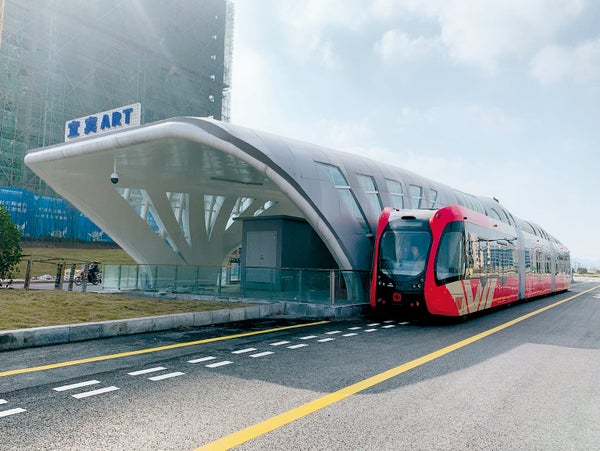
Joe Ciresi used to drive about 30 miles into Philadelphia for work every day. “It took anywhere from an hour and a half to three hours, depending on traffic,” he recounts. “I said, ‘This is insanity.’” Now a Pennsylvania state representative, Ciresi has been thinking about how to reduce the number of cars on the road. Recently he and his staff were looking at public transport options and encountered a video about trackless trams created by Peter Newman, a researcher at the Curtin University Sustainability Policy Institute in Perth, Australia.
Public transportation is essential to reducing gridlock and emissions on highways and in cities, Newman says. But trains require extensive infrastructure spending, and historically buses have been unpopular because of potentially bumpy and traffic-slowed rides. Now, however, new technology can let buslike vehicles run on roads for a ride resembling the more popular experience of rail travel—without rails. Newman describes one example already running in China: a self-driving electric bus with optical sensors that let it follow a white line painted on the road. Its hydraulic suspension system, a type often used in trains, eases jolts.
“What impressed me in China was that the ride quality was ... equivalent to what I had experienced on a modern light rail, where everything is fixed on a steel track,” Newman says. To emphasize the technological advances making these souped-up buses more pleasant to ride, Newman advocates officially calling them “trackless trams.” He is working to bring them to Perth and says they are being studied or tried out in Zimbabwe and Qatar. “I think you'll find that in the next decade [the idea will] take off very quickly,” he says.
On supporting science journalism
If you're enjoying this article, consider supporting our award-winning journalism by subscribing. By purchasing a subscription you are helping to ensure the future of impactful stories about the discoveries and ideas shaping our world today.
Trackless trams avoid the need for expensive rail systems, but they do require some changes to infrastructure. “Most of the cost of these new systems that we're building is in that cost of constructing the right of way,” says Yale Wong, a transportation researcher at the University of Sydney. In Ciresi's area of Pennsylvania, for example, creating a dedicated trackless tram lane would mean modifying about a dozen overpasses for the specialized vehicles. Wong notes that these changes could also support a dedicated bus route—but “people just don't like buses.” He suggests that a form of transit associated with rails (and with shiny new technology) has a better chance of earning the public's enthusiasm.
That is why Ciresi hopes to demonstrate trackless trams in the U.S. before pushing for infrastructure changes. “We do a test run, maybe for five miles ... and we find out if this is worth the investment,” he says. “I think, as Americans, we like to see the product and be able to hold, touch, feel and give our opinion of it.”