New Issue: Science’s Impossible Questions. Read Now

Win-Wins Everywhere

Join Our Community of Science Lovers!


On supporting science journalism

If you're enjoying this article, consider supporting our award-winning journalism by subscribing. By purchasing a subscription you are helping to ensure the future of impactful stories about the discoveries and ideas shaping our world today.


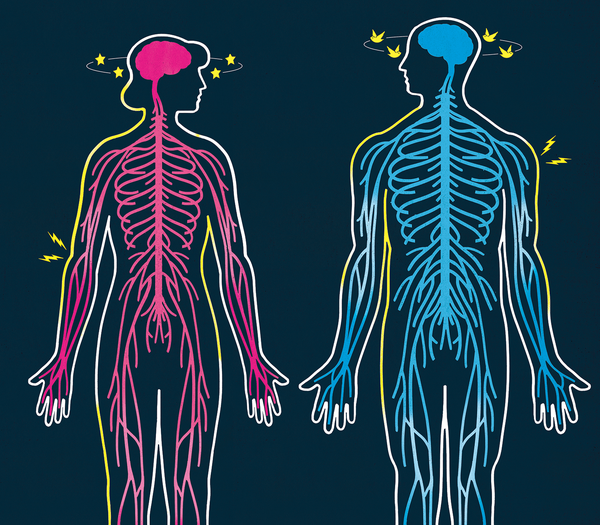
In a special report on sex and gender in the September 2017 issue of Scientific American, Stanford University professor of medicine Marcia L. Stefanick wrote that “medical researchers and physicians have a lot of untangling to do before they can offer better health care to women.” The tangle she was referring to? The woeful lack of data on how women experience diseases, how they respond to medications and the widespread bias in the medical field when diagnosing women. Change in a positive direction over the past several decades has been slow but steady, leading to more women in clinical trials and new rules that require scientists to justify their choices in the sex of their experimental animals. And these improvements have been leading to some fascinating new information about how the sexes are wired. For example, as Amber Dance writes in “The Pain Gap,” the latest findings suggest that genetics, hormone levels and anatomical development may all be at work in how individuals across the sexes experience pain. Such discoveries illuminate beyond women’s experience, too. “A deeper understanding of sex differences will improve health directives for men,” Stefanick writes. It’s a win-win.

Elsewhere in this issue, social media is having a dramatic impact on how clinical trials are recruiting and are being run—patients and their families are having more of a say than ever (see “A Question of Control”). And a theoretical physicist and microbiologist have teamed up to make the case that those who forgo vaccinations should be barred from public or private schools, workplaces or other institutions in the U.S. (see “Opting Out of Vaccines Should Opt You Out of American Society”). After all, your vaccination protects not only you from deadly disease but all those around you. Sounds like another win-win.

Andrea Gawrylewski is chief newsletter editor at Scientific American. She writes the daily Today in Science newsletter and oversees all other newsletters at the magazine. In addition, she manages all special editions and in the past was the editor for Scientific American Mind, Scientific American Space & Physics and Scientific American Health & Medicine. Gawrylewski got her start in journalism at the Scientist magazine, where she was a features writer and editor for "hot" research papers in the life sciences. She spent more than six years in educational publishing, editing books for higher education in biology, environmental science and nutrition. She holds a master's degree in earth science and a master's degree in journalism, both from Columbia University, home of the Pulitzer Prize.

More by Andrea Gawrylewski
SA Health & Medicine Vol 1 Issue 3This article was published with the title “Win-Wins Everywhere” in SA Health & Medicine Vol. 1 No. 3 (), p. 2
doi:10.1038/scientificamerican062019-10EaGKqSsaU5wRwbRaFbx1

Subscribe to Support Independent Journalism

Great science journalism requires human expertise, time, effort and creativity. And it costs money. That’s why I and the journalists here at Scientific American hope you’ll join our community.

When you subscribe, you are supporting staff and freelance journalists who are passionate about telling science stories that are true, important and compelling. Our editors and reporters are often experts in their fields, which means they understand the nuances of big discoveries and can untangle the breakthroughs from the hype. With a subscription, you are also supporting rigorous fact-checking to ensure the words we publish are precise and accurate. And you’re supporting original illustrations, graphics and photos that bring you closer to an advanced laboratory, an ice sheet in Antarctica or a space mission in orbit. You’re helping us craft other types of high-quality journalism as well: Our newsletters are carefully written, edited and curated by staffers you have or will come to know and love. Our Science Quickly podcast is based on original reporting, collaboration with editors and scientists and exacting production.

Subscriptions keep this engine running so we can continue to deliver thoughtful, rigorous and independent science journalism to you. In an era of viral misinformation, this work is crucial. If you value what we do, I hope you’ll consider joining us as a subscriber

Thank you,

Jeanna Bryner, Editor in Chief, Scientific American

Subscribe