
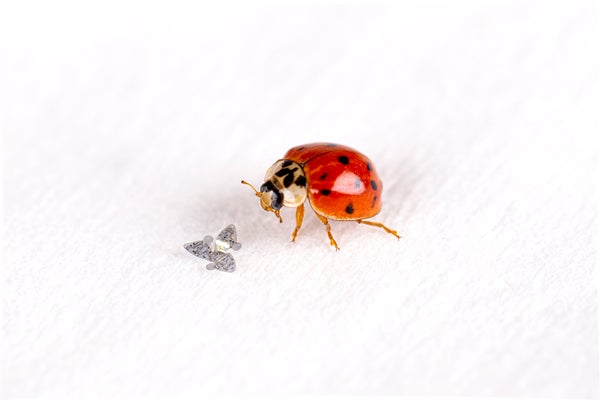
As spring ends, maple trees begin to unfetter winged seeds that flutter and swirl from branches to land gently on the ground. Inspired by the aerodynamics of these helicoptering pods, as well as other gliding, spinning tree seeds, engineers claim to have crafted the smallest ever wind-borne machines, which they call “microfliers.”
The largest versions of these winged devices, which the researchers sometimes refer to as “mesofliers” or “macrofliers,” are about two millimeters in length, roughly the size of a fruit fly. The smallest microfliers are a quarter that size. That makes them tiny enough to drift like seeds—but still large enough to tote compact microchips with sensors that gather information about the devices’ surroundings and wireless transmitters that send these data to scientists. Swarms of microfliers could be dropped from the sky to catch the wind and scatter across vast areas, says John Rogers, a physical chemist at Northwestern University. “Then you can exploit them as a network of sensors to map environmental contamination, disease spread, biohazards or other things,” he adds. Rogers and his colleagues describe the machines in a Nature paper published on Wednesday.
To help their contraptions descend as sedately and stably as possible, the engineers started by analyzing the shapes of airborne seeds such as those of big-leaf maples, box elders and woody vines in the genus Tristellateia. Then they used computers to simulate the airflow around similar shapes with slightly different geometries. This process allowed the researchers to refine a variety of designs until the microfliers fell even more steadily and slowly than their botanical counterparts.
On supporting science journalism
If you're enjoying this article, consider supporting our award-winning journalism by subscribing. By purchasing a subscription you are helping to ensure the future of impactful stories about the discoveries and ideas shaping our world today.
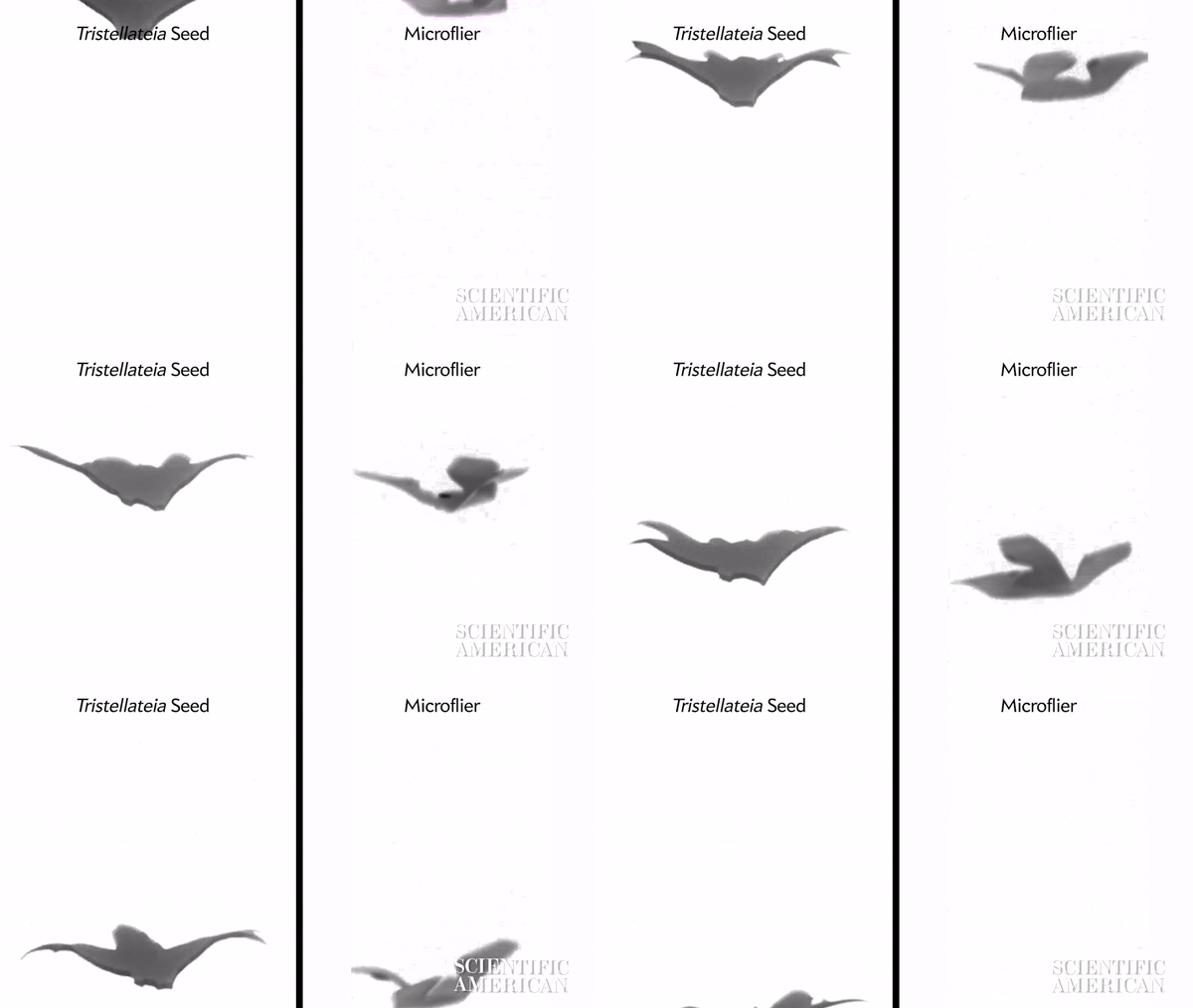
Some microfliers were designed to spin like the seeds of woody vines in the genus Tristellateia. Credit: Northwestern University
For the devices to monitor a large area, Rogers and his colleagues would have to produce them in vast numbers—a task that would be easier if they could use existing facilities and processes for manufacturing integrated circuits. But these production methods primarily produce flat shapes, and the microflier designs are three-dimensional. To solve this problem, the engineers fabricated two-dimensional microfliers, then bonded them to a layer of a stretchy material called an elastomer. When they allowed this material to relax, it scrunched up, pulling the tiny devices into their final 3-D form. “We can build a very wide variety of different kinds of winged structures starting from that planar shape,” Rogers says.
Despite the devices’ novelty, the question of whether they will actually benefit environmental monitoring campaigns is still up in the air, says Scott Weichenthal, an environmental epidemiologist at McGill University, who was not involved in the study. “Do they measure reliably?” he asks. “Are they any better than what we can do now in terms of monitoring? That is unclear.”
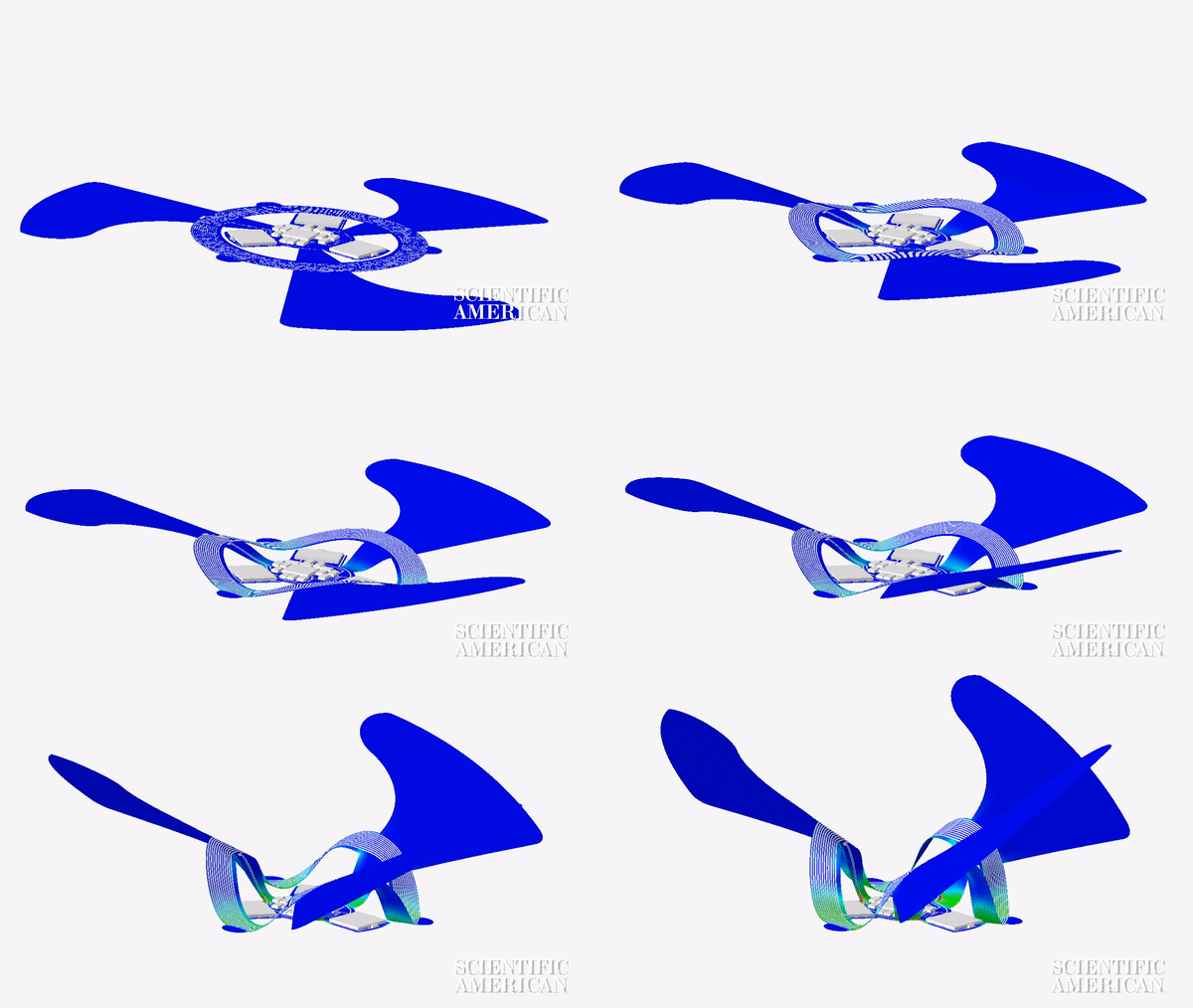
Microfliers are fabricated as two-dimensional planes, and then a stretchy layer pulls them into their final 3-D shape. Credit: Northwestern University
The microflier is still just a proof of concept, Rogers acknowledges. But he and his team plan to conduct field tests soon. They aim to air-drop thousands of the devices that will change color depending on the amount of lead, cadmium or mercury present where they land. A drone will then fly overhead and take high-resolution images of the area, spotting the color-changed devices and thus letting the researchers map the concentrations of contaminants.
Of course, leaving tiny machines scattered over the landscape does not seem particularly sustainable. To avoid damaging local ecosystems, Rogers and his colleagues fabricated microfliers from environmentally friendly polymers, conductors and circuit chips that degrade over time. After collecting and transmitting data about their landing zone, the fallen fliers disintegrate and melt into goo, which then washes away. This is better for the environment—and more convenient for researchers. As Rogers put it, “We don’t want to be in a position where we have to collect all these devices afterward.”