
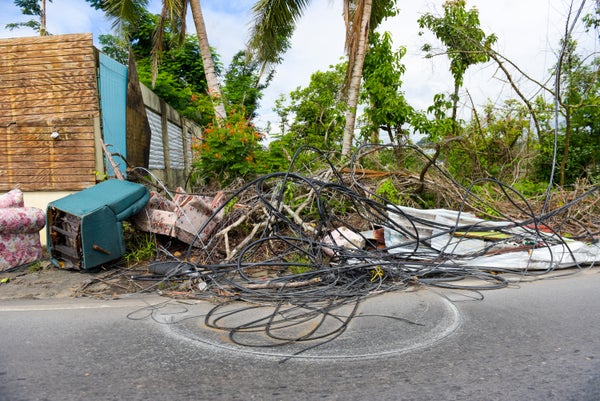
Internet interruptions caused by extreme weather events sap billions of dollars annually from the global economy and can interfere with the delivery of essential data and services by governments, utilities and first responders.
A Boston-based startup is trying to address that problem by applying climate resilience and adaptation principles to the internet, which experts say is vulnerable to climate change.
The firm, called Climate Resilient Internet LLC (CRi), last week rolled out a systems design platform that allows data to bypass traditional fiber optic lines—most of which are strung along utility poles or buried underground—and connect data centers to end users through a dedicated wireless network.
On supporting science journalism
If you're enjoying this article, consider supporting our award-winning journalism by subscribing. By purchasing a subscription you are helping to ensure the future of impactful stories about the discoveries and ideas shaping our world today.
"The cost of business disruption is colossal, and the threat grows exponentially with the rise of cloud computing,” said David Theodore, CRi’s co-founder and chief technology officer. "Today, our most mission-critical data lays in the tracks of climate change, and if your ear is close enough, you can hear the whistle blowing.”
CRi seeks to respond to that whistle by designing disaster-ready internet systems that transmit data over high-frequency microwaves—called millimeter waves—rather than ground-based fiber optic lines that are subject to high winds, flooding and other damage from natural disasters.
Such systems differ from routers that allow for wireless internet use on home or business networks. Rather, they serve as internet superhighways and repositories between massive data centers and internet users.
The platform, which tailors existing technologies like antennas and radio receivers to meet much higher performance standards during extreme events, was developed by two tech entrepreneurs seeking to provide an "all-wireless complement” to traditional data delivery systems that rely on ground-level infrastructure.
In an interview, Theodore likened a climate-resilient wireless network to an electricity microgrid where all of the essential components to energize an area—power production, transmission and consumption—are linked through a self-sustaining system.
Such systems can be applied to the internet to ensure that data continues to move during extreme climate events like hurricanes, floods, droughts and heat waves. That risk is especially high in coastal cities where cloud computing infrastructure and large data centers are threatened by the direct and indirect impacts of climate change.
"You take a place like Boston, where roughly a third of the city is in a floodplain,” Theodore said. "It’s also the case that we built a bunch of data centers long before anyone was thinking about climate change. Consequently, a lot of data centers are in floodplains when they should have been put someplace else.”
For cities and regions that already have experienced major climate disasters—New York during Superstorm Sandy, Houston during Hurricane Harvey, South Florida and Puerto Rico from Hurricanes Irma and Maria—building more robust internet systems is a top priority.
Sundeep Rangan, a professor of electrical and computer engineering at New York University and associate director of the NYU Wireless research center in Brooklyn, said that "high-level operators are very cognizant of this issue” and are eager to find ways to build wireless systems that can withstand extreme weather and other climate impacts.
Private and government-funded research on internet resilience is a growing field, he said, but important questions remain about how to design and construct tougher computing networks.
"We’re going to see more storms, and the resiliency of the network will definitely remain an issue,” Rangan said. But, he added, "the network has held up surprisingly well in the most recent storms, so I think there is already a good deal of improvement.”
Gino Villarini knows firsthand the risks of climate-juiced weather.
He’s the founder and president of AeroNet, one of Puerto Rico’s largest internet service providers, based in San Juan. When Category 5 Hurricane Maria swept over Puerto Rico in 2017, much of the island’s infrastructure was destroyed, including above- and below-ground fiber optic lines that AeroNet depended on for connectivity.
As part of the rebuilding effort, Villarini is relying on both fiber optic and microwave data delivery systems to keep his customers online when weather conditions deteriorate. He said the company mostly is making wireless investments in coastal areas like the capital, San Juan, where Maria downed 95% of AeroNet’s network.
AeroNet is considering a partnership with CRi to expand the wireless data delivery across its service territory. The company also is moving into new markets like Miami where demand is growing for climate-resilient technologies and data delivery systems.
"This is really about what equipment you use, how you install it, and how you engineer the system so it can withstand high-speed winds and flooding,” Villarini said. "When you think about your value proposition, you have to acknowledge the equipment doesn’t just sit idle. You have to protect it.”
It took four months to rebuild the network, he said, because downed utility lines and poles severed much of the island’s electric power and telecommunications grid, including fiber optic lines.
"At the time of the hurricane, most of the fiber was above ground on poles, so obviously that was a big problem for us,” Villarini said. "We also had a lot of power issues, and we had to rely on alternative power sources like solar and batteries and generators. Those ran for about a year.”
Industry officials also have endorsed CRi’s resilience approach. Claude Aiken, CEO of the Wireless Internet Service Providers Association, said, "We view climate change and extreme weather as a major issue and a threat to our telecom infrastructure and our customers.”
Reprinted from Climatewire with permission from E&E News. E&E provides daily coverage of essential energy and environmental news at www.eenews.net.