
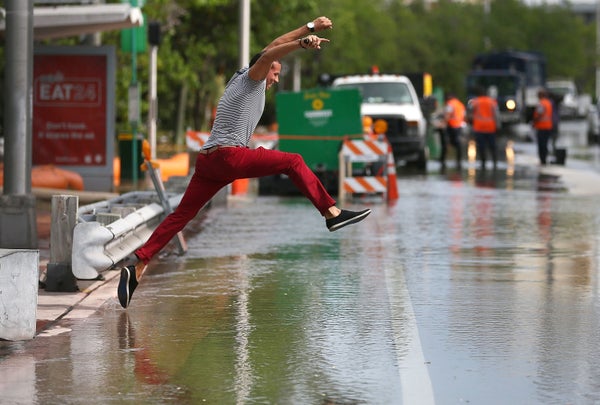
American coastal communities will experience high-tide flooding as many as 270 days a year by 2050, according to NOAA projections released yesterday that show sea-level rise causing the dramatic increases.
NOAA’s annual report on high-tide flooding—also called “sunny day” or “nuisance” flooding because it’s not related to storms—shows that records were set in the past year in one-quarter of the communities along the Atlantic and Gulf coasts where the agency has tide gauges.
Eagle Point, Texas, near Houston, experienced high-tide flooding 64 days in the one-year period from May 2019 through April.
On supporting science journalism
If you're enjoying this article, consider supporting our award-winning journalism by subscribing. By purchasing a subscription you are helping to ensure the future of impactful stories about the discoveries and ideas shaping our world today.
“This is the new normal. It’s a floodier future,” NOAA oceanographer William Sweet said. “It’s this drive in sea-level rise that is really pumping up the water levels and causing more flooding to occur.”
Fifteen communities set records in the past year for the number of days with high-tide flooding, NOAA reported. That includes five communities in southeast Texas, four in Maryland as well as Miami; Charleston, S.C.; and Savannah, Ga.
“Some very important areas are really starting to see flooding, and it’s driving changes in the conversation in these areas,” Sweet said.
The past year came close to breaking a record for high-tide flooding days set one year earlier. NOAA recorded 602 high-tide flooding days last year—nearly three times as many as it did in 2000, data shows.
“There’s been a dramatic change in less than two decades,” Nicole LeBoeuf, acting director of NOAA’s National Ocean Service, said yesterday.
NOAA’s projections for 2050 show huge spikes in the number of days communities will experience high-tide flooding as long-term sea-level rise makes coastal areas more vulnerable to short-term events not related to climate change such as full-moon tides and shifts in winds or currents. High-tide flooding is not nearly as damaging as hurricane-driven storm surge but occurs much more often, inundating streets, shorelines and basements.
Coastal communities are projected to have an average of seven to 15 high-tide flooding days by 2030 and an average of 25 to 75 high-tide flooding days by 2050. But there is great variation among communities and regions.
On Louisiana’s southeast coast, Grand Isle will have between 145 and 270 high-tide flooding days a year in 2050, NOAA projects.
Morgan’s Point, Texas, will see between 110 and 215 days of high-tide flooding a year by 2050.
By contrast, many areas in California, Washington, Oregon and Hawaii are projected to see at most 30 days of high-tide flooding by 2050.
NOAA measures high-tide flooding at 89 gauges in the U.S.
At the 62 communities between Maine and Texas with gauges, there could be 100 days a year of high-tide flooding in 38 of the communities by 2050, NOAA projects.
The 38 communities include New York City; Washington, D.C.; Philadelphia; Baltimore; Providence, R.I.; and the Norfolk, Va., area.
“High-tide flood levels may become the new high tide in some locations,” LeBoeuf said.
The growing frequency of high-tide flooding is driven in part by climate change, which is causing sea levels to rise about 1 inch every eight years as melting glaciers and increasing atmospheric warmth swell the planet’s oceans.
But another cause is the extraction of fossil fuels and groundwater from coastal areas, which causes subsidence.
“That’s an important contributor as well. There are lots of land management practices that are contributing to flooding,” Sweet said.
High-tide flooding is much more prevalent on the Atlantic and Gulf coasts than along the Pacific coast, where a deep continental shelf minimizes storm surge, Sweet said. The continental shelf on the Atlantic and Gulf coasts is shallow and wide, which enables strong winds to elevate water levels.
NOAA said that high-tide flooding predictions beyond 2050 are difficult because climate projections become less certain.
“We’re trying to give communities information that’s shorter term so they can plan accordingly,” Sweet said. “Beyond 2050, it’s largely emissions dependent. ... It’s an uncertain future.”
Reprinted from Climatewire with permission from E&E News. E&E provides daily coverage of essential energy and environmental news at www.eenews.net.