
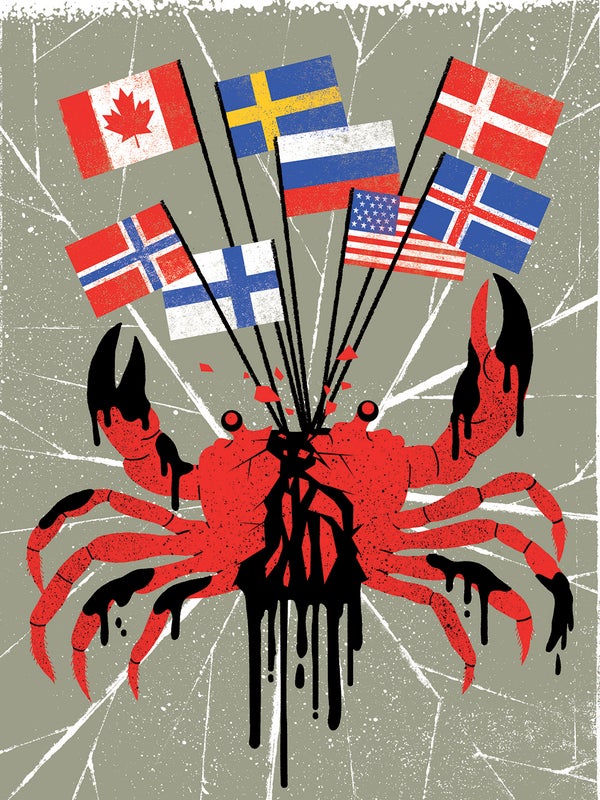
Snow crabs have arrived off the Arctic coast of Norway, around the islands of Svalbard—foot soldiers in the world's newest territorial battle. The crabs were not seen there at the start of this century, but today multitudes have migrated to the chilly waters. Models project that the snow crab catch could soon reach 170,000 metric tons a year—potentially bringing in about $1 billion and making it, with Arctic cod, one of the region's most lucrative resources.
That kind of money is one reason Norway grabbed a Latvian fishing vessel pulling crabs from Svalbard waters this past winter. (The ship was held and later fined.) But there are many other reasons—including the race to pump undersea oil and to establish new military outposts—that have nations with Arctic coasts scrabbling, like aggressive crabs, to establish territorial rights. Ice loss caused by climate change is opening up the Arctic, and it looks like the competition to take advantage has the potential to destroy the region and affect the entire planet.
The ice data are unequivocal: NASA reports that the average area of Arctic sea ice that remains after the summer melting season has shrunk by 40 percent since 1980. Winter sea ice has been at record lows for the past three years, according to the U.S. National Snow and Ice Data Center.
On supporting science journalism
If you're enjoying this article, consider supporting our award-winning journalism by subscribing. By purchasing a subscription you are helping to ensure the future of impactful stories about the discoveries and ideas shaping our world today.
The newly open area boasts many attractions for nations whose territories extend into the Arctic Circle (Russia, Canada, the U.S., Norway, and four more), as well as countries looking for more efficient shipping routes, such as China. As the ice retreats, financial and national security interests advance. Here is just some of what's at stake:
FISHERIES. Open waters allow more fishing fleets. But a free-for-all could lead to drastic depletion of fish and crab stocks. Hence, Norway's claim that European Union countries have very limited rights, or no rights at all, in its northern grounds.
OIL. This year Norway increased its estimate of the amount of oil in the Barents Sea, including areas north of the Arctic Circle, to 2.8 billion cubic meters. That's double previous estimates. The number of exploratory wells in the Barents is at a record high. The U.S. has announced plans to expand Arctic oil prospecting. Russia already has and asserts its continental shelf—and oil rights—extend even farther north.
MINING. A Chinese firm has taken over a mine in Greenland. And on the seafloor, nodules of valuable metals such as manganese and iron have been discovered, and companies are looking for ways to recover them.
NAVIGATION. Canada has mapped the newly widened Northwest Passage, noting that most of it sits over the country's continental shelf, giving it a claim of control that is challenged by the U.S. This shorter route between Asia and Europe will attract huge ships, and lack of safety and environmental regulations could lead to devastating accidents.
NATIONAL SECURITY. Russia has established a new military base in the Arctic, a move that has made NATO uneasy. The Russians have 40 icebreakers, some of them nuclear-powered. The U.S. has but two conventionally powered vessels.
Clearly, the world needs a treaty that governs how we use this valuable region. It is a unique place: parts of the Arctic are national territories, but as a whole, it is a global commons. Oil spills, construction, overfishing, coastal degradation (which will affect the indigenous peoples who live there), and military confrontation could have far-reaching consequences.
Such an agreement can't be a mirror of the 1961 Antarctic Treaty, which set aside that entire continent as a research reserve. That one was easy because no country bordered Antarctica and no one lived there. The Arctic is entirely different. Eight nations claim parts of it, and it is home to groups such as the Sami that live in Scandinavian countries and Russia. We need a treaty that sets resource limits in different categories and gets nations to agree on shares. This is a feasible approach: The United Nations Convention on the Law of the Sea was negotiated between many nations with exactly these kinds of principles. (Only one major seafaring country, the U.S., has refused to sign.) The Arctic Council, made up of the eight Arctic states, is the group to spearhead this, and the time is now. Otherwise the ice will be only the first of many things to disappear.