
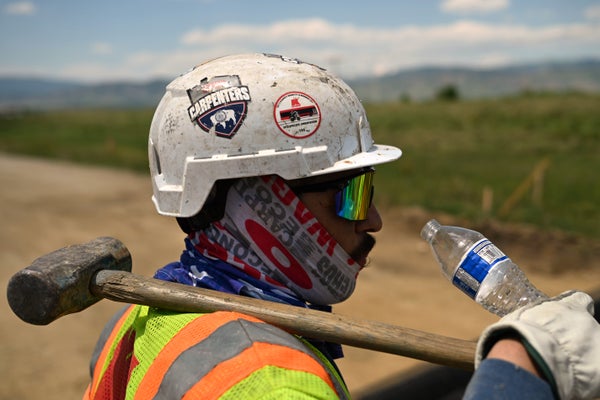
CLIMATEWIRE | High temperatures contributed to the deaths of at least three workers last week as a heat dome smothered much of the U.S., illustrating the high stakes of a public hearing that was unfolding at the same time to help determine the fate of the nation's first proposed worker heat protections.
The weekslong hearing hosted by the Occupational Safety and Health Administration is part of the federal agency’s process for deciding whether it should finalize, kill or edit the regulation drafted by the Biden administration to make companies offer rest and water breaks to their workers when temperatures hit dangerous levels. Over the course of the hearing, which began on June 16 and ended Wednesday, OSHA officials have faced industry pressure to weaken the rule.
Many industry groups complained that the rule would require employers to give workers 15 minutes of rest for every two hours of work when heat rises above 90 degrees. They argued that although 90 degrees may seem hot in New England or the Pacific Northwest, workers in the South are accustomed to much higher temperatures and don’t need protections.
On supporting science journalism
If you're enjoying this article, consider supporting our award-winning journalism by subscribing. By purchasing a subscription you are helping to ensure the future of impactful stories about the discoveries and ideas shaping our world today.
“My guys in south Texas are automatically looking at this and saying, hey, an 85-, 90-degree heat index down here is a vacation compared to their 104 heat index that they’re getting in the middle of summer,” said Stephen Kinn, speaking on behalf of the Associated General Contractors of America on June 18.
Days later, several people died as they worked in hot temperatures, according to news reports.
“There are far too many workers who are still getting sick or dying of heat-related illness,” Jordan Barab, former deputy assistant secretary of OSHA during the Obama administration, told officials Friday.
To see the need for heat protections, he added, “We don’t need to look at the data. We can just pick up the paper.”
The late-June heat dome that hovered over the South and Midwest was responsible for the death of a Georgia construction worker, medical officials told CBS News, with one doctor calculating that his hospital in Cumming, Georgia, had seen a 20 percent increase in heat-related visits, most of which were due to working outside in high temperatures.
A heat index in the upper 90s was also responsible for the death of a baseball umpire in Sumter County, South Carolina, who died of heat stroke on June 21. Witnesses told local news reporters that Mitchell Huggins, 61, passed out while officiating a youth softball tournament and later died at the hospital.
On the same day, U.S. Postal Service employee Jacob Taylor collapsed while delivering the mail in Dallas, Texas, when temperatures reached 94 degrees. Officials are investigating the role of heat in his death.
OSHA did not respond to a request for comment.
Three days earlier, OSHA officials heard testimony from Brian Renfroe, president of the National Association of Letter Carriers union, which represents Postal Service delivery workers.
He described how the USPS has at times ignored its own policies that were enacted to keep workers safe from the heat, by pushing them to continue delivering mail even after they have started experiencing leg cramps, nausea and other early signs of heat illness.
“These injuries and deaths are completely preventable,” he said.
At the time of his testimony, Renfroe said, heat had killed at least seven union members since 2012.
The Postal Service, he said, has resisted calls by the union to ease employees into work on hot days, noting that letter carriers experience more injuries at the beginning of hot periods. The OSHA rule, as currently written, would require that employees be offered water and given paid rest breaks every two hours when temperatures rise above 90 degrees. It would also help acclimate workers to heat.
“The Postal Service has demonstrated they are not willing to put any sort of preventative measures in place beyond what is required by OSHA,” Renfroe said. “That is where the importance of adoption of this rule really lies.”
Reprinted from E&E News with permission from POLITICO, LLC. Copyright 2025. E&E News provides essential news for energy and environment professionals.