
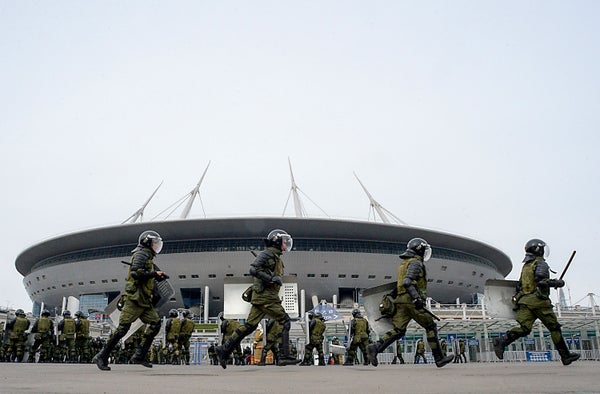
Football fans around the world are eagerly awaiting the kickoff of the World Cup in Russia on June 14. But some Russian researchers might find themselves with more time to watch the matches than they expected.
Because of security and counter-terror measures enacted by the government ahead of the World Cup tournament, some Russian labs will go without the radioactive reagents that they urgently need for their research, according to molecular biologists and biochemists who spoke to Nature.
In a presidential decree issued on May 11, the Russian government suspended the sale and transport of hazardous chemical and biological substances, including toxic and radioactive chemicals, for two months, citing security concerns. The World Cup runs until 15 July. The decree applies only to cities hosting the matches, but many of these, including Moscow, happen to be research hubs, says Konstantin Severinov, a biochemist at the Skolkovo Institute of Science and Technology (Skoltech) near Moscow.
On supporting science journalism
If you're enjoying this article, consider supporting our award-winning journalism by subscribing. By purchasing a subscription you are helping to ensure the future of impactful stories about the discoveries and ideas shaping our world today.
Labs out of luck
The measures threaten to stall the relatively little molecular-biology research that exists in Russia, says Severinov. Last month, Russian researchers who had recently ordered radioactive nucleotides, which they use to measure gene expression and for other assays, got bad news from the Russian Academy of Science’s Institute of Bioorganic Chemistry in Moscow: an expected June delivery to their labs would be cancelled because of the presidential decree. No other Russian centre supplies such reagents.
“This jeopardizes the whole workflow in my lab,” says Severinov, who is also group leader at the Russian Academy of Science’s Institutes of Molecular Genetics and Gene Biology in Moscow. Numerous projects—including CRISPR–Cas9 gene-editing experiments and those measuring the effects of toxins on cells—have been affected, he says.
Stephen O’Brien, director of the Theodosius Dobzhansky Center for Genome Bioinformatics in St. Petersburg, says his team's work, which is largely computational, hasn't been affected. But he has heard from colleagues at other institutes who are having trouble getting radioactive reagents and other toxic chemicals.
Maintaining lab supplies of research reagents and other consumables is notoriously problematic in Russia, O'Brien adds. Russian production capacities are scarce, and severe customs restrictions effectively bar scientists who depend on radio-labelled reagents from legally purchasing them from foreign suppliers, Severinov says.
Domestic demand
Meanwhile, domestic supply is routinely hampered by bureaucracy and long delivery times. “We always have problems with ordering research materials during summer,” says Ilya Osterman, a biochemist at the Skoltech Center for Translational Biomedicine in Moscow, who uses the chemicals to examine the shapes of different RNA molecules and to measure gene expression. “The World Cup only makes the situation worse.”
To prevent delays and frustrating disruptions to their research, scientists in Russia must order such reagents several weeks in advance, through their institution’s procurement department. With the World Cup and the ensuing summer break, the next deliveries of radio-labelled nucleotides might not arrive until early autumn. “This means a bad disruption,” says Severinov. “Four of my PhD students are caught midway in their thesis work.”
Alexei Khokhlov, a vice-president of the Russian Academy of Sciences, which runs the institute that supplies researchers with radio-labelled nucleotides, did not reply to an e-mail from Nature asking how many scientists were affected and how the delay might affect their research.
Before his re-election as president in March, Vladimir Putin promised to strengthen Russia’s struggling research base. But high customs and import restrictions on research materials continue to put Russian scientists at a competitive disadvantage compared with researchers in countries where there is an ample supply of chemicals and science equipment, says Fyodor Kondrashov, a Russian biologist at the Institute of Science and Technology Austria in Klosterneuburg.
The enhanced security restrictions will be lifted soon after the World Cup final is played at the Luzhniki Stadium in Moscow on July 15. “This current crisis might be short-lived,” says Kondrashov. “But it underlines the difficulty of doing cutting-edge research in a country that is not entirely free.”
This article is reproduced with permission and was first published on June 13, 2018.