
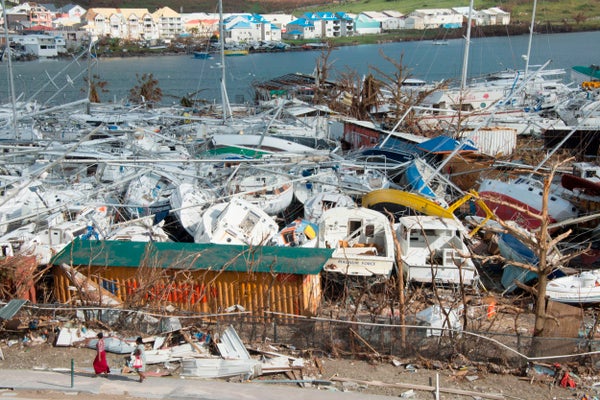
The impact of climate change on storms might be uncertain, but their growing damage is not. Hurricanes like Maria, now barreling toward Puerto Rico, could inflict much larger losses around the world as coastlines bristle with future development.
A series of recent studies by the National Center for Atmospheric Research (NCAR) predicts there will be mostly financial benefits from mitigating climate change. But some risks are unlikely to be reduced, including the financial exposure from future storms resembling Hurricanes Harvey, Irma and Maria.
A summary of the studies, released last month, warns of a nonlinear relationship between the strength of future storms and potential losses, which stand to grow even if the worst predictions about hurricanes aren’t realized. Financial exposure could grow as much as five times faster, because the number of buildings and the population in coastal areas continue to proliferate.
On supporting science journalism
If you're enjoying this article, consider supporting our award-winning journalism by subscribing. By purchasing a subscription you are helping to ensure the future of impactful stories about the discoveries and ideas shaping our world today.
“Regardless of how storms are going to change, the biggest change we found is that there are more people who are going to live near the coast, globally. People like coastlines. They like living near the beach. As air conditioning gets cheaper, more of them are going to be moving into some of these climate zones where they weren’t before,” explained Andrew Gettelman, an NCAR research scientist and author of one of the studies.
“Are they going to pay attention to 100-year flood risks, 500-year floods? No. Are we going to build levees to try to stop some of this stuff? Yes. We’re going to fill wetlands to make it more habitable for people, and that’s going to put more people at risk,” he added.
Projecting whether state and local governments will reduce their risk by adopting stricter zoning laws and building codes is hard to know, said Brian C. O’Neill, another NCAR scientist. “But we can address it by creating some intelligent alternative scenarios that represent ranges of possibility, so we don’t get caught with unanticipated surprises by putting more people in harm’s way,” he added.
The NCAR studies, collectively titled “Benefits of Reduced Anthropogenic Climate Change,” are an effort to show the benefits and the costs of global efforts to reduce greenhouse gases. The studies, authored by scientists from 20 universities from the U.S. and abroad, are intended to mesh together science and other disciplines, such as insurance, that measure some of the political and economic impacts of combating climate change.
They show that when it comes to reducing extreme heat, for example, the benefits of lowering greenhouse gas emissions are clear and substantial. In other areas, such as in agriculture, where more CO2 may help fertilize crops while also causing warming-related crop damage, there are “stubborn uncertainties” that make benefits harder to predict.
To weigh the net impacts of tropical storms, the scientists used a computer model predicting future climates and the possibilities of storms. The tropical cyclone study also used a model developed by Zurich-based Swiss Re, one of the world’s largest providers of reinsurance. It sells policies that are used to reduce or transfer storm risks.
The model, called Climada, predicts the potential damage in a given area, based on flood and wind risks, and by using local building codes and other records to gauge the resilience of buildings. “They go to an amazing amount of detail,” Gettelman said, to develop a portfolio that puts a price on damage and loss risks in a given area.
In the future, Gettelman thinks more accurate risk models will be needed to back up climate models, ultimately showing the accumulating dangers of consolidating societies on coastal shores. The potential of stronger storms is only one element. “Sea-level rise by itself makes flooding even worse. Not only that, on coastlines where they’re not getting river water, they’re pulling out ground water, which means that the land is sinking.”
Another aspect is dealing with heavy precipitation and the inundation of heavy rain that can accompany a storm like Harvey. “If you have large coastal wetlands and that area gets paved, you don’t have a lot of land that can soak up water,” Gettelman noted.
In the U.S., where flood insurance does not appeal to most commercial insurers, it is primarily provided by the federal government’s National Flood Insurance Program, which has borrowed over $25 billion from the national Treasury to help pay its claims. Over time, low-lying cities like Miami and Norfolk, Va., are facing a growing accumulation of expensive risks.
In Asia, where countries have more densely populated coastlines, Gettelman said the risks will grow higher even without more powerful storms. Asia is also one area where insurance coverage is relatively rare.
Up to now, he said, some Asian nations appear to have found ways to adapt. In a trip to Taipei, Taiwan, he found hotels that were built “a few steps up from the street,” with ground floors that were mainly concrete. “Even with flooding they could just squeegee it out and they were ready to go again,” Gettelman said. In Hanoi, Vietnam, he found homes built with masonry and other materials that don’t absorb water like drywall and siding, which often require flooded residences to be rebuilt.
Basically, he and other scientists hope America is headed for a learning curve. “As we saw in Harvey, this is no longer just an atmospheric problem,” explained Antonio Busalacchi Jr., president of the University Corporation for Atmospheric Research. It is a Boulder, Colo.-based nonprofit group of over 100 North American universities that operates NCAR.
NCAR’s research is paid for by the National Science Foundation, and Busalacchi predicted that future research will shift toward more precise computer modeling and include more interdisciplinary research about the risks and the adaptation that is, or is not, happening along coastlines.
“That’s clearly where our science is going,” he said.
Reprinted from Climatewire with permission from E&E News. E&E provides daily coverage of essential energy and environmental news at www.eenews.net.