
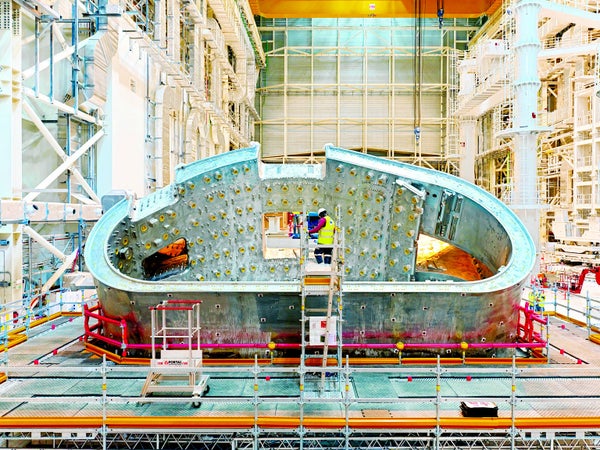
Humans are an energy-hungry species, and our current sources of power are not cutting it. Nuclear fusion, the process that fuels the sun, might offer the kind of clean, abundant energy we need—if only scientists can figure it out. The International Thermonuclear Experimental Reactor (ITER) is the biggest and most ambitious attempt yet to harness the energy produced by forcing two atoms to become one. The $25-billion experiment in Saint-Paul-lez-Durance, France, is a joint project of the European Union, China, India, Japan, South Korea, Russia and the U.S. Its ultimate goal is to do what no fusion experiment has done before: produce more heat than it consumes.
The project has been stymied by delays and ballooning costs, and a critical independent assessment forced out the top leadership several years ago. In some skeptics' eyes, it will always be a boondoggle, a waste of too much time and money for an experiment that is aiming to be not even a working power plant but merely a proof of concept. But ITER finally reached a long-sought milestone in July 2020 with the official start of machine assembly—when scientists began joining the various components provided by the partner countries. “We have the same feeling as somebody who is supposed to run successive marathons, and you achieve the first one, but still you know there are many more to do,” says Bernard Bigot, who took over as ITER director general in 2015. “It gives us more confidence in the future, but we know that nothing is [taken] for granted.”
The challenge is to essentially build a miniature star inside a laboratory—and then control it. The heart of the experiment is a 23,000-ton cylinder where intense superconducting magnets will try to keep a 150-million-degree-Celsius plasma contained long enough for fusion to occur. Making the physics work out will be a huge challenge, but so will conquering the construction. “It is a large-scale international project where parts are made all across the world, and it has to fit together like a puzzle, and it has to work,” says plasma physicist Saskia Mordijck of William & Mary, who is not part of the ITER team.
On supporting science journalism
If you're enjoying this article, consider supporting our award-winning journalism by subscribing. By purchasing a subscription you are helping to ensure the future of impactful stories about the discoveries and ideas shaping our world today.
Scientists hope to press the proverbial red button and turn on the reactor in 2025, with the ultimate goal of running it at full power by 2035. If it succeeds, the payoff would be gigantic. Fusion has the potential to release much more energy than burning coal or oil or even nuclear fission, which fuels traditional nuclear power plants. Fusion produces no greenhouse gases or radioactive waste. “Fusion from my point of view is really the one option that complements reusable energy and could be the solution for climate change,” Bigot says. “The next three or four years will be absolutely critical.
Credit: Manuela Schirra and Fabrizio Giraldi
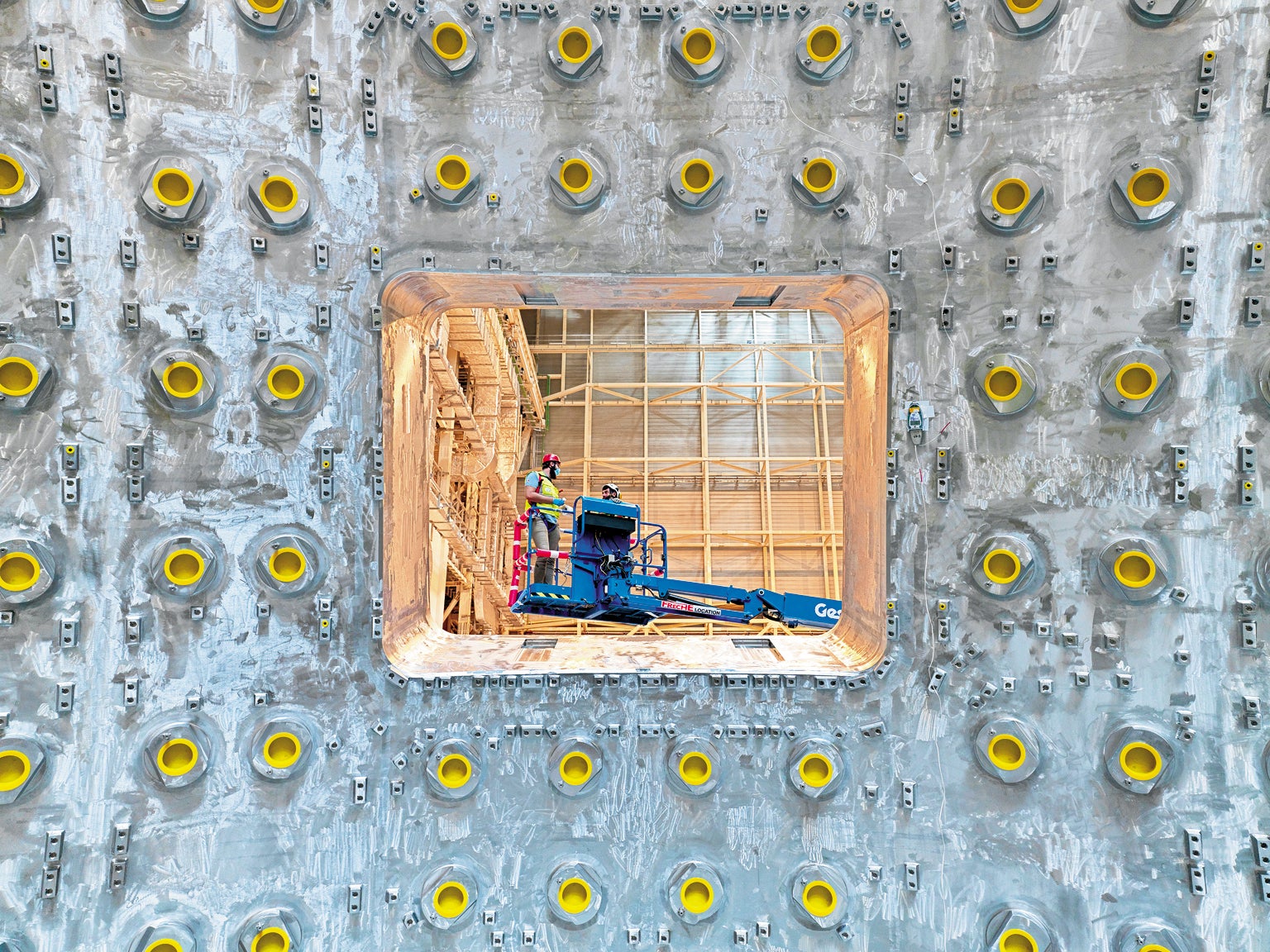
TEMPERATURE GRADIENT: ITER will include one of the hottest places in the universe—the vacuum vessel housing the 150-million-degree- Celsius plasma—as well as one of the coldest places in the universe; the magnets that will confine and control that plasma must be kept at about four kelvins (–269 degrees C). Separating the two will be a beryllium-coated steel “blanket” to shield the sections from each other, which will attach to the vacuum vessel’s interior wall via stub keys, currently covered by yellow caps to keep off dust.
Credit: Manuela Schirra and Fabrizio Giraldi
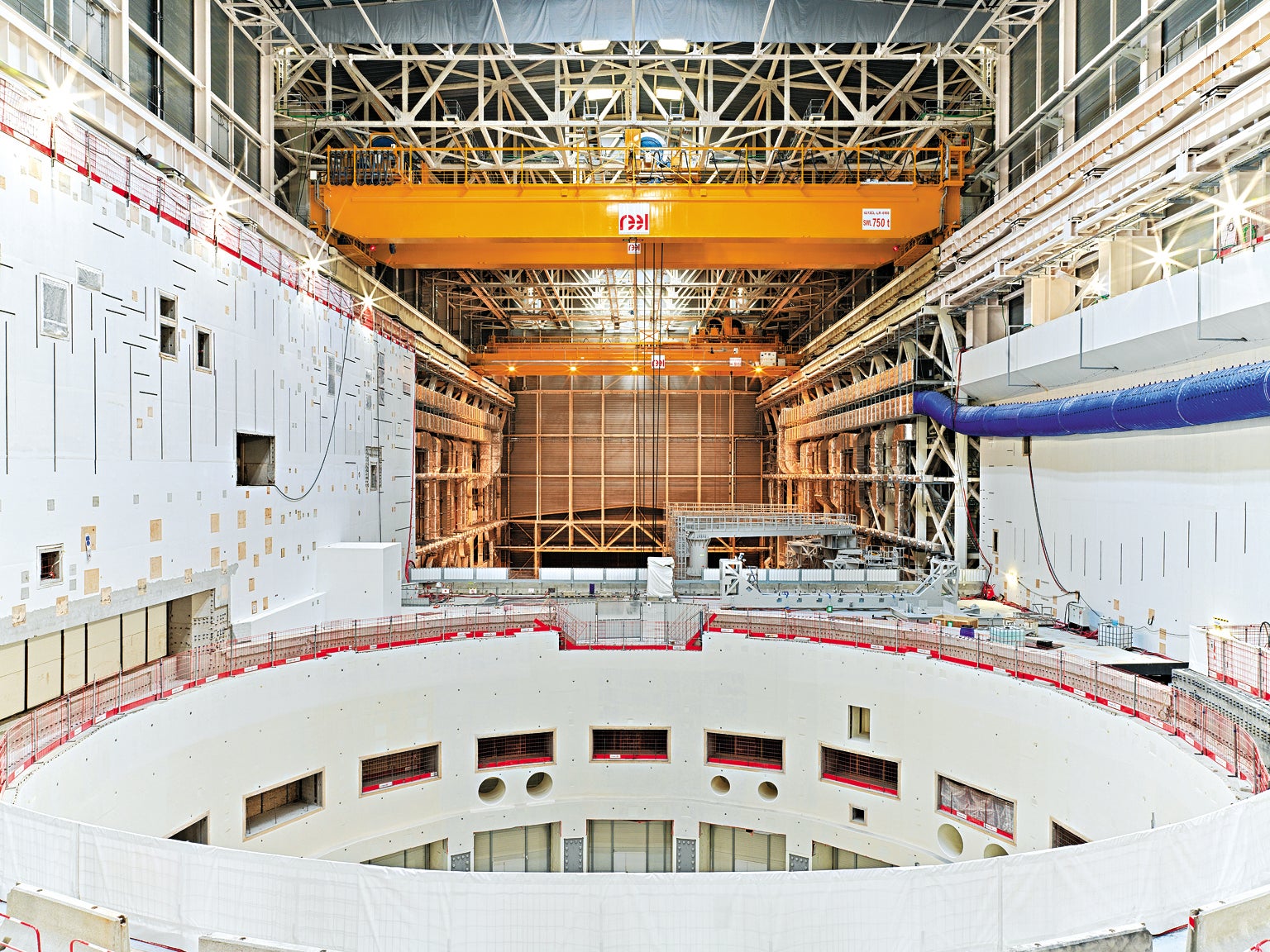
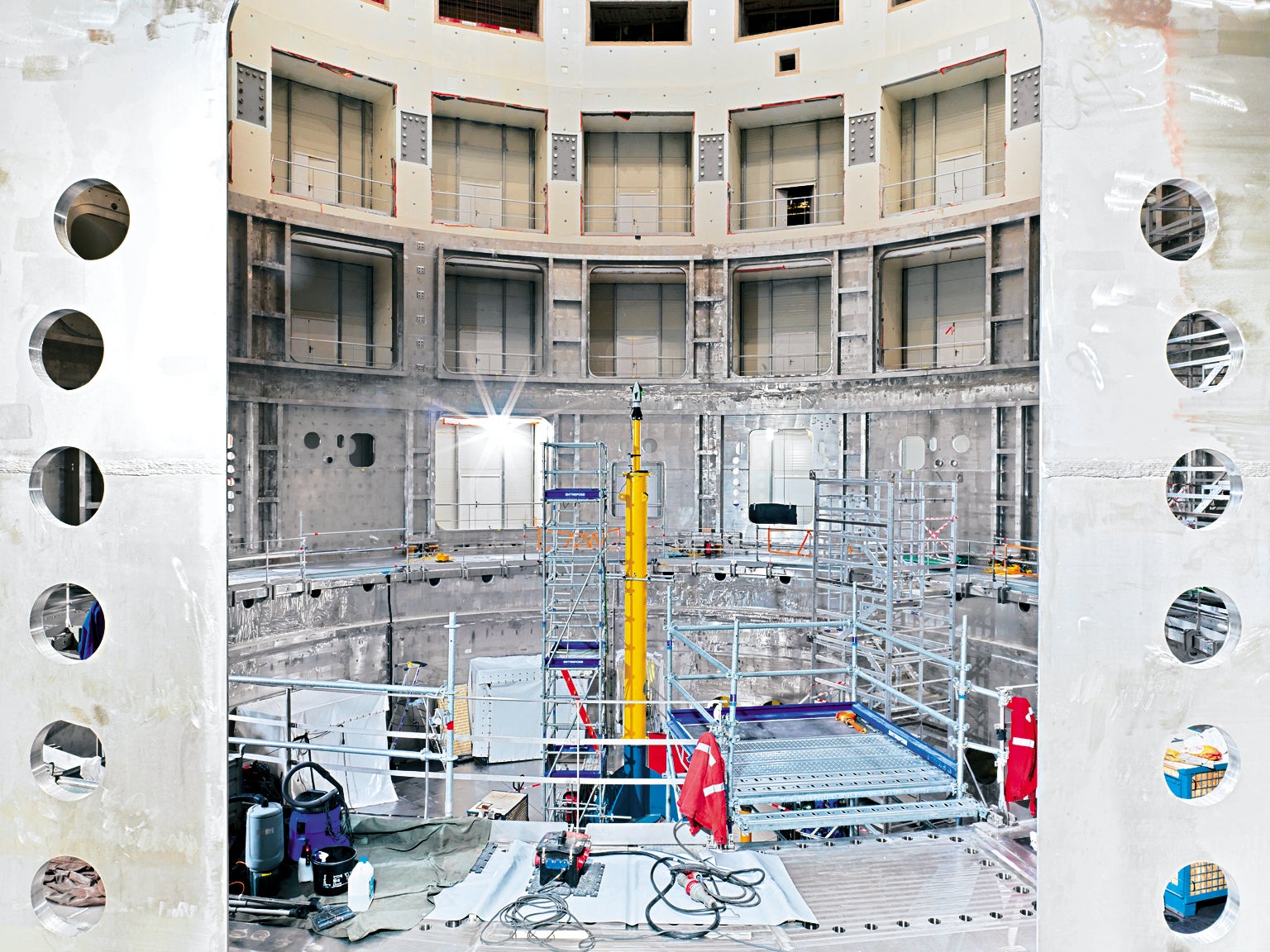
WORLD’S LARGEST: The tokamak chamber, seen from the top (top) and middle (bottom), is a cylinder that will hold the ITER experiment. The word “tokamak” is a Russian acronym for a “toroidal chamber with magnetic coils”—a concept first developed in 1957 by physicist Igor Golovin. ITER’s tokamak will be the biggest ever built, twice the size of the largest currently operating. The base of the machine was lowered into the chamber in July 2020, marking the beginning of the project’s assembly at the site in the south of France. The site is funded by Europe, which is paying for nearly half of the total cost of the project; Europe’s contribution is managed by Fusion for Energy.

Credit: Manuela Schirra and Fabrizio Giraldi
EMPTY VESSEL: ITER’s vacuum vessel will be made of six segments, each built in South Korea or Italy. The huge steel sections had to be shipped by boat to the port of Fos-sur-Mer near Marseille, where they were transported by road 100 kilometers northeast to the ITER site. Now that the first pieces have arrived, workers will connect them with magnets and thermal shields and then lower them into the tokamak chamber.

Credit: Manuela Schirra and Fabrizio Giraldi
DEEP FREEZE: The superconducting magnets in the reactor can work only at supercold temperatures near absolute zero, which will be maintained by liquid helium circulating through cryogenic pumps. Operators control the system via a complex set of hand valves (top) based on local readings of pressure, temperature and flow. The finished cryogenic plant, built by contractor Air Liquide (bottom), will be the world’s largest helium-refrigeration unit.
Credit: Manuela Schirra and Fabrizio Giraldi
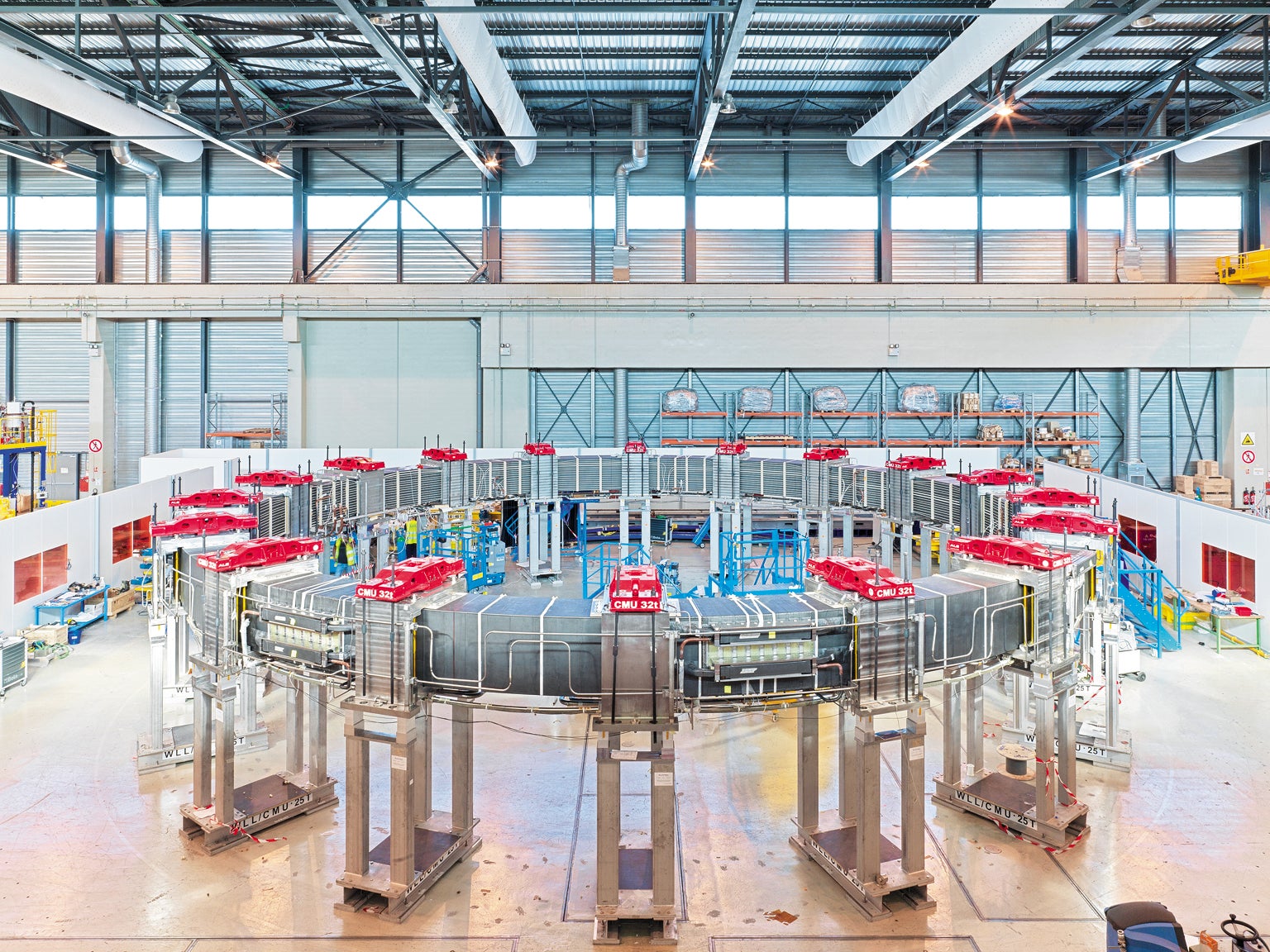
MAGNETIC CAGE: ITER’s fusion plasma will be encased and contained by a nest of magnets, including six ring-shaped superconducting poloidal magnets (shown here) that will pile on top of one another horizontally to surround the plasma. In addition, 18 toroidal field coils will encircle the machine vertically, and one large central solenoid will sit in the middle, forming the largest superconducting magnet system ever built. Superconductors allow electric current to flow without resistance, enabling electrons to move freely to create intense magnetic fields.
Credit: Manuela Schirra and Fabrizio Giraldi
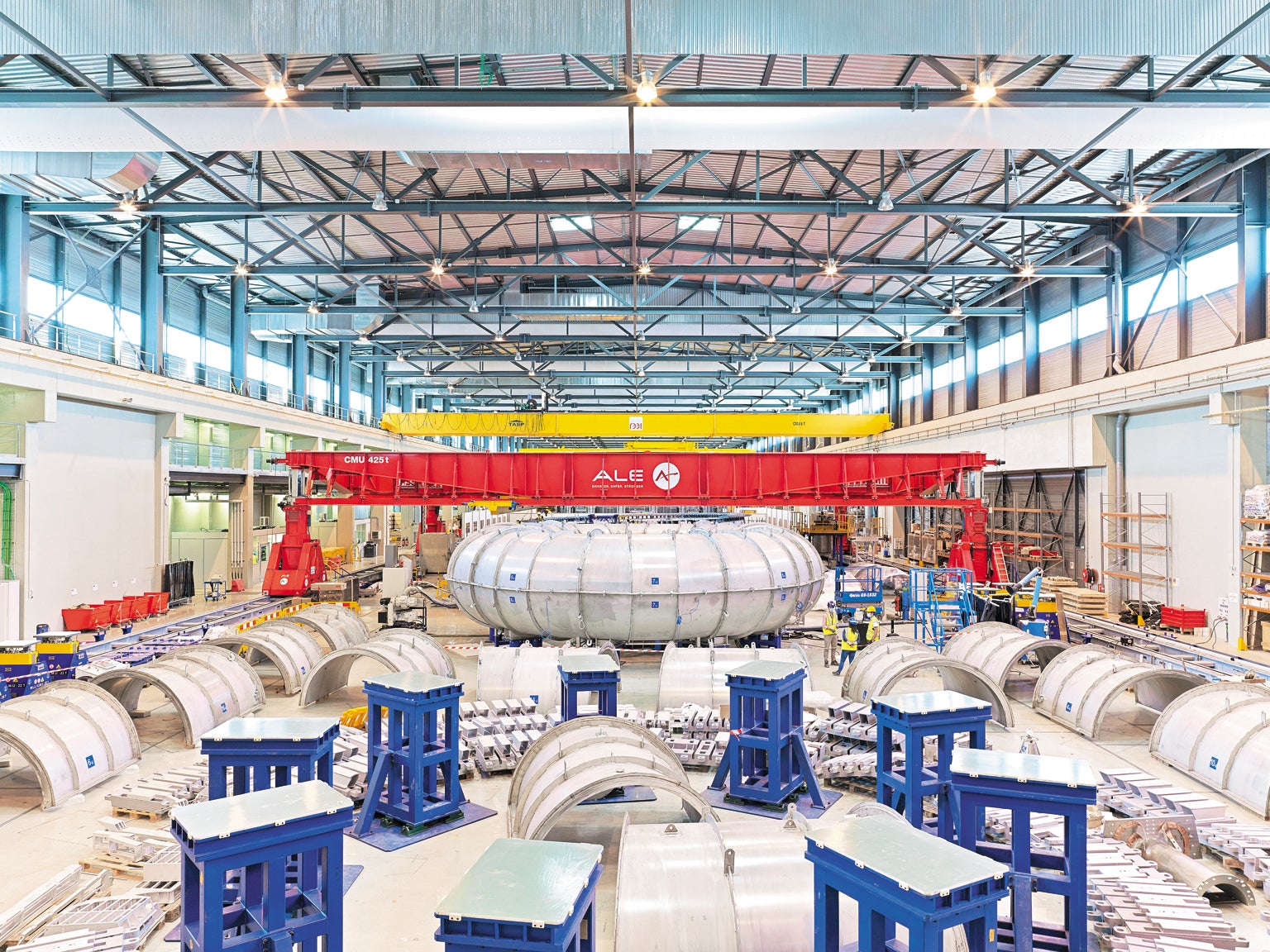
MAGNET CONSTRUCTION: Made of niobium-tin and niobium-titanium, the poloidal magnets are the only ITER components manufactured on-site. With diameters between 17 and 24 meters and weighing up to 400 metric tons each, they are too large to be built elsewhere and transported. Poloidal Field Coil #6 is shown here inside its cooling cryostat.