
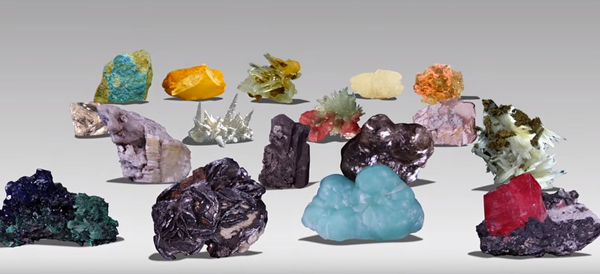
Calling all rock hounds, the Deep Carbon Observatory(DCO) wants you.
According to a new predictive model, more than 140 carbon mineral species on Earth have yet to be discovered, and DCO scientists have launched a citizen science project called the Carbon Mineral Challenge to find them.
Over the next four years, teams around the world will study samples of carbon minerals submitted not only by academic mineralogists, but by amateur collectors and explorers. Got some unusual-looking minerals you’ve collected and stored in your garage? Head to the Carbon Mineral Challenge’s website to see whether they might be worth scrutinizing, says Robert Hazen at the Carnegie Institution’s Geophysical Laboratory and executive director of DCO.
On supporting science journalism
If you're enjoying this article, consider supporting our award-winning journalism by subscribing. By purchasing a subscription you are helping to ensure the future of impactful stories about the discoveries and ideas shaping our world today.
As an institution devoted to exploring carbon’s role on a planetary scale, DCO has a particular interest in carbon minerals. Carbon plays a role in all of Earth’s biology and in fundamental processes from the atmosphere to Earth’s core. The discovery of new carbon mineral species could also add immeasurably to research on materials, energy, and climate. “The chemistry of carbon tells us a lot about the chemistry of Earth,” Hazen says.
Most of the mineral species we know of have been found serendipitously—a large number of those by amateur mineralogists.
Hazen and his colleagues recently developed a method that combines the distributions and locations of known minerals with statistical methods used in biology and lexicography to predict the number of unknown carbon minerals on Earth. Scientists have catalogued 5,027 mineral species, of which 406 contain carbon. The new analysis, currently in press in American Mineralogist, predicts that there are still about 145 carbon mineral species left for the finding.
Hazen and his colleagues announced the program, which is partly funded by the Alfred P. Sloan Foundation, on Dec. 17 at the American Geophysical Union meeting in San Francisco.
International teams of mineralogists are ready to vet promising candidates, determining compositions with electron microprobe analysis and crystal structures via X-ray crystallography.
“It will be fascinating to see what new and exciting carbon minerals might be lurking in our Smithsonian collection drawers,” says Jeffrey E. Post, chair of the mineral sciences department and curator of the National Gem & Mineral Collection at the Smithsonian Institution. “And what impact they might have on understanding our planet.”
This article is reproduced with permission from Chemical & Engineering News (© American Chemical Society). The article was first published on December 21, 2015.