
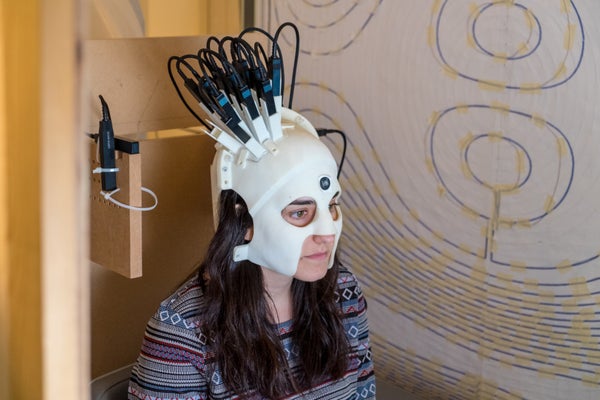
A brain scanner now used to guide treatment of patients with epilepsy and other neurological disorders is bulky and challenging to use on fidgety young children—but researchers hope it might soon be replaced by a new machine that’s not much bigger than a bike helmet.
Scientists at University College London have created a prototype of a lightweight, easier-to-use version of a magnetoencephalography, or MEG, brain scanner. These machines monitor the magnetic field created when neurons communicate with each other, allowing physicians to see how the brain functions from one second to the next.
They’re used to diagnose patients, and are particularly helpful for determining how to treat people with epilepsy who haven’t responded to anti-seizure medications and need surgery. The MEG scans help doctors to pinpoint the source of seizures and map nearby critical areas to avoid during surgery.
On supporting science journalism
If you're enjoying this article, consider supporting our award-winning journalism by subscribing. By purchasing a subscription you are helping to ensure the future of impactful stories about the discoveries and ideas shaping our world today.
“Up until now, people have had to lie on big scanners and we say, ‘Act naturally, but whatever you do, don’t move your head,’” said Gareth Barnes, who is developing the new scanner and works as a professor at UCL’s Wellcome Trust Center for Neuroimaging. He said the new scanner could be used in research to glean more insights into how the brain works in patients with neurological conditions. The researchers published a paper Wednesday about the new device in Nature.
A conventional MEG scanner isn’t exactly patient-friendly: It’s a bulky fixed machine that surrounds the head like a beehive hairdo.
.jpg?w=1350)
Standard magnetoencephalography scanner. Credit: Wellcome
“It looks like the thing you might get your hair permed in the old-fashioned way,” said Andrew Welchman, the head of neuroscience and mental health at the Wellcome Trust, which funded the new research.
The scanner is big because the sensors that measure the brain’s magnetic field need to be kept at close to absolute zero, or negative 269 degrees Celsius. And because the machine is sensitive to movement, it’s difficult to scan people who have trouble staying still for prolonged periods, such as kids and people with movement disorders.
“If someone moves their head, it blurs the picture of the brain activity,” said Welchman.
And for the most part, MEG scanners are one-size-fits-all, which means it can be incredibly tricky to use the machines on small children. Having the scanner as close to a patient’s head as possible is critical to capturing high-resolution images.
The new scanner aims to address those issues—it’s lighter, more flexible, and fits more like a helmet than a hair dryer.
“We can put the new sensors directly on to the subject’s scalp like a helmet,” Barnes said. He and his colleagues used a new type of quantum sensor that’s lightweight and works at room temperature, so they can be placed right next to the scalp in a helmet. Earth’s own magnetic field interferes with these new sensors, however, so the researchers created magnetic coils that surround the walls of the scanning room and shield the scanner from the Earth’s magnetic field.
Barnes said the scanner has the potential to improve clinical care by making MEG scans more accessible for young patients and people with epilepsy and movement disorders. And a more flexible system could allow doctors to capture more natural brain activity.
Dr. Christina Patterson, director of the epilepsy program at Children’s Hospital of Pittsburgh of UPMC, said a streamlined MEG scanner would make it easier to get clearer pictures of the brain in young patients with epilepsy. But, she said, she’d want to be sure the images from the final product are up to snuff.
But first, the new scanner has to get a little smaller—and a little less scary-looking. Right now, it’s a white face mask with a “Friday the 13th” vibe, with a bunch of wires hooked up to a patient’s head.
Currently, the sensors are about the size of a cigarette lighter. The researchers want to get them down to the size of a sugar cube, so that they can be tucked inside a device that looks like a bicycle helmet. They’re hopeful that’ll make the technology easier to use and less intimidating for patients.
“That would very much help in terms of being an easier test for kids to undergo,” said Patterson.
Republished with permission from STAT. This article originally appeared on March 21, 2018