
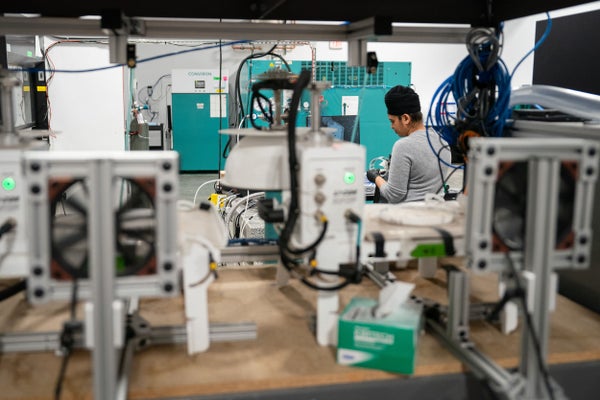
CLIMATEWIRE | Several U.S.-based startups that already have secured multimillion-dollar deals to filter carbon dioxide from the air or seas are among 20 finalists in a $100 million climate competition backed by billionaire entrepreneur Elon Musk.
The finalists announced Wednesday include direct air capture startup Heirloom and direct ocean capture firm Captura in California as well as Texas' Vaulted Deep, a biomass burial company. Each has brought in more than $45 million from investors or customers.
Leading contenders also hail from China, India, Kenya, Oman and six other countries where venture capital backing and corporate removal buyers are harder to come by.
On supporting science journalism
If you're enjoying this article, consider supporting our award-winning journalism by subscribing. By purchasing a subscription you are helping to ensure the future of impactful stories about the discoveries and ideas shaping our world today.
The carbon removal competition is run by XPrize, a nonprofit that promotes technological development through contests, with money from the Tesla CEO's Musk Foundation.
"These companies represent a collection of cutting-edge innovation that will be the basis of a new, trillion-dollar carbon removal industry that needs to reach gigaton scale by 2050," Nikki Batchelor, the executive director of the XPrize for carbon removal, said in an interview ahead of the announcement.
A gigaton of carbon dioxide is 1 billion metric tons, or roughly the annual emissions of 257 coal-fired power plants, according to EPA data. Climate scientists at the University of Oxford last year estimated that avoiding dangerous warming thresholds will require removing a minimum of 450 billion tons of CO2 by the end of the century — and billions more if the world doesn't quickly slash new emissions.
The carbon removal competition is advancing as commercial-scale carbon removal operations are expanding in Europe and the United States. The fledgling industry has attracted support from multinational corporations as well as U.S. policymakers.
The 20 XPrize finalists were selected by a team of independent judges out of a pool of more than 1,300 entrants. The remaining contenders were grouped by the ways they work to remove carbon. Some seek to filter CO2 from the air or to prevent carbon-rich biomass from biodegrading. Others aim to increase the carbon-absorbing potential of rocks or oceans.
XPrize plans to name the winner of the carbon removal competition next April, an honor that would come with a $50 million award. Runners up each would get $30 million. The competition already has awarded $20 million in earlier rounds of the contest.
The carbon removal competition began three years ago when U.S. policy support for carbon removal technologies was almost nonexistent. That all changed with the signing of the bipartisan infrastructure law in November 2021 and the Inflation Reduction Act the following August. Those bills included billions of dollars for companies developing direct air capture hubs and millions more to startups piloting other carbon removal technologies.
Despite the recent flood of taxpayer support for carbon removal, the eight-figure sums that XPrize is offering could provide lifelines for some startups, according to Batchelor — particularly ones outside the United States. Most firms in the competition, she added, are actively looking for new investors.
"These companies need a lot of money to build these systems," Batchelor said. "They will not continue to exist if they're not able to close those deals."
Reprinted from E&E News with permission from POLITICO, LLC. Copyright 2024. E&E News provides essential news for energy and environment professionals.