
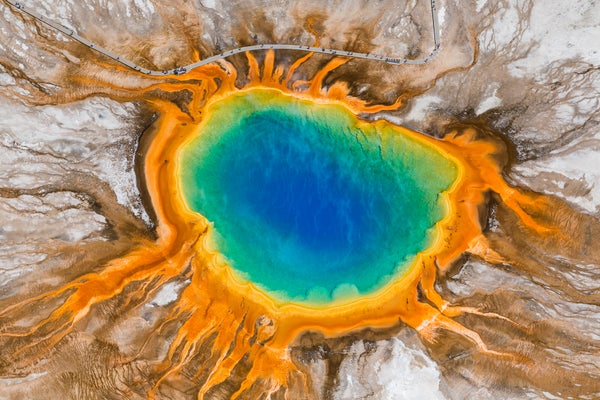
The last super-eruption at Yellowstone volcano, which occurred 631,000 years ago, was not one huge explosion. Instead, new research suggests it was a series of eruptions or multiple vents spewing volcanic material in rapid succession.
According to the U.S. Geological Survey's (USGS) Yellowstone Volcano Observatory 2022 Annual Report, published May 4, fieldwork over the past year has provided new geological evidence that "the formation of Yellowstone Caldera was much more complex than previously thought." A caldera is a large crater that forms after the collapse of a volcano following an eruption.
Yellowstone is one of the world's biggest volcanic systems. It sits above one of Earth's "hotspots" — areas in the mantle where hot plumes rise and form volcanoes on the crust above. It has produced three caldera-forming eruptions in the past 3 million years: the Huckleberry Ridge Tuff eruption, 2.1 million years ago; the Mesa Falls eruption, 1.3 million years ago; and the Lava Creek eruption, 631,000 years ago.
On supporting science journalism
If you're enjoying this article, consider supporting our award-winning journalism by subscribing. By purchasing a subscription you are helping to ensure the future of impactful stories about the discoveries and ideas shaping our world today.
What are super-eruptions?
The Huckleberry Ridge Tuff and Lava Creek events are considered super-eruptions because they expelled over 240 cubic miles (1,000 cubic kilometers) of material. The latter was responsible for the formation of the Yellowstone caldera. Mesa Falls erupted 67 cubic m (280 cubic km) of material, so — while still about 10 times bigger than the 1980 eruption of Mount St. Helens — is not considered a super-eruption.
Previous research has shown that the Lava Creek super-eruption was not out of the blue; deposits at the Sour Creek Dome region east of the national park suggest that the giant blast was preceded by at least one eruption. Ignimbrite (volcanic rock formed via the deposits of the hot mix of material ejected during an eruption) found at the site had completely cooled before the main, mapped Lava Creek eruption took place.
To better understand the timeline of the eruption, scientists spent 2022 remapping and collecting samples at Sour Creek Dome.
"It had always been known that there were at least two geological units [a volume of rock distinct from those surrounding it] from the eruption, and it was thought that there was little to no time gap between them," Michael Poland, scientist-in-charge at the Yellowstone Volcano Observatory, told Live Science in an email. "Now, we think there are more units. And we're just not sure what the time gap might have been, if any."
So far, the team has found four previously unrecognized ignimbrite units at Sour Creek, suggesting at least four eruptive pulses. They also found two structures that appear to be eruptive vents, which may have been the sources of these rocks.
"That could mean either several vents were active and/or there was time separation between the eruptions," Poland said. "But we don't yet have the data we need to answer those questions yet."
In 2020, scientists found the Huckleberry Ridge Tuff eruption — which ejected more than twice the amount of volcanic material as Lava Creek did — was also a phased event. Analysis of rocks at the site suggests there were three separate eruptions, with weeks to months between the first two, and years to decades between the second and third.
Yellowstone volcano is not expected to erupt anytime soon. However, the finding that the Lava Creek eruption may have followed a similar pattern to that of the Huckleberry Ridge Tuff eruption could give an idea of what to expect if and when Yellowstone does blow. "These major caldera-forming eruptions might not be single events at Yellowstone, but instead have multiple phases," Poland said.
Researchers at the volcano now plan to carry out detailed examinations of the newly discovered units and the boundaries between them. This will allow them to paint a more detailed picture of what the Lava Creek eruption looked like — and maybe even what triggered it.
Copyright 2023 LiveScience, a Future company. All rights reserved. This material may not be published, broadcast, rewritten or redistributed.