
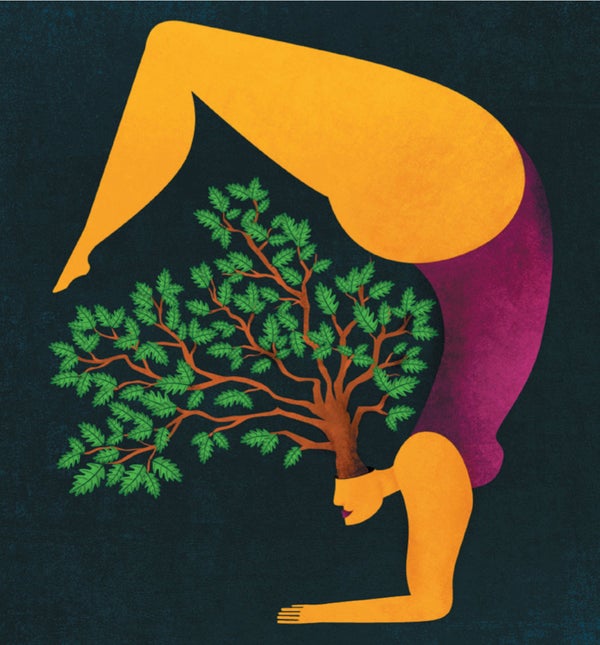
I’ll be honest: I’m something of a yoga nut. I’ve practiced for decades and became a certified yoga teacher. But, to be honest again, some of the health claims I’ve heard about yoga make me squirm. Does yoga really fix poor digestion? How on earth can it regulate thyroid function? In yoga classes, I sometimes struggle to calm my mind when a teacher invites us to do the anatomically impossible: “Breathe into your kidneys.”
Yoga is deeply linked to traditional Eastern medicine and a view of the body as a system of energy channels and nexuses—a perspective that does not easily align with Western medicine. But since the start of this century, scientific research on yoga has exploded. Many studies have assessed yoga as a “complementary therapy” to be used alongside other treatments for problems such as back pain, depression, anxiety and arthritis. Such research often has found that the practice can help. Still, yoga studies tend to be of uneven quality, often relying on self-reported survey data. For that reason, I was struck by a 2019 review paper that focused on a more objective measure: brain scans. Though far from definitive, the findings hint that the practice may improve brain health, and they indicate a way to bring yoga and science more convincingly together.
The review, led by Neha Gothe, director of the Exercise Psychology Lab at the University of Illinois at Urbana-Champaign, examined 11 peer-reviewed papers that used various types of brain scans to assess the impact of yoga practice on the brain. Gothe and her colleagues limited their review to studies in which all three major elements of yoga were included: the physical poses, breathing exercises, and meditation or mindfulness. Six of the studies compared the brains of longtime practitioners to “yoga-naive” people who were typically matched by age, health, and fitness or level of physical activity. Five examined yoga as an intervention, scanning the brains of subjects before and after they were randomly assigned to a defined period of yoga practice or a control group.
On supporting science journalism
If you're enjoying this article, consider supporting our award-winning journalism by subscribing. By purchasing a subscription you are helping to ensure the future of impactful stories about the discoveries and ideas shaping our world today.
Gothe admits this is a “nascent field,” and most of the studies were small. Yet despite varied populations, three patterns emerged with some consistency: yoga practice could be linked to increased gray matter volume in the hippocampus, a key structure for memory; increased volume in certain regions of the prefrontal cortex, the seat of higher-order cognition; and greater connectivity across the default mode network. This network plays a role in processing memories and emotions and “what we call self-referential processing—processing information about yourself,” explains Jessica Damoiseaux, a cognitive neuroscientist at Wayne State University and co-author of the review paper. The significance of having more gray matter volume in these regions is not entirely clear, she says, but “it suggests there may be more connections between neurons, which can indicate better functioning.”
Damoiseaux’s research focuses on aging-related changes in the brain, and she notes that the structures that seem to be beefed up by yoga are ones that tend to shrink with aging, especially in people with dementia. The greater volumes linked to yoga are similar to those seen in studies of aerobic exercise. This raises a question: Is there really anything special about yoga, with its meditative components, or is it just another brain-preserving workout?
At this point it’s hard to say. “The nice thing about yoga is that it combines a whole bunch of things that are good for you,” but “that makes it messy to study,” observes Catherine Bushnell, a senior investigator at the National Center for Complementary and Integrative Health, part of the National Institutes of Health. In the small observational studies that have been done, it is difficult to establish a cause-effect relationship between yoga and changes in brain anatomy and function. In her own work, for instance, Bushnell has found that veteran yoga practitioners have an increased tolerance for pain compared with non-yogis, and tolerance is associated with increased gray matter in a region called the insular cortex. But she cannot say yoga is directly responsible. “It could be something about your personality that makes you want to do yoga, and that same personality factor could contribute to more gray matter,” she says.
Clearer answers will come with better studies that build on the smaller experiments. Gothe, for example, received a federal grant for a study of 168 older adults randomly assigned to six months of classes of yoga, aerobic exercise, or stretching and strengthening. The goal was to compare the impact of the different regimens on brain anatomy and cognitive performance. Says Bushnell: “It’s exactly the kind of trial we need.”